El papel de la reproducción sexual y asexual de Prunus cerasus (Rosaceae) en la fructificación
DOI:
https://doi.org/10.25260/EA.25.35.1.0.2338Palabras clave:
fenología, invasiones biológicas, oferta de frutosResumen
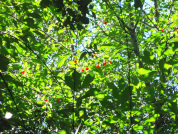
El cerezo ácido (Prunus cerasus) se dispersa e invade el Parque Nacional Los Alerces. Algunos individuos se establecen por germinación e incrementan localmente su abundancia por reproducción asexual. Nuestro objetivo fue determinar si la reproducción sexual era importante para aumentar la oferta de frutos en el tiempo, dado que los individuos originados por germinación varían en su fenología, mientras que los clones generados por los estolones fructifican de forma sincrónica. En un área de alta y otra de baja abundancia de cerezos se midieron las copas de 12 y 5 individuos, respectivamente, los diámetros de sus fustes, las áreas de sus parches de rebrote, la densidad de clones en los parches, y se estimó la producción de frutos de los clones. Además, se estudió por dos años la fenología de fructificación en ambos sitios en 19 y 5 individuos. El diámetro de los fustes se relacionó positivamente con el tamaño de las copas, pero no con el área ocupada por los parches de clones, ya que existieron distintas estrategias de crecimiento de parches, posiblemente relacionadas con las condiciones ambientales en que vive el individuo. Los clones incrementaron el área de fructificación de los individuos hasta 32 veces; la densidad de clones fue de hasta 2.47 individuos/m2, con una producción de frutos muy inferior a los individuos originales. Donde la invasión era incipiente, la oferta de frutos no superó los dos meses; donde estaba avanzada, se mantuvo de diciembre a mayo por la fructificación asincrónica entre parches. Ambos tipos de reproducción contribuyen al éxito de la invasión, aumentando la disponibilidad de frutos para la dispersión endozoocórica. Localmente, la reproducción sexual vuelve a la abundancia de frutos constante en el tiempo; la asexual, abundantes en el espacio. Posiblemente, esto ayude a atraer dispersores al inicio de la fructificación hacia el individuo original.
Citas
Agostinelli, C., and U. Lund. 2023. R package 'circular': Circular Statistics (version 0.5-0). URL: cran.r-project.org/package=circular.
Amodeo, M. R., and S. M. Zalba. 2013. Wild cherries invading natural grasslands: Unraveling colonization history from population structure and spatial patterns. Plant Ecology 214:1299-1307. https://doi.org/10.1007/s11258-013-0252-4.
Baskin, C. C., and J. M. Baskin. 1998. Seeds: Ecology, biogeography, and evolution of dormancy and germination. Elsevier.
Bittebiere, A-K., M-L. Benot, and C. Mony. 2020. Clonality as a key but overlooked driver of biotic interactions in plants. Perspectives in Plant Ecology, Evolution and Systematics 43:125510. https://doi.org/10.1016/j.ppees.2020.125510.
Blendinger, P. G., B. A. Loiselle, and J. G. Blake. 2008. Crop size, plant aggregation, and microhabitat type affect fruit removal by birds from individual melastome plants in the Upper Amazon. Oecologia 158:273-283. https://doi.org/10.1007/s00442-008-1146-3.
Bollen, A., L. Van Elsacker, and J. U. Ganzhorn. 2004. Tree dispersal strategies in the littoral forest of Sainte Luce (S.E. Madagascar). Oecologia 139:604-616. https://doi.org/10.1007/s00442-004-1544-0.
Borchert, R., G. Rivera, and W. Hagnauer. 2002. Modification of Vegetative Phenology in a Tropical Semi-deciduous Forest by Abnormal Drought and Rain. Biotropica 34(1):27-39. https://doi.org/10.1111/j.1744-7429.2002.tb00239.x.
Bravo, S. P., M. O. Berrondo, and V. R. Cueto. 2019. Are small abandoned plantations a threat for protected areas in Andean forests? The potential invasion of non-native cultivated species. Acta Oecologica 95:128-134. https://doi.org/10.1016/j.actao.2018.11.002.
Buckley, Y. M., S. Anderson, C. P. Catterall, R. T. Corlett, T. Engel, et al. 2006. Management of plant invasions mediated by frugivore interactions. Journal of Applied Ecology 43:848-857. https://doi.org/10.1111/j.1365-2664.2006.01210.x.
Charpentier, A. 2002. Consequences of clonal growth for plant mating. Evolutionary Ecology 15:521-530. https://doi.org/10.1007/978-94-017-1345-0_16.
Cisneros González, O. 2004. Autoecología del cerezo de monte (Prunus avium L.) en Castilla y León. Tesis Doctoral. Universidad Politécnica de Madrid. Madrid, España. Pp. 252. https://doi.org/10.20868/UPM.thesis.220.
Cisneros, O. and G. Montero. 2007. Selvicultura de Punus avium. URL: tinyurl.com/53b4x92p.
Clark, C. J., Poulsen, J. R., Bolker, B. M., Connor, E. F. and V. T. Parker. 2005. Comparative seed shadows of bird, monkey and wind-dispersed trees. Ecology 86(10):2684-2694. https://doi.org/10.1890/04-1325.
Cordeiro, N. J., D. A. G. Patrick, B. Munisi, and V. Gupta. 2004. Role of dispersal in the invasion of an exotic tree in an East African submontane forest. Journal of Tropical Ecology 20:449-457. https://doi.org/10.1017/S026646740400152X.
Dimitri, M. J. 1972. La región de los bosques andino-patagónicos, sinopsis general. INTA Colección Científica Tomo X, Buenos Aires, Argentina.
Ducci, F., and F. Santi. 1997. The distribution of clones in managed and unmanaged populations of wild cherry (Prunus avium). Canadian Journal of Forest Research 27:1998-2004. https://doi.org/10.1139/x97-159.
Engel, K., R. Tollrian, and J. M. Jeschke. 2011. Integrating biological invasions, climate change and phenotypic plasticity. Communicative and Integrative Biology 4(3):247-250. https://doi.org/10.4161/cib.4.3.14885.
Eskuche, U. 1968. Fisonomía y Sociología de los bosques de Nothofagus dombeyi en la Región de Nahuel Huapi. Vegetatio 16:1-4. https://doi.org/10.1007/BF00261362.
Fernández, R., F. Santi, and J. Dufour. 1994. Les matériels forestiers de reproduction sélectionnés de merisier (prunus avium L.): classement, provenances et variabilité. Revue Forestière Française 46:629-638. https://doi.org/10.4267/2042/26593.
Fischer, M., and M. Van Kleunen. 2001. On the evolution of clonal plant life histories. Evolutionary Ecology 15:565-582. https://doi.org/10.1023/A:1016013721469.
Fotirić Akšić, M. F., V. Raconaj, D. Nikolić, and G. Zec. 2013. Reproductive biology traits affecting productivity of sour cherry. Pesquisa Agropecuária Brasileira 48:33-41. https://doi.org/10.1590/S0100-204X2013000100005.
Fournier, L. A. 1974. Un método cuantitativo para la medición de características fenológicas en árboles. Turrialba 24:422-423.
Fredriksson, G. M., S. A. Wich, and Trisno. 2006. Frugivory in sun bears (Helarctos malayanus) is linked to El Niño-related fluctuations in fruiting phenology, East Kalimantan, Indonesia. Biological Journal of the Linnean Society 89:489-508. https://doi.org/10.1111/j.1095-8312.2006.00688.x.
González-Varo, J. P., J. V. López-Bao, and J. Guitián. 2013. Functional diversity among seed dispersal kernels generated by carnivorous mammals. Journal of Animal Ecology 82:562-571. https://doi.org/10.1111/1365-2656.12024.
Gosper, C. R. 2004. Fruit characteristics of invasive bitou bush, Chrysanthemoides monilifera (Asteraceae), and a comparison with co-occurring native plant species. Australian Journal of Botany 52:223-230. https://doi.org/10.1071/BT03046.
Guitián, J., and I. Munilla. 2010. Responses of mammal dispersers to fruit availability: Rowan (Sorbus aucuparia) and carnivores in mountain habitats of northern Spain. Acta Oecologica 36:242-247. https://doi.org/10.1016/j.actao.2010.01.005.
Hoermann, I. 2013. Flora nativa: Parque Nacional Los Alerces, Trevelin y Esquel. Dunken, Buenos Aires, Argentina.
Howe, H. F., and J. Smallwood. 1982. Ecology of seed dispersal. Annual Review Ecology and Systematic 13:201-228. https://doi.org/10.1146/annurev.es.13.110182.001221.
Höltken, A. M., and H-R. Gregorius. 2006. Detecting local establishment strategies of wild cherry (Prunus avium L.). BMC Ecology 6:13. https://doi.org/10.1186/1472-6785-6-13.
Jeník, J. 1994. Clonal growth in woody plants: a review. Folia Geobotanica 29:291-306. https://doi.org/10.1007/BF02803802.
Kitzberger, T. 2012. Ecotones Between Forest and Grassland. Springer. New York, NY, USA. Pp. 63. https://doi.org/10.1007/978-1-4614-3797-0.
Kitzberger, T., T. T. Veblen, and R. Villalba. 1995. Tectonic influences on tree growth in northern Patagonia, Argentina: the roles of substrate stability and climatic variation. Canadian Journal of Forest Research 25:1684-1696. https://doi.org/10.1139/x95-182.
Kitzberger, T., T. T. Veblen, and R. Villalba. 1997. Climatic influences on fire regimes along a rain forest-to-xeric woodland gradient in northern Patagonia, Argentina. Journal of Biogeography 24:35-47. https://doi.org/10.1111/j.1365-2699.1997.tb00048.x.
Kostick, S. A. 2016. A Survey of Winter-Hardy Prunus Species: Evaluation of Seed Germination, Seedling Establishment, and Pollen Viability. Tesis doctoral. Universidad de Minnesota. Pp. 129. URL: hdl.handle.net/11299/181802.
Kueffer, C., C. C. Daehler, C. W. Torres-Santana, C. Lavergne, J. Y. Meyer, R. Otto, and L. Silva. 2009. A global comparison of plant invasions on oceanic islands. Perspectives in Plant Ecology, Evolution and Systematics 12:145-161. https://doi.org/10.1016/j.ppees.2009.06.002.
Lediuk, K. D., M. A. Damascos, J. G. Puntieri, and M. Svriz. 2014. Differences in phenology and fruit characteristic between invasive and native woody species favor exotic species invasiveness. Plant Ecology 215:1455-1467. https://doi.org/10.1007/s11258-014-0402-3.
López-Bao, J. V., J. P. González-Varo, and J. Guitián. 2015. Mutualistic relationships under landscape change: Carnivorous mammals and plants after 30 years of land abandonment. Basic and Applied Ecology 16:152-161. https://doi.org/10.1016/j.baae.2014.12.001.
Lovett Doust, L. L. 1981. Population dynamics and local specialization in a clonal perennial (Ranunculus repens): I. The Dynamics of ramets in contrasting habitats. Journal of Ecology 69:743-755.
Malizia, L. R. 2001. Seasonal fluctuations of birds, fruits, and flowers in a subtropical forest of Argentina. The Condor 103:45-61. https://doi.org/10.1093/condor/103.1.45.
Meyer, J. Y. 1998. Observations on the reproductive biology of Miconia calvescens DC (Melastomataceae), an alien invasive tree on the island of Tahiti (South Pacific Ocean). Biotropica 30:609-624. https://doi.org/10.1111/j.1744-7429.1998.tb00101.x.
Moegenburg, S. M., and D. J. Levey. 2003. Do frugivores respond to fruit harvest? An experimental study of short-term responses. Ecology 84:2600-2612. https://doi.org/10.1890/02-0063.
Morellato, L. P., D. C. Talora, A. Takahasi, C. C. Bencke, E. C. Romera, et al. 2000. Phenology of Atlantic Rain Forest Trees: A Comparative Study. Biotropica 32(4b):811-823. https://doi.org/10.1111/j.1744-7429.2000.tb00620.x.
Nunez‐Mir, G. C., Q. Guo, M. Rejmánek, B. V. Iannone III, and S. Fei. 2019. Predicting invasiveness of exotic woody species using a traits‐based framework. Ecology 100(10):e02797. https://doi.org/10.1002/ecy.2797.
Orellana Ibáñez, I. A., and M. M. Novella. 2018. Parque Nacional Los Alerces, un acercamiento a conocer su diversidad. Secretaría de Ciencia, Tecnología e Innovación Productiva de la Provincia de Chubut. Rawson, Chubut, Argentina.
Palacio, F. X., J. F. Cataudela, D. Montalti, and M. Ordanod. 2021. Do frugivores exert selection on fruiting phenology? Potential scenarios across three plant populations of a Neotropical vine, Passiflora caerulea. Evolutionary Ecology 35:555-574. https://doi.org/10.1007/s10682-021-10121-0.
Peterson, C., and R. Jones. 1997. Clonality in Woody Plants: A Review and Comparison with Clonal Herbs. Pp. 263-289 in H. de Kroon and J. van Groenendael (eds.). The ecology and evolution of clonal plants. Backhuys Publishers, Leiden, the Netherlands.
Petrokas, R. 2010. Prerequisites for the reproduction of wild cherry (Prunus avium L.). Baltic Forestry 16:139-153.
R Development Core Team. 2023. R: A language and environment for statistical computing. R Foundation for Statistical Computing, Vienna, Austria. URL: R-project.org.
Raffaele, E., and T. T. Veblen. 1998. Facilitation by nurse shrubs of resprouting behavior in a post-fire shrub land in northern Patagonia, Argentina. Journal of Vegetation Science 9:693-698. https://doi.org/10.2307/3237287.
Rakonjac, V., M. Fotirić Akišć, D. Nikolić, D. Milatović, and S. Čolić. 2010. Morphological characterization of 'Oblačinska' sour cherry by multivariate analysis. Scientia Horticulturae 125:679684. https://doi.org/10.1016/j.scienta.2010.05.029.
Richardson, D. M., N. Allsopp, C. M. D’Antonio, S. J. Milton, and M. Rejmánek. 2000. Plant invasions-the role of mutualisms. Biological Reviews 75(1):65-93. https://doi.org/10.1017/s0006323199005435.
Ronsheim, M. L., and J. D. Bever. 2000. Genetic variation and evolutionary trade-offs for sexual and asexual reproductive modes in Allium vineale (Liliaceae). American Journal of Botany 87:1769-1777. https://doi.org/10.2307/2656827.
Sato, H. 2022. Significance of seed dispersal by the largest frugivore for large-diaspore trees. Scientific Reports 12:19086. https://doi.org/10.1038/s41598-022-23018-x.
Silvertown, J. 2008. The evolutionary maintenance of sexual reproduction: evidence from the ecological distribution of asexual reproduction in clonal plants. International Journal of Plant Science 169:157-168. https://doi.org/10.1086/523357.
Song, G-Q., G. A. Lang, S. V. Dolgov, and K. C. Sink. 2008. Cherries. Pp 161-187 in C. Kole and T. C. Hall (eds.). Compendium of Transgenic Crop Plants: Transgenic Temperate Fruits and Nuts. Chapter 6. Blackwell Publishing Ltd, Oxford, UK. https://doi.org/10.1002/9781405181099.k0406.
Stoeckel, S., J. Grange, J. F. Fernández-Manjarres, I. Bilger, N. Frascaria-Lacoste, et al. 2006. Heterozygote excess in a self-incompatible and partially clonal forest tree species - Prunus avium L. Molecular Ecology 15:2109-2118. https://doi.org/10.1111/j.1365-294X.2006.02926.x.
Stuefer, J. F., B. Erschbamer, H. Huber, and J. I. Suzuki. 2002. The ecology and evolutionary biology of clonal plants: an introduction to the proceedings of Clone-2000. Evolutionary Ecology 15:223-230. https://doi.org/10.1023/A:1016017822027.
Vaughan, S. P., J. E. Cottrell, D. J. Moodley, T. Connolly, and K. Russell. 2007. Clonal structure and recruitment in British wild cherry (Prunus avium L.). Forest Ecology and Management 242:419-430. https://doi.org/10.1016/j.foreco.2007.01.059.
Veblen, T. T., T. Kitzberger, and A. Lara. 1992. Disturbance and forest dynamics along a transect from Andean rainforest to Patagonian shrubland. Journal of Vegetation Science 3:507-520. https://doi.org/10.2307/3235807.
Veblen, T. T., T. Kitzberger, E. Raffaelle, and D. C. Lorenz. 2003. Fire history and vegetation changes in northern Patagonia, Argentina. Pp. 265-295 in T. T. Veblen, W. L. Laker, G. Montenegro and T. W. Swetnam (eds.). Fire and Climatic Change in Temperate Ecosystems of the Western Americas. Springer, New York, New York, USA. https://doi.org/10.1007/0-387-21710-X_9.
Veblen, T., and D. C. Lorenz. 1988. Post-fire stand development of Austrocedrus-Nothofagus forests in Patagonia. Vegetatio 71:113-126. https://doi.org/10.1007/BF00044825.
Wenny, D. G. 2001. Advantages of seed dispersal: a re-evaluation of directed dispersal. Evolutionary Ecology Research 3:51-74.
Westcott, D. A., and C. S. Fletcher. 2011. Biological invasions and the study of vertebrate dispersal of plants: Opportunities and integration. Acta Oecologica 37:650-656. https://doi.org/10.1016/j.actao.2011.04.007.
Ye, X. H., F. H. Yu, and M. Dong. 2006. A trade-off between guerrilla and phalanx growth forms in Leymus secalinus under different nutrient supplies. Annals of Botany 98:187-191. https://doi.org/10.1093/aob/mcl086.
Zar, J. H. 1996. Biostatistical Analysis. 3rd Edition, Prentice Hall, Inc., Upper Saddle River, New Jersey, USA.
Zhang, Y., and D. Zhang. 2007. Asexual and sexual reproductive strategies in clonal plants. Frontiers of Biology in China 2:256-262. https://doi.org/10.1007/s11515-007-0036-0.
Descargas
Publicado
Cómo citar
Número
Sección
Licencia
Derechos de autor 2025 Matías O. Berrondo, Susana P. Bravo

Esta obra está bajo una licencia internacional Creative Commons Atribución 4.0.
Las/os autoras/es conservan sus derechos de autoras/es: 1) cediendo a la revista el derecho a su primera publicación, y 2) registrando el artículo publicado con una Licencia de Atribución de Creative Commons (CC-BY 4.0), lo que permite a autoras/es y terceros verlo y utilizarlo siempre que mencionen claramente su origen (cita o referencia incluyendo autoría y primera publicación en esta revista). Las/os autores/as pueden hacer otros acuerdos de distribución no exclusiva siempre que indiquen con claridad su origen, así como compartir y divulgar ampliamente la versión publicada de su trabajo.