The role of sexual and asexual reproduction of Prunus cerasus (Rosaceae) in fruiting
DOI:
https://doi.org/10.25260/EA.25.35.1.0.2338Keywords:
biological invasions, fruit offer, phenologyAbstract
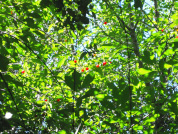
The acid cherry tree (Prunus cerasus) disperses and invades the National Park Los Alerces. Some individuals are established by germination and increase their abundance locally by asexual reproduction. Our objective was to determine if sexual reproduction was important to increase the supply of fruits over time, since individuals originating by germination show variability in phenology, while clones generated by stolons that fruit synchronously. The crowns of different individuals, the diameters of their trunks, the area of regrowth patches, the density of clones in the patches and the fruit production of clones were measured in one area with high and another with low abundance of P. cerasus. In addition, the phenology of fruiting in sites with different degrees of invasion was studied for two years. The diameter of trunks was positively related to the size of crowns, but not to the area occupied by the patches. Clones expanded the fruiting area by up to 32 times; clone density was up to 2.47 individuals/m2 in patches. The clones, however, yielded significantly fewer fruits compared to the original individuals. Fruits offering did not exceed two months in the area recently invaded. Due to asynchronous fruiting among patches, fruit offering remained from December to May in the area where invasion is advanced. Both types of reproduction contribute to invasion success, increasing the offer of fruits for endozoochoric dispersion. Sexual reproduction mantains the abundance of fruits over time and asexual reproduction makes them abundant in space, possibly helping to a�ract dispersers at the beginning of the fruiting period.
References
Agostinelli, C., and U. Lund. 2023. R package 'circular': Circular Statistics (version 0.5-0). URL: cran.r-project.org/package=circular.
Amodeo, M. R., and S. M. Zalba. 2013. Wild cherries invading natural grasslands: Unraveling colonization history from population structure and spatial patterns. Plant Ecology 214:1299-1307. https://doi.org/10.1007/s11258-013-0252-4.
Baskin, C. C., and J. M. Baskin. 1998. Seeds: Ecology, biogeography, and evolution of dormancy and germination. Elsevier.
Bittebiere, A-K., M-L. Benot, and C. Mony. 2020. Clonality as a key but overlooked driver of biotic interactions in plants. Perspectives in Plant Ecology, Evolution and Systematics 43:125510. https://doi.org/10.1016/j.ppees.2020.125510.
Blendinger, P. G., B. A. Loiselle, and J. G. Blake. 2008. Crop size, plant aggregation, and microhabitat type affect fruit removal by birds from individual melastome plants in the Upper Amazon. Oecologia 158:273-283. https://doi.org/10.1007/s00442-008-1146-3.
Bollen, A., L. Van Elsacker, and J. U. Ganzhorn. 2004. Tree dispersal strategies in the littoral forest of Sainte Luce (S.E. Madagascar). Oecologia 139:604-616. https://doi.org/10.1007/s00442-004-1544-0.
Borchert, R., G. Rivera, and W. Hagnauer. 2002. Modification of Vegetative Phenology in a Tropical Semi-deciduous Forest by Abnormal Drought and Rain. Biotropica 34(1):27-39. https://doi.org/10.1111/j.1744-7429.2002.tb00239.x.
Bravo, S. P., M. O. Berrondo, and V. R. Cueto. 2019. Are small abandoned plantations a threat for protected areas in Andean forests? The potential invasion of non-native cultivated species. Acta Oecologica 95:128-134. https://doi.org/10.1016/j.actao.2018.11.002.
Buckley, Y. M., S. Anderson, C. P. Catterall, R. T. Corlett, T. Engel, et al. 2006. Management of plant invasions mediated by frugivore interactions. Journal of Applied Ecology 43:848-857. https://doi.org/10.1111/j.1365-2664.2006.01210.x.
Charpentier, A. 2002. Consequences of clonal growth for plant mating. Evolutionary Ecology 15:521-530. https://doi.org/10.1007/978-94-017-1345-0_16.
Cisneros González, O. 2004. Autoecología del cerezo de monte (Prunus avium L.) en Castilla y León. Tesis Doctoral. Universidad Politécnica de Madrid. Madrid, España. Pp. 252. https://doi.org/10.20868/UPM.thesis.220.
Cisneros, O. and G. Montero. 2007. Selvicultura de Punus avium. URL: tinyurl.com/53b4x92p.
Clark, C. J., Poulsen, J. R., Bolker, B. M., Connor, E. F. and V. T. Parker. 2005. Comparative seed shadows of bird, monkey and wind-dispersed trees. Ecology 86(10):2684-2694. https://doi.org/10.1890/04-1325.
Cordeiro, N. J., D. A. G. Patrick, B. Munisi, and V. Gupta. 2004. Role of dispersal in the invasion of an exotic tree in an East African submontane forest. Journal of Tropical Ecology 20:449-457. https://doi.org/10.1017/S026646740400152X.
Dimitri, M. J. 1972. La región de los bosques andino-patagónicos, sinopsis general. INTA Colección Científica Tomo X, Buenos Aires, Argentina.
Ducci, F., and F. Santi. 1997. The distribution of clones in managed and unmanaged populations of wild cherry (Prunus avium). Canadian Journal of Forest Research 27:1998-2004. https://doi.org/10.1139/x97-159.
Engel, K., R. Tollrian, and J. M. Jeschke. 2011. Integrating biological invasions, climate change and phenotypic plasticity. Communicative and Integrative Biology 4(3):247-250. https://doi.org/10.4161/cib.4.3.14885.
Eskuche, U. 1968. Fisonomía y Sociología de los bosques de Nothofagus dombeyi en la Región de Nahuel Huapi. Vegetatio 16:1-4. https://doi.org/10.1007/BF00261362.
Fernández, R., F. Santi, and J. Dufour. 1994. Les matériels forestiers de reproduction sélectionnés de merisier (prunus avium L.): classement, provenances et variabilité. Revue Forestière Française 46:629-638. https://doi.org/10.4267/2042/26593.
Fischer, M., and M. Van Kleunen. 2001. On the evolution of clonal plant life histories. Evolutionary Ecology 15:565-582. https://doi.org/10.1023/A:1016013721469.
Fotirić Akšić, M. F., V. Raconaj, D. Nikolić, and G. Zec. 2013. Reproductive biology traits affecting productivity of sour cherry. Pesquisa Agropecuária Brasileira 48:33-41. https://doi.org/10.1590/S0100-204X2013000100005.
Fournier, L. A. 1974. Un método cuantitativo para la medición de características fenológicas en árboles. Turrialba 24:422-423.
Fredriksson, G. M., S. A. Wich, and Trisno. 2006. Frugivory in sun bears (Helarctos malayanus) is linked to El Niño-related fluctuations in fruiting phenology, East Kalimantan, Indonesia. Biological Journal of the Linnean Society 89:489-508. https://doi.org/10.1111/j.1095-8312.2006.00688.x.
González-Varo, J. P., J. V. López-Bao, and J. Guitián. 2013. Functional diversity among seed dispersal kernels generated by carnivorous mammals. Journal of Animal Ecology 82:562-571. https://doi.org/10.1111/1365-2656.12024.
Gosper, C. R. 2004. Fruit characteristics of invasive bitou bush, Chrysanthemoides monilifera (Asteraceae), and a comparison with co-occurring native plant species. Australian Journal of Botany 52:223-230. https://doi.org/10.1071/BT03046.
Guitián, J., and I. Munilla. 2010. Responses of mammal dispersers to fruit availability: Rowan (Sorbus aucuparia) and carnivores in mountain habitats of northern Spain. Acta Oecologica 36:242-247. https://doi.org/10.1016/j.actao.2010.01.005.
Hoermann, I. 2013. Flora nativa: Parque Nacional Los Alerces, Trevelin y Esquel. Dunken, Buenos Aires, Argentina.
Howe, H. F., and J. Smallwood. 1982. Ecology of seed dispersal. Annual Review Ecology and Systematic 13:201-228. https://doi.org/10.1146/annurev.es.13.110182.001221.
Höltken, A. M., and H-R. Gregorius. 2006. Detecting local establishment strategies of wild cherry (Prunus avium L.). BMC Ecology 6:13. https://doi.org/10.1186/1472-6785-6-13.
Jeník, J. 1994. Clonal growth in woody plants: a review. Folia Geobotanica 29:291-306. https://doi.org/10.1007/BF02803802.
Kitzberger, T. 2012. Ecotones Between Forest and Grassland. Springer. New York, NY, USA. Pp. 63. https://doi.org/10.1007/978-1-4614-3797-0.
Kitzberger, T., T. T. Veblen, and R. Villalba. 1995. Tectonic influences on tree growth in northern Patagonia, Argentina: the roles of substrate stability and climatic variation. Canadian Journal of Forest Research 25:1684-1696. https://doi.org/10.1139/x95-182.
Kitzberger, T., T. T. Veblen, and R. Villalba. 1997. Climatic influences on fire regimes along a rain forest-to-xeric woodland gradient in northern Patagonia, Argentina. Journal of Biogeography 24:35-47. https://doi.org/10.1111/j.1365-2699.1997.tb00048.x.
Kostick, S. A. 2016. A Survey of Winter-Hardy Prunus Species: Evaluation of Seed Germination, Seedling Establishment, and Pollen Viability. Tesis doctoral. Universidad de Minnesota. Pp. 129. URL: hdl.handle.net/11299/181802.
Kueffer, C., C. C. Daehler, C. W. Torres-Santana, C. Lavergne, J. Y. Meyer, R. Otto, and L. Silva. 2009. A global comparison of plant invasions on oceanic islands. Perspectives in Plant Ecology, Evolution and Systematics 12:145-161. https://doi.org/10.1016/j.ppees.2009.06.002.
Lediuk, K. D., M. A. Damascos, J. G. Puntieri, and M. Svriz. 2014. Differences in phenology and fruit characteristic between invasive and native woody species favor exotic species invasiveness. Plant Ecology 215:1455-1467. https://doi.org/10.1007/s11258-014-0402-3.
López-Bao, J. V., J. P. González-Varo, and J. Guitián. 2015. Mutualistic relationships under landscape change: Carnivorous mammals and plants after 30 years of land abandonment. Basic and Applied Ecology 16:152-161. https://doi.org/10.1016/j.baae.2014.12.001.
Lovett Doust, L. L. 1981. Population dynamics and local specialization in a clonal perennial (Ranunculus repens): I. The Dynamics of ramets in contrasting habitats. Journal of Ecology 69:743-755.
Malizia, L. R. 2001. Seasonal fluctuations of birds, fruits, and flowers in a subtropical forest of Argentina. The Condor 103:45-61. https://doi.org/10.1093/condor/103.1.45.
Meyer, J. Y. 1998. Observations on the reproductive biology of Miconia calvescens DC (Melastomataceae), an alien invasive tree on the island of Tahiti (South Pacific Ocean). Biotropica 30:609-624. https://doi.org/10.1111/j.1744-7429.1998.tb00101.x.
Moegenburg, S. M., and D. J. Levey. 2003. Do frugivores respond to fruit harvest? An experimental study of short-term responses. Ecology 84:2600-2612. https://doi.org/10.1890/02-0063.
Morellato, L. P., D. C. Talora, A. Takahasi, C. C. Bencke, E. C. Romera, et al. 2000. Phenology of Atlantic Rain Forest Trees: A Comparative Study. Biotropica 32(4b):811-823. https://doi.org/10.1111/j.1744-7429.2000.tb00620.x.
Nunez‐Mir, G. C., Q. Guo, M. Rejmánek, B. V. Iannone III, and S. Fei. 2019. Predicting invasiveness of exotic woody species using a traits‐based framework. Ecology 100(10):e02797. https://doi.org/10.1002/ecy.2797.
Orellana Ibáñez, I. A., and M. M. Novella. 2018. Parque Nacional Los Alerces, un acercamiento a conocer su diversidad. Secretaría de Ciencia, Tecnología e Innovación Productiva de la Provincia de Chubut. Rawson, Chubut, Argentina.
Palacio, F. X., J. F. Cataudela, D. Montalti, and M. Ordanod. 2021. Do frugivores exert selection on fruiting phenology? Potential scenarios across three plant populations of a Neotropical vine, Passiflora caerulea. Evolutionary Ecology 35:555-574. https://doi.org/10.1007/s10682-021-10121-0.
Peterson, C., and R. Jones. 1997. Clonality in Woody Plants: A Review and Comparison with Clonal Herbs. Pp. 263-289 in H. de Kroon and J. van Groenendael (eds.). The ecology and evolution of clonal plants. Backhuys Publishers, Leiden, the Netherlands.
Petrokas, R. 2010. Prerequisites for the reproduction of wild cherry (Prunus avium L.). Baltic Forestry 16:139-153.
R Development Core Team. 2023. R: A language and environment for statistical computing. R Foundation for Statistical Computing, Vienna, Austria. URL: R-project.org.
Raffaele, E., and T. T. Veblen. 1998. Facilitation by nurse shrubs of resprouting behavior in a post-fire shrub land in northern Patagonia, Argentina. Journal of Vegetation Science 9:693-698. https://doi.org/10.2307/3237287.
Rakonjac, V., M. Fotirić Akišć, D. Nikolić, D. Milatović, and S. Čolić. 2010. Morphological characterization of 'Oblačinska' sour cherry by multivariate analysis. Scientia Horticulturae 125:679684. https://doi.org/10.1016/j.scienta.2010.05.029.
Richardson, D. M., N. Allsopp, C. M. D’Antonio, S. J. Milton, and M. Rejmánek. 2000. Plant invasions-the role of mutualisms. Biological Reviews 75(1):65-93. https://doi.org/10.1017/s0006323199005435.
Ronsheim, M. L., and J. D. Bever. 2000. Genetic variation and evolutionary trade-offs for sexual and asexual reproductive modes in Allium vineale (Liliaceae). American Journal of Botany 87:1769-1777. https://doi.org/10.2307/2656827.
Sato, H. 2022. Significance of seed dispersal by the largest frugivore for large-diaspore trees. Scientific Reports 12:19086. https://doi.org/10.1038/s41598-022-23018-x.
Silvertown, J. 2008. The evolutionary maintenance of sexual reproduction: evidence from the ecological distribution of asexual reproduction in clonal plants. International Journal of Plant Science 169:157-168. https://doi.org/10.1086/523357.
Song, G-Q., G. A. Lang, S. V. Dolgov, and K. C. Sink. 2008. Cherries. Pp 161-187 in C. Kole and T. C. Hall (eds.). Compendium of Transgenic Crop Plants: Transgenic Temperate Fruits and Nuts. Chapter 6. Blackwell Publishing Ltd, Oxford, UK. https://doi.org/10.1002/9781405181099.k0406.
Stoeckel, S., J. Grange, J. F. Fernández-Manjarres, I. Bilger, N. Frascaria-Lacoste, et al. 2006. Heterozygote excess in a self-incompatible and partially clonal forest tree species - Prunus avium L. Molecular Ecology 15:2109-2118. https://doi.org/10.1111/j.1365-294X.2006.02926.x.
Stuefer, J. F., B. Erschbamer, H. Huber, and J. I. Suzuki. 2002. The ecology and evolutionary biology of clonal plants: an introduction to the proceedings of Clone-2000. Evolutionary Ecology 15:223-230. https://doi.org/10.1023/A:1016017822027.
Vaughan, S. P., J. E. Cottrell, D. J. Moodley, T. Connolly, and K. Russell. 2007. Clonal structure and recruitment in British wild cherry (Prunus avium L.). Forest Ecology and Management 242:419-430. https://doi.org/10.1016/j.foreco.2007.01.059.
Veblen, T. T., T. Kitzberger, and A. Lara. 1992. Disturbance and forest dynamics along a transect from Andean rainforest to Patagonian shrubland. Journal of Vegetation Science 3:507-520. https://doi.org/10.2307/3235807.
Veblen, T. T., T. Kitzberger, E. Raffaelle, and D. C. Lorenz. 2003. Fire history and vegetation changes in northern Patagonia, Argentina. Pp. 265-295 in T. T. Veblen, W. L. Laker, G. Montenegro and T. W. Swetnam (eds.). Fire and Climatic Change in Temperate Ecosystems of the Western Americas. Springer, New York, New York, USA. https://doi.org/10.1007/0-387-21710-X_9.
Veblen, T., and D. C. Lorenz. 1988. Post-fire stand development of Austrocedrus-Nothofagus forests in Patagonia. Vegetatio 71:113-126. https://doi.org/10.1007/BF00044825.
Wenny, D. G. 2001. Advantages of seed dispersal: a re-evaluation of directed dispersal. Evolutionary Ecology Research 3:51-74.
Westcott, D. A., and C. S. Fletcher. 2011. Biological invasions and the study of vertebrate dispersal of plants: Opportunities and integration. Acta Oecologica 37:650-656. https://doi.org/10.1016/j.actao.2011.04.007.
Ye, X. H., F. H. Yu, and M. Dong. 2006. A trade-off between guerrilla and phalanx growth forms in Leymus secalinus under different nutrient supplies. Annals of Botany 98:187-191. https://doi.org/10.1093/aob/mcl086.
Zar, J. H. 1996. Biostatistical Analysis. 3rd Edition, Prentice Hall, Inc., Upper Saddle River, New Jersey, USA.
Zhang, Y., and D. Zhang. 2007. Asexual and sexual reproductive strategies in clonal plants. Frontiers of Biology in China 2:256-262. https://doi.org/10.1007/s11515-007-0036-0.
Downloads
Published
How to Cite
Issue
Section
License
Copyright (c) 2025 Matías O. Berrondo, Susana P. Bravo

This work is licensed under a Creative Commons Attribution 4.0 International License.
Authors retain their rights as follows: 1) by granting the journal the right to its first publication, and 2) by registering the published article with a Creative Commons Attribution License (CC-BY 4.0), which allows authors and third parties to view and use it as long as they clearly mention its origin (citation or reference, including authorship and first publication in this journal). Authors can make other non-exclusive distribution agreements as long as they clearly indicate their origin and are encouraged to widely share and disseminate the published version of their work.