Effect of the reintroduced guanaco vs. domestic livestock herbivory over the lawns of the Quebrada del Condorito National Park
DOI:
https://doi.org/10.25260/EA.25.35.1.0.2369Keywords:
grazing, ungulates, ecological restoration, large mountains of Argentina, Poa stuckertiiAbstract
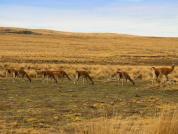
The Quebrada del Condorito National Park was created to protect a high-elevation ecosystem that experienced severe degradation due to centuries of overgrazing. For this reason, domestic livestock was partially excluded from the area since 1999. However, the absence of largescale herbivory led to the encroachment of Poa stuckertii thick grasslands over grazing-lawn patches, risking their high biological diversity. To reverse this situation, in 2007 the guanaco (Lama guanicoe) was reintroduced. This is a low-impact wild herbivore that was locally extinct at the beginning of the 20th century. In this study, we compared interannual changes (2016-2017) in different types of cover present in the study area (thick tussock grasses, thin tussock grasses, short vegetation, and surface without vascular vegetation) between four paddocks with different grazing conditions: 1) grazing by domestic livestock and guanacos; 2) grazing by domestic livestock; 3) grazing only by guanacos; and 4) complete exclusion of large herbivores. We observed that grazing by reintroduced guanacos, at their current densities, does not alone limit the spread of thick grasses, promoting the persistence of grazing-lawn patches, whereas, in contrast, grazing by domestic livestock produces a slight reduction in thick tussock grasses. Therefore, to conserve grass patches, it will be necessary to combine moderate densities of domestic livestock, avoiding to provoke erosion, with grazing by reintroduced guanacos. Additionally, it is necessary to reinforce the guanaco population until it reaches a size large enough to asses whether they can prevent thick tussock grasses from invading the grazing-lawns and permanently exclude domestic livestock.
References
Argañaraz, J. P., G. Gavier Pizarro, M. Zak, and L. M. Bellis. 2015. Fire regime, climate, and vegetation in the Sierras de Córdoba, Argentina. Fire Ecology 11: 55-73. https://doi.org/10.4996/fireecology.1101055.
Barri, F. R., V. Falczuk, A. M. Cingolani, and S. Díaz. 2014. Dieta de la población de guanacos (Lama guanicoe) reintroducida en el Parque Nacional Quebrada del Condorito, Argentina. Ecología Austral 24(2):203-211. https://doi.org/10.25260/EA.14.24.2.0.23.
Barri, F. R. 2016. Reintroducing guanaco in the upper belt of Central Argentina: using population viability analysis to evaluate extinction risk and management priorities. PLoS ONE 11(10):e0164806. https://doi.org/10.1371/journal.pone.0164806.
Bonino, N., and A. Pelliza Sbriller. 1991. Composición botánica de la dieta del guanaco (Lama guanicoe) en dos ambientes contrastantes de Tierra del Fuego, Argentina. Ecología Austral 1(02):097-102.
Cabido, M., R. Breimer, and G. Vega. 1987. Plant communities and associated soil types in a high plateau of the Córdoba mountains, central Argentina. Mountain Research and Development 7(1):25-42. https://doi.org/10.2307/3673322.
Cabido, M., S. R. Zeballos, M. Zak, M. L. Carranza, M. A. Giorgis, J. J. Cantero, and A. T. Acosta. 2018. Native woody vegetation in central Argentina: Classification of Chaco and Espinal forests. Applied Vegetation Science 21(2):298-311. https://doi.org/10.1111/avsc.12369.
Choquenot, D., and S. McLeod. 1997. Large herbivore population dynamics. Trends in Ecology and Evolution 12(10):400-401. https://doi.org/10.1016/S0169-5347(97)87385-5.
Cingolani, A. M., M. Cabido, D. Renison, and V. Solís Neffa. 2003. Combined effects of environment and grazing on vegetation structure in Argentine granite grasslands. Journal of Vegetation Science 14(2):223-232. https://doi.org/10.1111/j.1654-1103.2003.tb02147.x.
Cingolani, A. M., D. Renison, M. R. Zak, and M. Cabido. 2004. Mapping vegetation in a heterogeneous mountain rangeland using Landsat data: an alternative method to define and classify land-cover units. Remote sensing of environment 92(1):84-97. https://doi.org/10.1016/j.rse.2004.05.008.
Cingolani, A. M., I. Noy-Meir, D. Renison, and M. Cabido. 2008a. La ganadería extensiva:¿ es compatible con la conservación de la biodiversidad y de los suelos? Ecología austral 18(3):253-271.
Cingolani, A. M., D. Renison, P. A. Tecco, D. E. Gurvich, and M. Cabido. 2008b. Predicting cover types in a mountain range with long evolutionary grazing history: a GIS approach. Journal of Biogeography 35(3):538-551. https://doi.org/10.1111/j.1365-2699.2007.01807.x.
Cingolani, A. M., M. V. Vaieretti, M. A. Giorgis, N. La Torre, J. I. Whitworth-Hulse, and D. Renison. 2013. Can livestock and fires convert the sub-tropical mountain rangelands of central Argentina into a rocky desert? The Rangeland Journal 35(3):285-297. https://doi.org/10.1071/RJ12095.
Cingolani, A. M., M. V. Vaieretti, M. A. Giorgis, M. Poca, P. A. Tecco, and D. E. Gurvich. 2014. Can livestock grazing maintain landscape diversity and stability in an ecosystem that evolved with wild herbivores?. Perspectives in Plant Ecology, Evolution and Systematics 16(4):143-153. https://doi.org/10.1016/j.ppees.2014.04.002.
Cingolani, A. M., M. Poca, M. A. Giorgis, M. V. Vaieretti, D. E. Gurvich, J. I. Whitworth-Hulse, and D. Renison. 2015. Water provisioning services in a seasonally dry subtropical mountain: Identifying priority landscapes for conservation. Journal of Hydrology 525:178-187. https://doi.org/10.1016/j.jhydrol.2015.03.041.
Cingolani, A. M., M. A. Giorgis, L. E. Hoyos, and M. R. Cabido. 2022. La vegetación de las montañas de Córdoba (Argentina) a comienzos del siglo XXI: un mapa base para el ordenamiento territorial. Boletín de la Sociedad Argentina de Botánica 57(1):51-60. https://doi.org/10.31055/1851.2372.v57.n1.34924.
Cingolani, A. M., M. Poca, J. I. Whitworth-Hulse, M. A. Giorgis, M. V. Vaieretti, M. L. Herrero, S. E. Navarro-Ramos, and D. Renison. 2023. Los mosaicos de vegetación y roca maximizan los servicios hídricos en las zonas altas de montaña del centro de la Argentina. Ecología Austral 658-673. https://doi.org/10.25260/EA.23.33.3.0.2127.
Codron, D., J. S. Brink, L. Rossouw, and M. Clauss. 2008. The evolution of ecological specialization in southern African ungulates: competition‐or physical environmental turnover? Oikos 117(3):344-353. https://doi.org/10.1111/j.2007.0030-1299.16387.x.
Colladon, L. 2010. Anuario de temperaturas y pluviométrico 1992-2010. Cuenca del Río San Antonio. Sistema del Río Suquía - Provincia de Provincia de Córdoba. Instituto Nacional del Agua y del Ambiente (INAA) y Centro de Investigaciones de la Región Semiárida (CIRSA): Córdoba, Argentina.
Contarde, C. B., and D. A. Guzmán. 2024. From Pest to Vulnerable Species: Combining Ecological and Behavioural Knowledge for the Conservation and Management of Lagostomus maximus. Pp. 145-170 en L. L. Rasia, C. G. Barbeito and F. Acuña (eds.). Plains Vizcachas: Biology and Evolution of a Peculiar Neotropical Caviomorph Rodent. Cham: Springer Nature Switzerland. https://doi.org/10.1007/978-3-031-49487-1_8.
Cromsigt, J. P., and D. P. Kuijper. 2011. Revisiting the browsing lawn concept: Evolutionary Interactions or pruning herbivores? Perspectives in Plant Ecology, Evolution and Systematics 13(3):207-215. https://doi.org/10.1016/j.ppees.2011.04.004.
Di Rienzo, J. A., F. Casanoves, M. G. Balzarini, L. González, M. Tablada, and C. W. Robledo. 2009. InfoStat versión 2018. Grupo InfoStat, FCA, Universidad Nacional de Córdoba, Argentina. URL: infostat.com.ar.
Díaz, S., A. Acosta, and M. Cabido. 1994. Community structure in montane grasslands of central Argentina in relation to land use. Journal of Vegetation Science 5(4):483-488. https://doi.org/10.2307/3235974.
Falczuk, V. 2002. Relaciones entre selección de dieta de grandes herbívoros, disponibilidad y características físico-químicas de las plantas en un pastizal de altura de las Sierras de Córdoba. Tesis Doctoral. Facultad de Ciencias Exactas, Físicas y Naturales. Universidad Nacional de Córdoba. Córdoba. Argentina. Pp. 794.
Flores, C. E., A. M. Cingolani, A. von Müller, and F. R. Barri. 2012. Habitat selection by reintroduced guanacos (Lama guanicoe) in a heterogeneous mountain rangeland of central Argentina. The Rangeland Journal 34(4):439-445. https://doi.org/10.1071/RJ12040.
Giorgis, M. A., A. M. Cingolani, I. Teich, and M. Poca. 2020. Can livestock coexist with Polylepis australis forests in mountains of central Argentina? Setting thresholds for a land sharing landscape. Forest Ecology and Management 457:117728. https://doi.org/10.1016/j.foreco.2019.117728.
Marino, A., V. Rodríguez, and N. M. Schroeder. 2020. Wild guanacos as scapegoat for continued overgrazing by livestock across southern Patagonia. Journal of Applied Ecology 57(12):2393-2398. https://doi.org/10.1111/1365-2664.13536.
Mysterud, A. 2006. The concept of overgrazing and its role in management of large herbivores. Wildlife Biology 12(2):129-141. https://doi.org/10.2981/0909-6396(2006)12[129:TCOOAI]2.0.CO;2.
Pastor, S., and E. Berberián. 2007. Arqueología del sector central de las Sierras de Córdoba (Argentina): Hacia una definición de los procesos sociales del período prehispánico tardío (900-1573 DC). Intersecciones en Antropología (8):31-47.
Perevolotsky, A., and N. A. Seligman. 1998. Role of grazing in Mediterranean rangeland ecosystems. Bioscience 48(12):1007-1017. https://doi.org/10.2307/1313457.
Pucheta, E., M. Cabido, S. Díaz, and G. Funes. 1998. Floristic composition, biomass, and aboveground net plant production in grazed and protected sites in a mountain grassland of central Argentina. Acta Oecologica 19(2):97-105. https://doi.org/10.1016/S1146-609X(98)80013-1.
Puig, S., F. Videla, M. I. Cona, and S. A. Monge. 2001. Use of food availability by guanacos (Lama guanicoe) and livestock in Northern Patagonia (Mendoza, Argentina). Journal of Arid Environments 47(3):291-308. https://doi.org/10.1006/jare.2000.0677.
Renison, D., I. Hensen, R. Suarez, and A. M. Cingolani. 2006. Cover and growth habit of Polylepis woodlands and shrublands in the mountains of central Argentina: human or environmental influence? Journal of Biogeography 33(5):876-887. https://doi.org/10.1111/j.1365-2699.2006.01455.x.
Renison, D., I. Hensen, R. Suarez, A. M. Cingolani, P. Marcora, and M. A. Giorgis. 2010. Soil conservation in Polylepis mountain forests of Central Argentina: is livestock reducing our natural capital? Austral Ecology 35(4):435-443. https://doi.org/10.1111/j.1442-9993.2009.02055.x.
Renison, D., M. P. Chartier, M. Menghi, P. Marcora, R. C. Torres, M. A. Giorgis, I. Hensen, and A. M. Cingolani. 2015. Spatial variation in tree demography associated to domestic herbivores and topography: Insights from a seeding and planting experiment. Forest Ecology and Management 335:139-146. https://doi.org/10.1016/j.foreco.2014.09.036.
Renison, D., H. R. Quispe-Melgar, G. A. Erica Cuyckens, and A. M. Cingolani. 2023. Setting large-and medium-sized mammal restoration goals in a last mountain Chaco remnant from central Argentina. Ecological Processes 12(1):1-12. https://doi.org/10.1186/s13717-023-00434-z.
San Martin, F., and F. C. Bryant. 1989. Nutrition of domesticated South American llamas and alpacas. Small Ruminant Research 2(3):191-216. https://doi.org/10.1016/0921-4488(89)90001-1.
Seddon, P. J., D. P. Armstrong, and R. F. Maloney. 2007. Developing the science of reintroduction biology. Conservation Biology 21(2):303-312. https://doi.org/10.1111/j.1523-1739.2006.00627.x.
Tobler, M. W., R. Cochard, and P. J. Edwards. 2003. The impact of cattle ranching on large scale vegetation patterns in a coastal savanna in Tanzania. Journal of Applied Ecology 40(3):430-444. https://doi.org/10.1046/j.1365-2664.2003.00816.x.
Vaieretti, M. V., A. M. Cingolani, N. Pérez Harguindeguy, and M. Cabido. 2013. Effects of differential grazing on decomposition rate and nitrogen availability in a productive mountain grassland. Plant and soil 371:675-691. https://doi.org/10.1007/s11104-013-1831-9.
von Müller, A. R., A. M. Cingolani, M. V. Vaieretti, and D. Renison. 2012. Estimación de carga bovina localizada a partir de frecuencia de deposiciones en un pastizal de montaña. Ecología austral 22(3):178-187. https://doi.org/10.25260/EA.12.22.3.0.1223.
Downloads
Published
How to Cite
Issue
Section
License
Copyright (c) 2025 Fernando R. Barri, Rosario Garzón, Ana M. Cingolani

This work is licensed under a Creative Commons Attribution 4.0 International License.
Authors retain their rights as follows: 1) by granting the journal the right to its first publication, and 2) by registering the published article with a Creative Commons Attribution License (CC-BY 4.0), which allows authors and third parties to view and use it as long as they clearly mention its origin (citation or reference, including authorship and first publication in this journal). Authors can make other non-exclusive distribution agreements as long as they clearly indicate their origin and are encouraged to widely share and disseminate the published version of their work.