Habitat use and densities of two sympatric foxes in the Mburucuyá National Park (Iberá Wetlands ecoregion, Argentina) during the winter season
DOI:
https://doi.org/10.25260/EA.25.35.1.0.2405Keywords:
Cerdocyon thous, Lycalopex gymnocercus, área protegidaAbstract
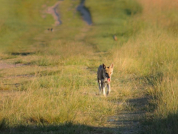
In Argentina, two fox species —Lycalopex gymnocercus and Cerdocyon thous— are generally considered abundant and coexist across various natural, transitional and anthropogenic environments. However, studies on habitat use and population size estimation in sympatric areas remain scarce. Their low densities, elusive behavior and morphological similarities make them particularly difficult to study. The Mburucuyá National Park (Corrientes, Argentina), which conserves terrestrial ecosystems within the Iberá wetlands region, served as the study site for assessing habitat use based on density estimates. Surveys were conducted between May and August 2015, during both diurnal and nocturnal periods, along 12 linear transects spanning three habitat types: mesophilous forest, mesophilous grassland and Butia yatay savanna. Fox detections were analyzed using the hierarchical distance sampling (HDS) method, applying a probability function to model detection distances perpendicular to the transect centerline. A total of 63 fox detections were recorded over a sampling effort of 103.8 km. Of these, 37 detections were identified as L. gymnocercus (51.4% in savanna, 29.7% in forest and 18.9% in grassland), while 26 detections corresponded to C. thous (73.1% in savanna). The mean population density was estimated at 0.27 individuals/km² for L. gymnocercus and 0.50 individuals/km² for C. thous. No statistically significant differences were found between species or across habitat types within each species. The findings of this study will contribute to understanding species coexistence, enable comparisons with other sympatric populations and help assess carnivore responses to varying anthropogenic pressures.
References
Arbo, M. 2004. Flórula del Parque Nacional Mburucuyá. Miscelánea 117-124. URL: tinyurl.com/mu55et69.
Armenta-Méndez, L., J. P. Gallo-Reynoso, B. T. Wilder, A. A. Gardea, M. M. Ortega-Nieblas, and I. Barba-Acuña. 2020. The role of wilds canids in the seed dispersal of Washingtonia robusta (Arecaceae) en oasis del desierto sonorense. Revista Mexicana de Biodiversidad 91:e913129. https://doi.org/10.22201/ib.20078706e.2020.91.3129.
Ayala, J., and A. Noss. 2000. Censos por transectas en el Chaco Boliviano: limitaciones biológicas y sociales de la metodología. Pp. 15-36 in E. Cabrera, C. Mercolli and R. Resquín (eds.). Manejo de fauna silvestre en Amazonía y Latinoamérica. CITES Paraguay, Fundación Moises Bertoni, University of Florida, Asunción, Paraguay.
Bay-Jouliá, R., V. L. Romero, M. B. Natalini, and M. M. Kowalewski. 2024. Feeding ecology of two wild sympatric canids in protected areas of northeastern Argentina. Journal of Zoology. https://doi.org/10.1111/jzo.13239.
Brown, J. H. 1984. On the relationship between abundance and distribution of species. The American Naturalist 124(2):255-279. https://doi.org/10.1086/284267.
Browne, M., C. Pasian, A. G. Di Giacomo, M. S. Di Bitetti, and A. S. Di Giacomo. 2023. Variation in mesopredator abundance and nest predation rate of the endangered Strange-tailed Tyrant (Alectrurus risora). Ibis 165(4):1201-1216. https://doi.org/10.1111/ibi.13202.
Cabrera, A. L. 1976. Regiones Fitogeográficas argentinas. Fascículo 1, Tomo 2 in W. F. Kugler and E. F. Ferreira Sobral (eds.). Enciclopedia argentina de agricultura y jardinería. 2da edición. Acme, Buenos Aires, Argentina.
Castelló, J. R., and C. Sillero-Zubiri. 2018. Canids of the World: Wolves, Wild Dogs, Foxes, Jackals, Coyotes, and Their Relatives. Princeton University Press, Princeton, New Jersey. URL: jstor.org/stable/j.ctv39x6vm.
Chandler, R. B., J. A. Royle, and D. King. 2011. Inference about density and temporary emigration in unmarked populations. Ecology 92:1429-1435. https://doi.org/10.1890/10-2433.1.
Cirignoli, S., J. A. Pereira, and D. Varela. 2019. Cerdocyon thous. Categorización 2019 de los mamíferos de Argentina según su riesgo de extinción. Lista Roja de los mamíferos de Argentina. https://doi.org/10.31687/SaremLR.19.122.
Contreras, F. I., S. A. Contreras, C. R. Méndez, M. N. Baruzzo, E. A. Ojeda, and I. E. Kovalsky. 2018. El paisaje de las Lomadas Arenosas (Corrientes, Argentina) desde el Pleistoceno Superior hasta la Actualidad. Boletín Geográfico 40:30-50. URL: ri.conicet.gov.ar/handle/11336/92992.
De Almeida Jácomo, A. T., L. Silveira, and J. A. F. Diniz-Filho. 2004. Niche separation between the maned wolf (Chrysocyon brachyurus), the crab-eating fox (Dusicyon thous) and the hoary fox (Dusicyon vetulus) in central Brazil. Journal of Zoology 262:99-106. https://doi.org/10.1017/S0952836903004473.
Di Bitetti, M. S., Y. E. Di Blanco, J. A. Pereira, A. Paviolo, and I. J. Pírez. 2009. Time Partitioning Favors the Coexistence of Sympatric Crab-Eating Foxes (Cerdocyon thous) and Pampas Foxes (Lycalopex gymnocercus). Journal of Mammalogy 90:479-490. https://doi.org/10.1644/08-MAMM-A-113.1.
Di Bitetti, M. S., M. E. Iezzi, P. Cruz, S. Cirignoli, D. Varela, and C. de Angelo. 2022. Enemies or good neigbhors? No indication of spatial or temporal avoidance between two sympatric South American canids. Journal of Zoology 317(3):170-184. https://doi.org/10.1111/jzo.12965.
Dinerstein, E., D. Olson, A. Joshi, C. Vynne, N. D. Burgess, et al. 2017. An ecoregion-based approach to protecting half the terrestrial realm. BioScience 67(6):534-545. https://doi.org/10.1093/biosci/bix014.
Buckland, S. T., D. R. Anderson, K. P. Burnham, and J. L. Laake. 1993. Distance Sampling: Estimating Abundance of Biological Populations. Chapman and Hall, London. https://doi.org/10.1007/978-94-011-1574-2.
Faria-Corrêa M., R. A. Balbueno, E. M. Vieira, and T. R. O. De Freitas. 2009. Activity, habitat use, density, and reproductive biology of the crab-eating fox (Cerdocyon thous) and comparison with the pampas fox (Lycalopex gymnocercus) in a Restinga area in the southern Brazilian Atlantic Forest. Mammalian Biology 74:220-229. https://doi.org/10.1016/j.mambio.2008.12.005.
Fiske, I. J., and R. B. Chandler. 2011. Unmarked: An R package for fitting hierarchical models of wildlife occurrence and abundance. Journal of Statistical Software 43:1-23. https://doi.org/10.1016/j.mambio.2008.12.005.
Fontana, J. L. 2017. Guía de la vegetación de los Esteros del Iberá, Corrientes, Argentina. Editorial Vida Correntina, Argentina.
Lípori, M., and L. De Oto. 2012. Características ambientales y áreas protegidas de la Ecorregión Esteros del Iberá. Revista El ojo del Cóndor, Una mirada diferente a nuestra geografía 2:14-20.
Lucherini, M. 2015. Cerdocyon thous. The IUCN Red List of Threatened Species 2015:e.T4248A81266293. https://doi.org/10.2305/IUCN.UK.2015-4.RLTS.T4248A81266293.en.
Lucherini, M. 2016. Lycalopex gymnocercus. The IUCN Red List of Threatened Species 2016:e.T6928A85371194. https://doi.org/10.2305/IUCN.UK.2016-1.RLTS.T6928A85371194.en.
Lucherini, M., and E. M. Luengos Vidal. 2008. Lycalopex gymnocercus (Carnivora: Canidae). Mammalian Species 820:1. https://doi.org/10.1644/820.1.
Lucherini, M., M. PESSINO, and A. A. FARIAS. 2004. Pampas fox Pseudalopex gymnocercus (Fischer, 1814). Pp 63-68 in Status survey and conservation action plan. C. Sillero-Zubiri, M. Hoffmann and D. W. Macdonald (eds.). Publisher: IUCN/SSC Canid Specialist Group.
Luengos Vidal, E., A. Farías, A. E. J. Valenzuela, and N. Caruso. 2019. Lycalopex gymnocercus. Categorización 2019 de los mamíferos de Argentina según su riesgo de extinción. Lista Roja de los Mamíferos de Argentina. https://doi.org/10.31687/SaremLR.19.127.
Luengos Vidal, E. M. 2004. Estudio comparado de metodologías de captura y de estimación de poblaciones de zorro pampeano Pseudalopex gymnocercus. Mastozoología Neotropical 11(2):249. URL: redalyc.org/pdf/457/45711210.pdf.
Maffei, L., R. Paredes, A. Segundo, and A. Noss. 2007. Home range and activity of two sympatric fox species in the Bolivian Dry Chaco. Canid news IUCN 10:1-7. URL: canids.org/canidnews/10.
Maffei, L., and A. B. Taber. 2003. Área de acción, actividad y uso de hábitat del zorro patas negras, Cerdocyon thous, en un bosque seco. Mastozoología Neotropical 10: 154-160.
Mayr, E. 1963. Animal Species and Evolution. Belknap of Harvard University Press. Cambridge, Massachusetts. Pp. 824.
Mazerolle, M. M. 2023. AICcmodavg: Model selection and multimodel inference based on (Q)AIC(c). R package version 2.3.3. URL: cran.r-project.org/package=AICcmodavg.
Miller, D. L., E. Rexstad, L. Thomas, J. L. Laake, and L. Marshall. 2019. Distance sampling in R. Journal of Statistical Software 89:1-28. https://doi.org/10.18637/jss.v089.i01.
Mota Poveda, J., J. Garrido, F. Martínez Hernández, J. Medina-Cazorla, D. Elias, and L. Rodríguez-Tamayo. 2014. Las plantas viven en sociedades: Fundamentos de la Fitosociología. Fitosociología y Series de Vegetación 173-214.
Natalini, M. B, P. F. Cuervo, M. S. Gennuso, V. L. Romero, R. Bay Juliá, P. M. Beldoménico, and M. M. Kowalewski. 2021. Influence of extraordinary floods on wildlife parasites: the case of gastrointestinal helminths and protozoa of wild canids from the Iberá Ecoregion, Argentina. Parasitology Research. https://doi.org/10.1007/s00436-021-07330-5.
Orfeo, O. 2012. Las aguas brillantes de Corrientes. Revista El ojo del Cóndor, Una mirada diferente a nuestra geografía 2:7-9.
Oyarzabal, M., J. Clavijo, L. Oakley, F. Biganzoli, P. Tognetti, et al. 2018. Unidades de vegetación de la Argentina. Ecología Austral 28:040-063. https://doi.org/10.25260/EA.18.28.1.0.399.
Rocha, F. L. 2006. Áreas de uso e seleção de habitats de três espécies de carnívoros de médio porte na Fazenda Nhumirim e arredores, Pantanal da Nhecolândia. Dissertação Mestrado em Ecologia e Conservação. Universidade Federal de Mato Grosso do Sul, Brasil. Pp. 92.
Romero, V. L. 2018. Ecología trófica, uso del hábitat y densidad de tres especies de cánidos (Carnivora, Canidae) simpátricos en el Parque Nacional Mburucuyá, Corrientes, Argentina. Doctorado en Biología. Universidad Nacional del Nordeste, Corrientes, Argentina. Pp. 150.
Rstudio Team. 2020. RStudio: Integrated Development for R. RStudio, PBC, Boston, MA. URL: rstudio.com.
Ruette, S., P. Stahl, and M. Albaret. 2003. Applying distance-sampling methods to spotlight counts of red foxes. Journal of Applied Ecology 40:32-43. https://doi.org/10.1046/j.1365-2664.2003.00776.x.
Sarmento, P., Cruz J., C. Eira, and C. Fonseca. 2009. Evaluation of camera trapping for estimating red fox abundance. The Journal of Wildlife Management 73(7):1207-1212. https://doi.org/10.2193/2008-288.
Schmitz, O. J. 2007. Ecology and Ecosystem Conservation. Yale University School of Forestry and Environmental Studies Washington. Yale University School of Forestry and Environmental Studies, Washington, Covelo, London.
Sillero-Zubiri, C., M. Hoffmann, and D. W. Macdonald. 2004. Canids: Foxes, Wolves, Jackals and Dogs. Status Survey and Conservation Action Plan. IUCN/SSC Canid Specialist Group, Gland, Switzerland and Cambridge, UK.
Teta, P., A. M. Abba, G. H. Cassini, D. A. Flores, C. A. Galliari, et al. 2018. Lista Revisada De Los Mamíferos De Argentina. Mastozoología Neotropical 25:163-198. https://doi.org/10.31687/saremMN.18.25.1.0.15.
Thomas, L., S. T. Buckland, K. P. Burnham, D. R. Anderson, J. L. Laake, et al. 2002. Distance sampling. Pp. 544-552 in A. H. El-Shaarawi and W. W. Piegorsch (eds.). Encyclopedia of Environmetrics 1:544-552, Chichester, London. URL: tinyurl.com/57w682td.
Trovati, R. G., B. Alves de Brito, J. Maurício, and B. Duarte. 2007. Área de uso e utilização de habitat de cachorro-do-mato (Cerdocyon thous Linnaeus, 1766) no cerrado da região central do tocantins, Brasil. Mastozoología Neotropical 14:61-68. URL: redalyc.org/pdf/457/45714107.pdf.
Wallace, R. B., F. Alfaro, L. Sainz, B. Rios-Uzeda, and A Noss. 2010. Capítulo 14: Canidae. Pp. 367-400 in R. B. Wallace, H. Gómez, Z. R. Porcel and D. I. Rumiz. Distribución, ecología y conservación de los mamíferos medianos y grandes de Bolivia. Centro de Ecología Difusión Simón I. Patiño, Santa Cruz, Bolivia.
Vieira, E. M., and D. Port. 2007. Niche overlap and resource partitioning between two sympatric fox species in southern Brazil. Journal of Zoology 272:57-63. https://doi.org/10.1111/j.1469-7998.2006.00237.x.
Downloads
Additional Files
Published
How to Cite
Issue
Section
License
Copyright (c) 2025 Verónica L. Romero, Martín M. Kowalewski, Javier A. Pereira

This work is licensed under a Creative Commons Attribution 4.0 International License.
Authors retain their rights as follows: 1) by granting the journal the right to its first publication, and 2) by registering the published article with a Creative Commons Attribution License (CC-BY 4.0), which allows authors and third parties to view and use it as long as they clearly mention its origin (citation or reference, including authorship and first publication in this journal). Authors can make other non-exclusive distribution agreements as long as they clearly indicate their origin and are encouraged to widely share and disseminate the published version of their work.