Urban grasslands in the Metropolitan Region of Buenos Aires: A debate on the importance and challenges of their conservation
DOI:
https://doi.org/10.25260/EA.24.34.3.0.2433Keywords:
citizen participation, conservation, fragmentation, native and exotic plants, plant diversity, urban environments, urban protected areasAbstract
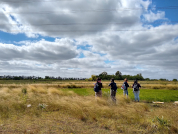
The conservation of vegetation in urban environments, particularly grasslands, is a seldom-addressed yet highly relevant issue from both ecological and social perspectives. In this article, we open a discussion on the importance of urban and peri-urban grasslands, the challenges of conserving biodiversity in these areas, and the related socioecological issues. To support this discussion, we conducted surveys of plant diversity in five urban grasslands within the Metropolitan Region of Buenos Aires (RMBA), where socio-environmental organizations actively engage in conservation efforts. First, we explore the problems of grasslands, the definition of urban grasslands and their various interpretations in the literature, and society’s perception and appreciation of these areas. We summarize the benefits that urban grasslands provide to society, including biodiversity conservation, recreation and environmental education. Next, we describe the specific characteristics of five RMBA grassland areas designated for conservation. In these areas, despite the fragmentation of the urban matrix and the presence of invasive exotic species, a significant proportion of native species typical of the Pampean grassland remains, which are valuable for conserving urban biodiversity. This highlights the ecological importance of these areas and the need to develop effective strategies for conserving and restoring urban grassland fragments. Finally, we examine the advantages and potential opportunities these fragments represent for the region and propose solutions to the identified challenges, such as implementing suitable management practices to reduce exotic species invasion and restore grasslands.
References
Beninde, J., M. Veith, and A. Hochkirch. 2015. Biodiversity in cities needs space: a meta‐analysis of factors determining intra‐urban biodiversity variation. Ecology Letters 18(6):581-592. https://doi.org/10.1111/ele.12427.
Bertonatti, C. 2021. Una reserva natural para cada ciudad. 1a ed. Ciudad Autónoma de Buenos Aires. Fundación de Historia Natural Félix de Azara. ISBN 978-987-3781-65-0.
Buchholz, S., A. K. Gathof, A. J. Grossmann, I. Kowarik, and L. K. Fischer. 2020. Wild bees in urban grasslands: Urbanisation, functional diversity and species traits. Landscape and Urban Planning 196:103731. https://doi.org/10.1016/j.landurbplan.2019.103731.
Buisson, E., S. Le Stradic, F. A. O. Silveira, G. Durigan, G. E. Overbeck, A. Fidelis, G. W. Fernandes, W. J. Bond, J. M. Hermann, G. Mahy, S. T. Alvarado, N. P. Zaloumis, and J. W. Veldman. 2019. Resilience and restoration of tropical and subtropical grasslands, savannas, and grassy woodlands. Biol Rev 94:590-609. https://doi.org/10.1111/brv.12470.
Burkart, S., E. León, R. J. Conde, M. C., and S. B. Perelman. 2011. Plant species diversity in remnant grasslands on arable soils in the cropping Pampa. Plant Ecology 212:1009-1024. https://doi.org/10.1007/s11258-010-9881-z.
Carbutt, C., W. D. Henwood, and L. A. Gilfedder. 2017. Global plight of native temperate grasslands: going, going, gone? Biodiversity and Conservation 26:2911-2932. https://doi.org/10.1007/s10531-017-1398-5.
Caruso, S. A. 2022. Las áreas protegidas del Aglomerado Gran Buenos Aires: derivas entre políticas públicas y conflictos ambientales. Estudios Socioterritoriales. Revista de Geografía 32:127. https://doi.org/10.37838/unicen/est.32-127.
Cook, C. N., R. S. Valkan, and M. A. McGeoch. 2019. Beyond total area protected: A new set of metrics to measure progress in building a robust protected area estate. Global Environmental Change 58:101963. https://doi.org/10.1016/j.gloenvcha.2019.101963.
Daubenmire, R. 1959. A canopy-coverage method of vegetational analysis. Northwest Science 33:43-64.
Dearborn, D. C., and S. Kark. 2010. Motivations for conserving urban biodiversity. Conservation Biology 24(2):432-440. https://doi.org/10.1111/j.1523-1739.2009.01328.x.
Dixon, A. P., D. Faber‐Langendoen, C. Josse, J. Morrison, and C. J. Loucks. 2014. Distribution mapping of world grassland types. Journal of Biogeography 41(11):2003-2019. https://doi.org/10.1111/jbi.12381.
Dylewski, Ł., Ł. Maćkowiak, and W. Banaszak‐Cibicka. 2019. Are all urban green spaces a favorable habitat for pollinator communities? Bees, butterflies and hoverflies in different urban green areas. Ecological Entomology 44(5):678-689. https://doi.org/10.1111/een.12744.
Escobar Basavilbaso, M. 2022. ¿Giro ecoterritorial en Gregorio de Laferrere? Vecinos autoconvocados por la lucha de la reserva urbana. Sociales y Virtuales 9(9). URL: tinyurl.com/4attx5rb.
Farrar, A., D. Kendal, K. J. Williams, and B. J. Zeeman. 2020. Social and ecological dimensions of urban conservation grasslands and their management through prescribed burning and woody vegetation removal. Sustainability 12(8):3461. https://doi.org/10.3390/su12083461.
Filibeck, G., P. Petrella, and P. Cornelini. 2016. All ecosystems look messy, but some more so than others: A case-study on the management and acceptance of Mediterranean urban grasslands. Urban Forestry and Urban Greening 15:32-39. https://doi.org/10.1016/j.ufug.2015.11.005.
Fischer, L. K., L. Neuenkamp, J. Lampinen, M. Tuomi, J. G. Alday, A. Bucharova, and V. H. Klaus. 2020. Public attitudes toward biodiversity-friendly greenspace management in Europe. Conservation Letters 13:e12718. https://doi.org/10.1111/conl.12718.
Fischer, L. K., M. von der Lippe, and I. Kowarik. 2013b. Urban land use types contribute to grassland conservation: The example of Berlin. Urban Forestry and Urban Greening 12(3):263-272. https://doi.org/10.1016/j.ufug.2013.03.009.
Fischer, L. K., M. von der Lippe, M. C. Rillig, and I. Kowarik. 2013a. Creating novel urban grasslands by reintroducing native species in wasteland vegetation. Biological Conservation 159:119-126. https://doi.org/10.1016/j.biocon.2012.11.028.
Francis, R. A., and M. A Chadwick. 2015. Urban invasions: non-native and invasive species in cities. Geography 100(3):144-151. https://doi.org/10.1080/00167487.2015.12093969.
Funk, J. L., E. E. Cleland, K. N. Suding, and E. S. Zavaleta. 2008. Restoration through reassembly: plant traits and invasion resistance. Trends in Ecology and Evolution 23(12):695-703. https://doi.org/10.1016/j.tree.2008.07.013.
Hallett L. M., D. E. Chapple, N. Bickart, A. Cherbowsky, L. Fernández, C. H. Ho, M. Alexander, K. Schwab, and K. N. Suding. 2017. Trait Complementarity Enhances Native Plant Restoration in an Invaded Urban Landscape 35(2):148-155. https://doi.org/10.3368/er.35.2.148.
Hejkal, J., Buttschardt, T. K., and V. H. Klaus. 2017. Connectivity of public urban grasslands: implications for grassland conservation and restoration in cities. Urban Ecosystems 20:511-519. https://doi.org/10.1007/s11252-016-0611-8.
Henwood, W. D. 2010. Toward a strategy for the conservation and protection of the world's temperate grasslands. Great Plains Research 20(1):121-134. URL: jstor.org/stable/23782179.
Hess, M. C., F. Mesléard, and E. Buisson. 2019. Priority effects: Emerging principles for invasive plant species management. Ecological Engineering 127:48-57. https://doi.org/10.1016/j.ecoleng.2018.11.011.
Ignatieva, M., D. Haase, D. Dushkova, and A. Haase. 2020. Lawns in cities: from a globalised urban green space phenomenon to sustainable nature-based solutions. Land 9(3):73. https://doi.org/10.3390/land9030073.
Instituto de Botánica Darwinion. s.f. Catálogo de las Plantas Vasculares del Conosur. URL: darwin.edu.ar/proyectos/floraargentina/fa.htm.
Kendal, D., B. J. Zeeman, K. Ikin, I. D. Lunt, M. J. McDonnell, A. Farrar, L. M. Pearce, and J. W. Morgan. 2017. The importance of small urban reserves for plant conservation, Biological Conservation 213(A):146-153. https://doi.org/10.1016/j.biocon.2017.07.007.
Kirchhoff, T. 2012. Urban grasslands: between nostalgia, control of nature, and wildness. Local Land and Soil 42/43(2):19-21. URL: tinyurl.com/npcwbz64.
Klaus, V. H. 2013. Urban grassland restoration: a neglected opportunity for biodiversity conservation. Restoration Ecology 21(6):665-669. https://doi.org/10.1111/rec.12051.
Klaus, V. H., and K. Kiehl. 2021. A conceptual framework for urban ecological restoration and rehabilitation. Basic and Applied Ecology 52:82-94. https://doi.org/10.1016/j.baae.2021.02.010.
Knapp, S., M. F. J Aronson, E. Carpenter, A. Herrera-Montes, K. Jung, D. J. Kotze, F. A. La Sorte, et al. 2021. A Research Agenda for Urban Biodiversity in the Global Extinction Crisis. BioScience 71(3):268-279. https://doi.org/10.1093/biosci/biaa141.
Lampinen J., M. Tuomi, L. K. Fischer, L. Neuenkamp, J. G. Alday, A. Bucharova, L. Cancellieri, et al. 2021. Acceptance of near-natural greenspace management relates to ecological and socio-cultural assigned values among European urbanites. Basic and Applied Ecology 50:119-131. https://doi.org/10.1016/j.baae.2020.10.006.
Lucero, R. F., F. L. Agnolín, S. O. Lucero, and M. D. C. Molina. 2011. Fauna de la Reserva Micológica “Dr. Carlos Spegazzini”, partido de Lomas de Zamora, Buenos Aires, Argentina. Historia Natural (tercera serie) 1(1):65-94.
Marshall, A. 2013. Start with the grasslands: Design guidelines to support native grasslands in urban areas. URL: apo.org.au/node/186346.
Matteucci, S. D., and M. Falcón. 2012. Efectos de la urbanización sobre la biodiversidad. Fundación de Historia Natural Félix de Azara. Pp. 272-291. URL: ri.conicet.gov.ar/handle/11336/160506.
McCarthy, M. A., C. J. Thompson, and N. S. Williams. 2006. Logic for designing nature reserves for multiple species. The American Naturalist 167(5):717-727. https://doi.org/10.1086/503058.
McDonald, R. I., P. Kareiva, and R. T. Forman. 2008. The implications of current and future urbanization for global protected areas and biodiversity conservation. Biological Conservation 141(6):1695-1703. https://doi.org/10.1016/j.biocon.2008.04.025.
Mejía, M. A., and J. D. Amaya-Espinel (eds.). 2022. BiodiverCities by 2030: Transforming cities with biodiversity. Instituto de Investigación de Recursos Biológicos Alexander von Humboldt, Bogotá. URL: tinyurl.com/4t7fhcfd.
Ministerio de Ambiente y Desarrollo Sostenible. 2021. Especies exóticas invasoras. Argentina: argentina.gob.ar. URL: tinyurl.com/5cdu6rw7.
Molina, C. D., P. M. Tognetti, and P. Graff. 2023. Restoration of invaded temperate grasslands: species phenology adds to microsite and seed availability. Applied Vegetation Science 26(3). https://doi.org/10.1111/avsc.12742.
Mollashahi, H., M. Szymura, and T. H. Szymura. 2020. Connectivity assessment and prioritization of urban grasslands as a helpful tool for effective management of urban ecosystem services. PloS ONE 15(12):e0244452. https://doi.org/10.1371/journal.pone.0244452.
Municipio de Monte. 2020. Ordenanza N° 4308/2020. Normativa para el Mantenimiento y Limpieza de Inmuebles baldíos y/o Edificados. URL: tinyurl.com/34svetke.
Nanni, A. S., M. Piquer Rodríguez, D. Rodríguez, M. Nuñez Regueiro, M. E. Periago, S. Aguiar, et al. 2020. Presiones sobre la conservación asociadas al uso de la tierra en las ecorregiones terrestres de la Argentina. Ecología Austral 30(2):304-320. https://doi.org/10.25260/EA.20.30.2.0.1056.
Neuenkamp, L., L. K. Fischer, R. Schröder, and V. H. Klaus. 2021. Urban ecosystems: potentials, challenges, and solutions. Basic and Applied Ecology 56:281-288. https://doi.org/10.1016/j.baae.2021.08.010.
Nuñez Bustos, E. 2008. Las especies urbanas de Rhopalocera de la Reserva Ecológica Costanera Sur, Ciudad de Buenos Aires, Argentina (Lepidoptera: Hesperioidea y Papilionoidea). SHILAP Revista de Lepidopterología 36(144):435-447.
Onandia, G., C. Schittko, M. Ryo, M. Bernard-Verdier, T. Heger, J. Joshi, I. Kowarik, and A. Gessler. 2019. Ecosystem functioning in urban grasslands: The role of biodiversity, plant invasions and urbanization. PloS ONE 14(11):e0225438. https://doi.org/10.1371/journal.pone.0225438.
Organización de Naciones Unidas. s.f. Población: Una población en crecimiento. URL: tinyurl.com/mmfzzm8d.
Padayachee, A. L., U. M. Irlich, K. T. Faulkner, M. Gaertner, Ş. Procheş, J. R. Wilson, and M. Rouget. 2017. How do invasive species travel to and through urban environments? Biological Invasions 19:3557-3570. https://doi.org/10.1007/s10530-017-1596-9.
Pereira, P. D. 2021. Áreas protegidas urbanas: tensiones y desafíos de la conservación en la Cuenca Matanza-Riachuelo (Argentina). Medio Ambiente y Urbanización 94(1):165-206. URL: hdl.handle.net/11336/157060.
Perelman, P., J. Breuste, N. Madanes, C. Gropper, E. Melignani, and A. Faggi. 2013. Use of visitors’ perception in urban reserves in the Buenos Aires metrópolis. Urban Ecosystems 16:841-851. https://doi.org/10.1007/s11252-012-0279-7.
Petermann, J. S., and O. Y. Buzhdygan. 2021. Grassland biodiversity. Current Biology 31(19):R1195-R1201. https://doi.org/10.1016/j.cub.2021.06.060.
Pithon, J. A., R. Duflot, V. Beaujouan, M. Jagaille, G. Pain, and H. Daniel. 2021. Grasslands provide diverse opportunities for bird species along an urban-rural gradient. Urban Ecosystems 24(6):1281-1294. https://doi.org/10.1007/s11252-021-01114-6.
Proyecto MapBiomas Argentina. s.f. Colección 1 de los Mapas Anuales de Cobertura y Uso del Suelo en Argentina. URL: plataforma.argentina.mapbiomas.org.
Rudolph, M., F. Velbert, S. Schwenzfeier, T. Kleinebecker, and V. H. Klaus. 2017. Patterns and potentials of plant species richness in high‐and low‐maintenance urban grasslands. Applied Vegetation Science 20(1):18-27. https://doi.org/10.1111/avsc.12267.
Schmidt, M. A. 2016. Expansión de la frontera urbana y áreas de protección ambiental en la región metropolitana de Buenos Aires, Argentina. Papeles de Coyuntura 42:138-161. URL: papelesdecoyuntura.com.
Sehrt, M., O. Bossdorf, M. Freitag, and A. Bucharova. 2020. Less is more! Rapid increase in plant species richness after reduced mowing in urban grasslands. Basic and Applied Ecology 42:47-53. https://doi.org/10.1016/j.baae.2019.10.008.
Sistema de Boletines Oficiales Municipales. 2018. Ordenanza Nº48/18. Sistema de Boletín Oficial Municipal, Buenos Aires Provincia. URL: sibom.slyt.gba.gob.ar/bulletins/1720/contents/1278217.
Soanes, K., L. Taylor, C. E. Ramalho, C. Maller, K. Parris, J. Bush, L. Mata, N. S. G Williams, and C. G. Threlfall. 2023. Conserving urban biodiversity: Current practice, barriers, and enablers. Conservation Letters 16(3):e12946. https://doi.org/10.1111/conl.12946.
Volenec, Z. M., and A. P. Dobson. 2020. Conservation value of small reserves. Conservation Biology 34(1):66-79. https://doi.org/10.1111/cobi.13308.
White, R. P., S. Murray, M. Rohweder, S. D. Prince, and K. M. Thompson. 2000. Grassland Ecosystems. Pp. 81. World Resources Institute. Washington, DC, USA. URL: portals.iucn.org/library/node/24538.
Williams, N. S., J. W. Morgan, M. A. McCarthy, and M. J. McDonnell. 2006. Local extinction of grassland plants: the landscape matrix is more important than patch attributes. Ecology 87(12):3000-3006. https://doi.org/10.1890/0012-9658(2006)87[3000:LEOGPT]2.0.CO;2.
Zeeman, B. J., M. J. McDonnell, D. Kendal, and J. W. Morgan. 2017. Biotic homogenization in an increasingly urbanized temperate grassland ecosystem. Journal of Vegetation Science 28(3):550-561. https://doi.org/10.1111/jvs.12507.
Downloads
Additional Files
Published
How to Cite
Issue
Section
License
Copyright (c) 2024 Cecilia D. Molina, Sofía Campana, Mariana Ciavattini, Sara Aradvari Horvat, María C. Silvoso, María M. Caffaro, Mora Jeroham, Pamela Graff

This work is licensed under a Creative Commons Attribution 4.0 International License.
Authors retain their rights as follows: 1) by granting the journal the right to its first publication, and 2) by registering the published article with a Creative Commons Attribution License (CC-BY 4.0), which allows authors and third parties to view and use it as long as they clearly mention its origin (citation or reference, including authorship and first publication in this journal). Authors can make other non-exclusive distribution agreements as long as they clearly indicate their origin and are encouraged to widely share and disseminate the published version of their work.