The complexity of aquatic macrophytes and environmental variables as a filter of functional traits of aquatic invertebrates from a subtropical stream in southern Brazil
DOI:
https://doi.org/10.25260/EA.25.35.1.0.2440Keywords:
aquatic invertebrates, functional traits, subtropical sand stream, macrophyte architectureAbstract
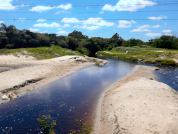
Aquatic macrophytes play a key role in structuring aquatic ecosystems due to their varying degrees of structural complexity and perform diverse functions for different organisms (e.g., refuge and food resources). Environmental variables can serve as filters by selecting organisms with characteristics adapted for establishment in these environments. The aquatic invertebrate community is the most frequent and abundant biotic component associated with these plants. In this study, we investigated whether macrophyte complexity and environmental variables affect the richness, abundance and functional traits of the aquatic invertebrate community across different seasons in a subtropical stream. We collected different species of macrophytes in the fall and spring of 2021 and defined the degree of structural complexity —low (C1), medium (C2) and high (C3)— based on biotype and plant biomass. We washed the plants under running water and identified the organisms at the lowest possible taxonomic level. Five functional characteristics were defined: size, life stage, reproduction, body shape and eating habits. We determined the richness, abundance, frequency of occurrence, density and frequency of functional traits of invertebrates, and calculated the Shannon-Weiner index, Simpson dominance and evenness. A total of 1650 individuals were recorded in the fall and 1228 in the spring. The lowest diversity, equitability and dominance were observed for C1 in autumn and for C3 in spring. Autumn showed a greater number of categories of functional traits than spring. The flow and width of the stream showed greater amounts of correlations with the functional traits. The different degrees of macrophyte complexities influence the metrics and functional traits; however, environmental variables act primarily on them.
References
Albertoni, E. F., L. U. Hepp, C. Carvalho, and C. Palma-Silva. 2018. Invertebrate composition in submerged macrophyte debris: habitat and degradation time effects. Ecol Austral 28:93-103. https://doi.org/10.25260/EA.18.28.1.0.462.
Albertoni, E. F., L. I. Prellvitz, and C. Palma-Silva. 2007. Macroinvertebrate fauna associated with Pistia stratiotes and Nymphoides indica in subtropical lakes (South Brazil). Braz J Biol 67(3):499.507. https://doi.org/10.1590/S1519-69842007000300015.
Alvares, C. A., K. L Stape, P. C. Sentelhas, J. L. M. Gonçalves, and G. Sparovek. 2013. Köppen’s climate classification map for Brazil. Meteorol Z 22(6):711-728. https://doi.org/10.1127/0941-2948/2013/0507.
Baumgarten, M., J. Rocha, and L. Niencheski. 1996. Manual de análises em oceanografia química. 1ª ed. FURG. Rio Grande, Rio Grande do Sul, Brasil.
Brito, J. S., T. S. Michelan, and L. Juen. 2021. Aquatic macrophytes are important substrates of Libellulidae (Odonata) larvae and adults. Limnol 22:139-149. https://doi.org/10.1007/s10201-020-00643-x.
Buchmann, F. S. C., F. Caron, R. P. Lopes, A. Ugri, and L. Gonçalves. 2009. Panorama Geológico da Planície Costeira do Rio Grande do Sul. Pp. 35-56 in A. M. Ribeiro, S. G. Bauermann and C. S. Scherer (eds.). Quaternário do Rio Grande do Sul: Integrando Conhecimentos. 1st ed. Brasil: Sociedade Brasileira de Paleontologia. Porto Alegre, Rio Grande do Sul, Brasil.
Callisto, M., P. Moreno, J. F. J. Gonçalves, and F. A. Esteves. 2002. Diversity and biomass of Chironomidae (Diptera) larvae in an impacted coastal Lagoon in Rio de Janeiro, Brazil. Braz J Biol 62(1):77-84. https://doi.org/10.1590/S1519-69842002000100010.
Castro, D. M. P., S. Dolédec, and M. Callisto. 2018. Land cover disturbance homogenizes aquatic insect functional structure in neotropical savanna streams. Ecol Indic 84:573-582. https://doi.org/10.1016/j.ecolind.2017.09.030.
Conceição, A. A., E. F. Albertoni, S. V. Milesi, and L. U. Hepp. 2020. Influence of anthropic impacts on the functional structure of aquatic invertebrates in subtropical wetlands. Wetlands 40:2287-2296. https://doi.org/10.1007/s13157-020-01317-1.
Cummins, K. W., R. W. Merritt, and P. C. N. Andrade. 2005. The use of invertebrate functional groups to characterize ecosystem attributes in selected streams and rivers in South Brazil. Stud Neotrop Fauna and Environ 40(1):69-89. https://doi.org/10.1080/01650520400025720.
Cyr, H., and J. A. Dowing. 1988. The abundance of phytophilous invertebrates on different species of submerged macrophytes. Freshw Biol 20(3):365-374. https://doi.org/10.1111/j.1365-2427.1988.tb00462.x.
Diarra, B., K. J. Konan, L. M. Yapo, and K. P. Kouassi. 2018. Aquatic macroinvertebrates associated with free-floating macrophytes in a marginal lentic ecosystem (Ono Lagoon, Cotê d’ Ivoire). J Entomol Zool Stud 6(3):1432-1441. https://doi.org/10.22161/ijeab/3.6.17.
Diaz, S., and M. Cabido. 2001. Vive la difference: Plant functional diversity matters to ecosystem process. Trends Ecol Evol 16:646-655. https://doi.org/10.1016/S0169-5347(01)02283-2.
Dolédec, S., D. Chessel, C. J. F. Braak, and S. Champely. 1996. Matching species traits to environmental variables: a new three-table ordination method. Environ Ecol Stat 3:143-166. https://doi.org/10.1007/BF02427859.
Domínguez, E., and H. R. Fernández. 2009. Guía para la determinación de los artrópodos bentónicos sudamericanos. 2ºed. Editorial Universitaria de Tucumán. Argentina.
Dray, S., P. Choler, S. Dolédec, P. R. Peres-Neto, W. Thuiller, et al. 2014. Combining the fourth-corner and the RLQ methods for assessing trait responses to environmental variation. Ecology 95(1):14-21. https://doi.org/10.1890/13-0196.1.
Durdevic, A., A. Medeiros, V. Zikic, A. Milosavljevic, D. Savic-Zdravkovic, et al. 2023. Mandibular shape as a proxy for the identification of functional feeding traits of midge larvae (Diptera: Chironomidae). Ecol Indic 147:109908. https://doi.org/10.1016/j.ecolind.2023.109908.
Edegbene, A. O., S. E. Yaagoubi, and T. T. E. Ovie. 2024. Macroinvertebrates functional feeding groups (FFGs) of forested streams draining urban catchments in the Niger Delta: identifying and classifying vulnerable and tolerant FFGs. Chem Ecol 1-21. https://doi.org/10.1080/02757540.2024.2432895.
Ehlert, B., C. Rempel, M. S. Dalzochio, P. C. Bergmann, and C. M. Zerwes. 2021. Insetos aquáticos e seus grupos tróficos relacionados a cobertura vegetal de propriedades leiteiras do Vale do Taquari/RS. Rev Ibero-Am Ciênc Ambient 12(3):102-110. http://doi.org/10.6008/CBPC2179-6858.2021.003.0010.
Ferreiro, N., C. Feijó, A. Giorgi, and L. Leggieri. 2011. Effects of macrophyte heterogeneity and food availability on structural parameters of the macroinvertebrate Community in a Pampean stream. Hydrobiologia 664:199-211. https://doi.org/10.1007/s10750-010-0599-7.
Gomes, L. F., H. R. Pereira, A. C. A. M. Gomes, M. C. Vieira, P. R. Martins, et al. 2019. Zooplankton functional approach studies in continental aquatic environments: a systematic review. https://doi.org/10.1007/s10452-019-09682-8.
Aquat Ecol 53:191-203. https://doi.org/10.1007/s10452-019-09682-8.
Gomes, W. I. A., D. S. Jovem-Azevêdo, F. F. Paiva, S. V. Milesi, and J. Motozzi. 2018. Functional attributes of Chironomidae for detecting anthropogenic impacts on reservoirs: A biomonitoring approach. Ecol Indic 95:404-410. https://doi.org/10.1016/j.ecolind.2018.05.006.
Growder, L. B., and W. E. Cooper. 1982. Habitat structural complexity and the interaction between bluegills and their prey. Ecology 63:1802-1813. https://doi.org/10.2307/1940122.
Kim, B. G., T. J. Yoon, M. J. Baek, and Y. J. Bae. 2018. Impact of rainfall intensity on benthic macroinvertebrate communities in a mountain stream under the East Asian monsoon climate. J Freshw Ecol 33(1):489-501. https://doi.org/10.1080/02705060.2018.1476271.
Kleine, P., and S. Trivinho-Strixino. 2005. Chironomidae and Other aquatic macroinvertebrates of first ordem stream: Community response after habitat fragmentation. Acta Limnol Bras 17(1):81-90.
INMET. 2024. Instituto Nacional de Meterologia. URL: portal.inmet.gov.br.
Lamourox, N., S. Dolédec, and S. Gavraud. 2004. Biological traits of stream macroinvertebrate communities: effects of micro-habitat, reach, and basic filters. J N Am Benthol Soc 23(3):449-466. https://doi.org/10.1899/0887-3593(2004)023%3C0449:BTOSMC%3E2.0.CO;2.
Leunda, P., J. Oscoz, R. Miranda, and A. H. Ariño. 2009. Longitudinal and seasonal variation of the benthic macroinvertebrate community and biotic indices in an undisturbed Pyrenean river. Ecol Indic 9(1):52-63. https://doi.org/10.1016/j.ecolind.2008.01.009.
Mackereth, J., J. Heron, and J. F. Talling. 1978. Water analysis: some revised methods for limnologists. Freshw Biol Assoc Sci Pub 36:117.
Madomguia, D., S. H. Z. Togouet, and A. Fomen. 2016. Macro invertebrates functional feeding groups, hilsenhoff biotic index, percentage of tolerant taxa and intolerant taxa as major indices of biological assesment in ephemeral stream in sudano-sahelian zone (Far-North, Cameroon). IJCMAS 5(10):792-806. https://doi.org/10.20546/ijcmas.2016.510.086.
McAbendroth, P. M., A. Ramsay, S. D. Foggo, and T. Bilton. 2005. Does macrophyte fractal complexity drive invertebrate diversity, biomass and body size distributions? Oikos 111:279-290. https://doi.org/10.1111/j.0030-1299.2005.13804.x.
Merritt, R. W., and K. W. Cummins. 2009. An introduction to the aquatic insects of North America. Kendall Hunt Publishing. Dubuque.
Milesi, S. V., C. Biasi, and L. U. Hepp. 2009. Distribution of benthic macroinvertebrates in Subtropical streams (Rio Grande do Sul, Brazil). Acta Limnol Bras 21(4):419-429.
Nascimento-Filho, S., W. A. Gama, and N. A. Moura. 2021. Effect of the structural complexity of aquatic macrophytes on epiphytic algal, macroinvertebrates, and their interspecific relationships. Aquat Sci 83:57. https://doi.org/10.1007/s00027-021-00812-9.
Oksanen, J., F. G. Blanchet, R. Kindt, and P. Legendre. 2017. Vegan: Community Ecology Package.
Poi, A. S. G., L. I. Gallardo, S. L. Casco, L. M. Sabater, and B. Úbeda. 2021. Influence of Macrophyte Complexity and Environmental Variables on Macroinvertebrate Assemblages Across a Subtropical Wetland System. Wetlands 41:105. https://doi.org/10.1007/s13157-021-01508-4.
Quirino, B. A., F. M. Lansac-Toha, S. M. Thomaz, J. Heino, and R. Fugi. 2021. Macrophyte stand complexity explains the functional α and β diversity of fish in a tropical river-floodplain. Aquat Sci 83:12. https://doi.org/10.1007/s00027-020-00768-2.
R Core Team. 2024. R: a language and environment for statistical computing. R Foundation for Statistical Computing.
Santana, M. S., C. B. Santos, and P. M. Mitsuka. 2021. Composição de macroinvertebrados associados a macrófitas aquáticas como parâmetro para avaliação da qualidade da água de um reservatório no semiárido baiano. Biotemas 34(3):1-14. https://doi.org/10.5007/2175-7925.2021.e78598.
Saito, V. S., T. Siqueira, and A. A. Fonseca-Gessner. 2015. Should phylogenetic and functional diversity metrics compose macroinvertebrate multimetric indices for stream biomonitoring? Hydrobiologia 745:167-179. https://doi.org/10.1007/s10750-014-2102-3.
Schmera, D., J. Heino, J. Podani, T. Erõs, and S. Dolédec. 2017. Functional diversity: a review of methodology and current knowledge in freshwater macroinvertebrate research. Hydrobiologia 787:27-44. https://doi.org/10.1007/s10750-016-2974-5.
Serra, R. R. Q., A. R. Calapez, N. E. Simões, J. A. A. S. Marques, M. Laranjo, et al. 2019. Effects of variations in water quantity and quality in the structure and functions of invertebrates community of a Mediterranean urban stream. Urban Ecosyst 22:1173- 1185. https://doi.org/10.1007/s11252-019-00892-4.
Schiller, A. P., A. Kunh, J. Manfrin, M. C. Ferronato, D. Schwantes, et al. 2017. Bioindicadores de qualidade de água como ferramenta de impacto ambiental de uma bacia hidrográfica. Rev Gest Ambient Sus 6(3). https://doi.org/165:180. 10.19177/rgsav6e32017165-180.
Silva, F. L., D. C. Moreira, G. L. Bochini, and S. S. Ruiz. 2008. Hábitos alimentares de larvas de Chironomidae (Insecta: Diptera) do córrego Vargem Limpa, Bauru, SP, Brasil. Biotemas 21(2):155-159. https://doi.org/10.5007/2175-7925.2008v21n2p155.
Sodré, E. O., and R. L. Bozelli. 2019. How planktonic microcrustaceans respond to environment and affect ecosystem: a functional trait perspective. Int Aquat Res 11:207-223. https://doi.org/10.1007/s40071-019-0233-x.
Son, S. H., S. J. Kwon, J. H. Kim, D. Kong, and J. Y. Choi. 2021. Aquatic Macrophytes Determine the Spatial Distribution of Invertebrates in a Shallow Reservoir. Water 13:1455. https://doi.org/10.3390/w13111455.
Strixino, S. T. 2023. Larvas de Chironomidae: Guia de identificação. UFSCAR 1º. São Carlos, SP, Brasil. https://doi.org/10.4322/978-65-00-62449-6
Tachet, H., P. Richoux, M. Bournaud, and P. Usseglio- Polatera. 2002. Invertébrés d’Eau Douce. 2ª ed. CNRS. Paris. France.
Thomaz, S. M., and E. R. Cunha. 2010. The role of macrophytes in habitat structuring in aquatic ecosystems: methods of measurement, causes and consequences on animal assemblages composition and biodiversity. Acta Limnol Bras 22(2):218-236. https://doi.org/ 10.4322/actalb.02202011.
Trindade, C. R. T., A. S. Pereira, E. F. Albertoni, and C. Palma-Silva. 2010. Caracterização e importância das macrófitas aquáticas com ênfase nos ambientes límnicos do Campus Carreiros- FURG, Rio Grande, RS. Cadern Ecol Aquátic. 5:2.
Triplehorn, C. A., and N. F. Johnson. 2011. Estudo dos Insetos. 7ºed. Cengage Leaming.
Trivinnho-Strixino, S. 2011. Larvas de Chironomidae. Guia de identificação. UFSCAR. São Carlos, São Paulo, Brasil.
Valderrama, J. C. 1981. The simultaneous analysis of total nitrogen and total phosphorus in natural waters. Mar Chem 10:109-22. https://doi.org/10.1016/0304-4203(81)90027-X.
Vieira, E. F., and S. S. Rangel. 1988. Planície Costeira do Rio Grande do Sul: geografia física, vegetação e dinâmica sociodemográfica. Editora Sagra. Porto Alegre, Rio Grande do Sul, Brasil.
Weyl, P., and J. Coetzee. 2013. An integrated remote sampling approach for aquatic invertebrates associated with submerged macrophytes. Afr J Aquat Sci 38(3): 337-340. http://doi.org/10.2989/16085914.2013.768196.
Wolters, J. M., R. C. M. Verdonschot, J. Shoelynck, and P. F. M. Verdonschot. 2018. The role of macrophyte structural complexity and waterflow in a lowland stream. Hydrobiologia 806:157-173. https://doi.org/10.1007/s10750-017-3353-6.
Downloads
Published
How to Cite
Issue
Section
License
Copyright (c) 2025 Bárbara Oleinski, Mikael L. Pereira Morales, Edélti Faria Albertoni

This work is licensed under a Creative Commons Attribution 4.0 International License.
Authors retain their rights as follows: 1) by granting the journal the right to its first publication, and 2) by registering the published article with a Creative Commons Attribution License (CC-BY 4.0), which allows authors and third parties to view and use it as long as they clearly mention its origin (citation or reference, including authorship and first publication in this journal). Authors can make other non-exclusive distribution agreements as long as they clearly indicate their origin and are encouraged to widely share and disseminate the published version of their work.