Women in the marine sciences and in the aquatic ecology of Uruguay
DOI:
https://doi.org/10.25260/EA.25.35.2.1.2483Keywords:
oceanography, aquatic ecology, gender gap, violence, research, perception, cooperationAbstract
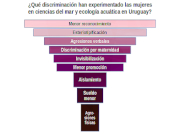
A plea of approaches is better to solve any problem. This is especially relevant in the field of science and technological innovation, in which women are recognized for promoting interdisciplinary and teamwork more strongly than men. However, women’s contributions are not recognised, their academic careers are negatively affected and, at work, they suffer situations that affect their health. Marine and aquatic sciences are among the areas with the greatest bias to women. To improve female participation, working conditions and to contribute to the diversity of thought, the visibility and discussion of these topics is fundamental. Our objective was to understand different aspects of the role of women, to evaluate gender biases and investigate gender discrimination in marine sciences and water ecology in Uruguay. Through a questionnaire targeting professors, researchers, students, and technicians in these fields, we evaluated gender gaps, discrimination perceptions, and links to caregiving and household responsibilities (including participants of all genders). Our results reveal a gap in academic training, career advancement and leadership opportunities. We also identified multiple forms of violence against women. Notably, while discrimination was reported exclusively by women, some men perceived it as irrelevant or external to their own experiences. These findings align with historical stereotypes faced by women in science, particularly in marine and aquatic ecology.
References
Alper, J. 1993. The Pipeline Is Leaking Women All the Way Along. Science 260(5106):409-411. https://doi.org/10.1126/science.260.5106.409.
Álvarez Burgos, M. C. 2020. No queremos ser pesca acompañante, sino pesca objetivo. RUNA, archivo para las ciencias del hombre 41(2). https://doi.org/10.34096/runa.v41i2.8691.
Arias, P. G. 2012. Corazonar desde el calor de las sabidurías insurgentes, la frialdad de la teoría y la metodología. Colección de Filosofía de la Educación 13:200-228.
Arismendi, I., and B. E. Penaluna. 2016. Examining Diversity Inequities in Fisheries Science: A Call to Action. BioScience 66(7):584-591. https://doi.org/10.1093/biosci/biw041.
Arrarte-Arzola, M. C. 2024. La comunidad docente del centro universitario regional del este, Uruguay. Un análisis con perspectiva de género. MLS Educational Research (MLSER) 8(2). https://doi.org/10.29314/mlser.v8i2.2383.
Bonatti, E., and K. Crane. 2012. Oceanography and Women: Early Challenges. Oceanography 25(4):32-39. https://doi.org/10.5670/oceanog.2012.103.
Bukstein, D., and N. Gandelman. 2017. Glass Ceiling in Research: Evidence from a National Program in Uruguay. Inter-American Development Bank. https://doi.org/10.18235/0011792.
Bulanti, L. B., X. Lagos, and L. M. Beramendi. 2022. Empty oceans - humanizing ocean and seascapes for building transdisciplinary knowledge and practice. Pp. 27-45 en S. Gómez and V. Köpsel (eds.). Transdisciplinary Marine Research. 1a ed. Routledge. https://doi.org/10.4324/9781003311171-3.
Canfield, K. N., A. R. Sterling, C. M. Hernández, S. N. Chu, B. R. Edwards, D. N. Fontaine, J. M. Freese, M. S. Giroux, et al. 2023. Building an inclusive wave in marine science: Sense of belonging and Society for Women in Marine Science symposia. Progress in Oceanography 218:103110. https://doi.org/10.1016/j.pocean.2023.103110.
Cech, E. A., and M. Blair-Loy. 2010. Perceiving Glass Ceilings? Meritocratic versus Structural Explanations of Gender Inequality among Women in Science and Technology. Social Problems 57(3):371-397. https://doi.org/10.1525/sp.2010.57.3.371.
Cullen, Z., and R. Pérez-Truglia. 2023. The old boys’ club: Schmoozing and the gender gap. American Economic Review 113(7):1703-1740.
de Miguel, A., L. Nuno, E. Rodríguez, and C. Roldan. 2016. Patriarcado académico y neoliberalismo sexual. Asociación Cultural Iberoamericana.
Derks, B., N. Ellemers, C. Van Laar, and K. De Groot. 2011. Do sexist organizational cultures create the Queen Bee? British Journal of Social Psychology 50(3):519-535. https://doi.org/10.1348/014466610X525280.
Diele-Viegas, L. M., T. E. F. Cordeiro, T. Emmerich, J. Hipólito, C. Queiroz-Souza, E. Sousa, A. C. Vançan, and L. Leite. 2021. Potential solutions for discrimination in STEM. Nature Human Behaviour 5(6):672-674. https://doi.org/10.1038/s41562-021-01104-w.
Dresden, B., A. Dresden, and R. Ridge. 2018. The Boys Club: Engineering a More Positive Environment for Women in Male-Dominated Majors. Social Sciences 7(2):17. https://doi.org/10.3390/socsci7020017.
Ellemers, N., H. Van Den Heuvel, D. De Gilder, A. Maass, and A. Bonvini. 2004. The underrepresentation of women in science: Differential commitment or the queen bee syndrome? British Journal of Social Psychology 43(3):315-338. https://doi.org/10.1348/0144666042037999.
Frins, E., A. Auyuanet, C. Cabeza, C. Stari, S. Kahan, and M. Renom. 2015. The presence of women in physics in Uruguay. AIP Conference Proceedings 1697(1):060046. https://doi.org/10.1063/1.4937693.
Gallego-Morón, N., and M. Matus López. 2021. Análisis de género de las barreras en la promoción académica. Estudio de caso de una universidad argentina. Perfiles Latinoamericanos 29(57). https://doi.org/10.18504/pl2957-011-2021.
Giakoumi, S., C. Pita, M. Coll, S. Fraschetti, E. Gissi, I. Katara, E. Lloret-Lloret, F. Rossi, M. Portman, V. Stelzenmüller, and F. Micheli. 2021. Persistent gender bias in marine science and conservation calls for action to achieve equity. Biological Conservation 257:109134. https://doi.org/10.1016/j.biocon.2021.109134.
Heijstra, T. M., Þ. Einarsdóttir, G. M. Pétursdóttir, and F. S. Steinþórsdóttir. 2017. Testing the concept of academic housework in a European setting: Part of academic career-making or gendered barrier to the top? European Educational Research Journal 16(2-3):200-214. https://doi.org/10.1177/1474904116668884.
Hernando, A. 2015. Mujeres, hombres, poder. Subjetividades en conflicto. Editorial Traficantes de Sueños. Madrid, España. ISBN: 978-84-943111-2-3.
Hofstra, B., V.V. Kulkarni, S. Munoz-Najar Galvez, B. He, D. Jurafsky, and D. A. McFarland. 2020. The Diversity-Innovation Paradox in Science. Proc. Natl. Acad. Sci. U.S.A. 117(17):9284-9291. https://doi.org/10.1073/pnas.1915378117.
IOC-UNESCO (Intergov. Oceanogr. Comm.–UN Educ. Sci. Cult. Organ.). 2020. Global ocean science re- port 2020: charting capacity for ocean sustainability. Rep., UNESCO, Paris. URL: tinyurl.com/2tcbsfnw.
Kalm, S. 2019. On academic housekeeping and its allocation. Sociologisk Forskning 56:5-26.
Kruk, C., H. C. D. S. D. Assis, S. X. González, A. Migliaro, P. S. Guillermo, A. Stewart-Ibarra, and E. Arismendi. 2024. Ciencias por y para mujeres: tiempo de compartir desde América Latina. Revista de Ciências Humanas 25(2):300-315. https://doi.org/10.31512/19819250.2024.25.02.300-315.
Kruk, C., R. Trinchin, S. De Mello, G. M. Vélez-Rubio, and R. Cantieri. 2020. Mujeres Con-Ciencia: Una mirada a las Geociencias en Uruguay. Descentrada 4(2):e122. https://doi.org/10.24215/25457284e122.
Legg, S., C. Wang, E. Kappel, and L. Thompson. 2023. Gender Equity in Oceanography. Annual Review of Marine Science 15(1):15-39. https://doi.org/10.1146/annurev-marine-032322-100357.
Lercari, D. 2021. Analysis of three decades of research in marine sciences in Uruguay through mapping of science and bibliometric indexes. Latin American Journal of Aquatic Research 49(1):1-17.
Linsalata, L. 2023. La academia patriarcal daña a todxs, pero no de la misma forma. Mapas-relatos de nuestras cuerpas dañadas. Debate Feminista 66:293-325. https://doi.org/10.22201/cieg.2594066xe.2023.66.2412.
Martinis, P. 2012. Prólogo. Pp. 7-9 en V. Giorgi, G. Kaplún and L. Eduardo Morás (organizadores). La violencia está en los otros. La palabra de los actores educativos. Montevideo, Trilce.
Morrison, E., E. Rudd, and M. Nerad. 2011. Onto, Up, Off the Academic Faculty Ladder: The Gendered Effects of Family on Career Transitions for a Cohort of Social Science Ph.D.s. The Review of Higher Education 34(4):525-553. https://doi.org/10.1353/rhe.2011.0017.
Nielsen, M. W., S. Alegria, L. Börjeson, H. Etzkowitz, H. J. Falk-Krzesinski, A. Joshi, E. Leahey, L. Smith-Doerr, A. W. Woolley, and L. Schiebinger. 2017. Gender diversity leads to better science. Proceedings of the National Academy of Sciences 114(8):1740-1742. https://doi.org/10.1073/pnas.1700616114.
O’Connell, S., and M. A. Holmes. 2005. Women of the Academy and the Sea. Oceanography 18(1):12-24. https://doi.org/10.5670/oceanog.2005.66.
O’Neill, M. T., V. Jones, and A. Reid. 2023. Impact of menopausal symptoms on work and careers: a cross-sectional study. Occupational Medicine 73(6):332-338, https://doi.org/10.1093/occmed/kqad078.
Orcutt, B., and I. Cetinic. 2014. Women in Oceanography: Continuing Challenges. Oceanography 27(4):5-13. https://doi.org/10.5670/oceanog.2014.106.
Oreskes, N. 2000. Laissez-tomber: Military Patronage and Women’s Work in Mid-20th-Century Oceanography. Historical Studies in the Physical and Biological Sciences 30(2):373-392. https://doi.org/10.2307/27757836.
Piccini, C., M. Devercelli, L. Yema, A. Segura, M. Bastidas Navarro, M. B. Sathicq, G. Martínez De La Escalera, et al. 2023. From competition to cooperation: Paradigm shifts in trait-based ecology change our understanding of the processes that structure microbial communities. Ecología Austral 33(3):887-893. https://doi.org/10.25260/EA.23.33.3.0.2093.
Rojas, C., and D. Wong. 2023. El trabajo de cuidados y la trayectoria educativa de las mujeres en las áreas de ciencia, tecnología, ingeniería y matemáticas (CTIM) (No. 68640). Naciones Unidas Comisión Económica para América Latina y el Caribe (CEPAL).
Rossiter, M. W. 1993. The Matthew Matilda effect in science. Social Studies of Science, London 23(2):325-341. https://doi.org/10.1177/030631293023002004.
Sánchez-Montoya, M. M., et al. 2016. Women in limnology in the Iberian Peninsula: biases, barriers and recommendations. Limnética 35:61-72.
Shen, H. 2013. Inequality quantified: Mind the gender gap. Nature 495(7439):22-24. https://doi.org/10.1038/495022a.
Spirito, F., P. Meli, M. F. Reyes, G. Núñez‐Vivanco, Z. Beloff, and J. L. De Paepe. 2024. Estereotipos de género en los temas de investigación en ecología: Un análisis de los últimos 20 años de las Reuniones Argentinas de Ecología. Austral Ecology 49(1):e13372. https://doi.org/10.1111/aec.13372.
St. Clair, M. 2021. Sexual harassment in marine science. Women in Ocean Science CIC. URL: tinyurl.com/2hs9shw9.
Tomassini, C. 2012. Ciencia académica y género: trayectorias académicas de varones y mujeres en dos disciplinasdel conocimiento dentro de la Universidad de la República. Montevideo: Ediciones Universitarias.
Valcárcel, A. 1998. La política de las mujeres, Madrid, Cátedra.
Van Den Brink, M., and Y. Benschop. 2012. Gender practices in the construction of academic excellence: Sheep with five legs. Organization 19(4):507-524. https://doi.org/10.1177/1350508411414293
Vila-Concejo, A., S. L. Gallop, S. M. Hamylton, L. S. Esteves, K. R. Bryan, I. Delgado-Fernández, E. Guisado-Pintado, S. Joshi, G. M. Da Silva, A. Ruiz De Alegria-Arzaburu, H. E. Power, N. Senechal, and K. Splinter. 2018. Steps to improve gender diversity in coastal geoscience and engineering. Palgrave Communications 4(1):103. https://doi.org/10.1057/s41599-018-0154-0.
Viscardi, N. 2008. Violencia en las aulas: práctica educativa, conflicto escolar y exclusión social. Pp. 145-160 en R. Paternain and R. Sanseviero (comps.) Violencia, inseguridad y miedos en Uruguay. ¿Qué tienen para decir lasCiencias Sociales? Montevideo: FESUR.
Wolfinger, N. H., M. A. Mason, and M. Goulden. 2009. Stay in the Game: Gender, Family Formation and Alternative Trajectories in the Academic Life Course. Social Forces 87(3):1591-1621. https://doi.org/10.1353/sof.0.0182.
Wschebor, M. 1998. Facultad de Ciencias: Los primeros siete años. Memorias del Decanato. Edición DI.R.A.C., Facultad de Ciencias de la Universidad de la República. ISBN 9974-0-0103-X.
Zimmermann, L. S. 2023. El rol de las epistemologías feministas y trans* en la deconstrucción de la ciencia androcéntrica y [cis]sexista. Ciencia Política 18(35):61-91. https://doi.org/10.15446/cp.v18n35.104940.
Downloads
Additional Files
Published
How to Cite
Issue
Section
License
Copyright (c) 2025 Carla Kruk, Gabriela M. Vélez-Rubio, Noelia Bortolotto, Valentina Amaral, Romina Trinchin, Cecilia Arrartre, Beatriz Yannicelli, Claudia Piccini

This work is licensed under a Creative Commons Attribution 4.0 International License.
Authors retain their rights as follows: 1) by granting the journal the right to its first publication, and 2) by registering the published article with a Creative Commons Attribution License (CC-BY 4.0), which allows authors and third parties to view and use it as long as they clearly mention its origin (citation or reference, including authorship and first publication in this journal). Authors can make other non-exclusive distribution agreements as long as they clearly indicate their origin and are encouraged to widely share and disseminate the published version of their work.