Chronicle of inequality: The case of ecology in Argentina
DOI:
https://doi.org/10.25260/EA.25.35.2.1.2505Keywords:
authorships, gender inequity, hierarchical positions, homophily, positions of power, publications, scientific meetings, science, visibilityAbstract
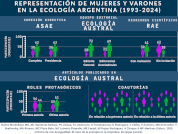
Historically, the trajectories of women in science have been less recognized than those of men. In Ecology, the lower participation of women in academia and scientific articles reflects global gender inequities. We evaluated the representation and visibility of women and men in the field of Ecology in Argentina over the past 30 years. Using generalized linear models, we analyzed gender disparities over time in key areas: the directive board of the Asociación Argentina de Ecología (AsAE), the Argentine Ecology Meeting (RAE), the editorial team of Ecología Austral (EA) and the authors publishing in the journal. We found a gender gap spanning 30 years. In both the directive board of AsAE and the editorial team of EA, there was a high representation of men in key leadership positions, while women dominated subordinate roles. Women participated less frequently as invited speakers at conferences and symposia in the RAE and presented more posters than men. Finally, women published more than men as first authors at EA. Our results align with global trends, which we explain by considering various phenomena and effects that render women invisible and that —despite some initial favorable changes— seem to be still present in our national system. The analysis used gender as a lens to advocate for a fairer and more equitable scientific system. Inclusion of women and other marginalized groups —through an intersectional lens— in the construction of scientific knowledge, is not only an ethical and political imperative, but also a catalyst for diverse perspectives and experiences for the development of concepts, approaches and tools leading to new and interesting advances in Ecology. An English version of this article is available in Supplementary Material 2.
References
Alper, J. 1993. The pipeline is leaking women all the way along. Science 260(5106):409-411. https://doi.org/10.1126/science.260.5106.409.
Andersson, E. R., C. E. Hagberg, and S. Hägg. 2021. Gender bias impacts top-merited candidates. Frontiers in Research Metrics and Analytics 6:594424. https://doi.org/10.3389/frma.2021.594424.
Astegiano, J., E. S. González, and C. Castanho. 2019. Unravelling the gender productivity gap in science: a meta- analytical review. Royal Society Open Science 6:181566. https://doi.org/10.1098/rsos.181566.
Barres, B. A. 2006. Does gender matter? Nature 442(7099):133-136. https://doi.org/10.1038/442133a.
Blanco, L. C. 2023. Engañadas por la academia: una revisión del estatus de las mujeres en la academia. Revista de Ciencias Económicas 41(1):e51726. https://doi.org/10.15517/rce.v41i1.51726.
Boletín de Pobreza. 2021. Indigencia y pobreza según tipología de hogares. Consejo Nacional de Coordinación de Políticas Sociales, Sistema de Información, Evaluación y Monitoreo de Programas Sociales. Argentina Unida. Reporte. Argentina.
Bradshaw, C. J., and F. Courchamp. 2018. Gender bias when assessing recommended ecology articles. Rethinking Ecology 3:1-12. https://doi.org/10.3897/rethinkingecology.3.24333.
Carrasquer, P., T. Torns, E. Tejero, and A. Romero. 1998. El trabajo reproductivo. Papers: Revista de Sociología 55:0095-114.
Cech, E. A. 2022. The intersectional privilege of white able-bodied heterosexual men in STEM. Science Advances 8(24):eabo1558. https://doi.org/10.1126/sciadv.abo1558.
Ceci, S. J., and W. M. Williams. 2011. Understanding current causes of women's underrepresentation in science. Proceedings of the National Academy of Sciences 108(8):3157-3162. https://doi.org/10.1073/pnas.1014871108.
Cho, A. H., S. A. Johnson, C. E. Schuman, J. M. Adler, O. González, et al. 2014. Women are under- represented on the editorial boards of journals in environmental biology and natural resource management. PeerJ 2:e542. https://doi.org/10.7717/peerj.542.
Chuliver Pereyra, M., J. Grosso, G. Fontanarrosa, J. Fratani, D. P. Ferraro, et al. 2021. Gender inequities in Herpetology: the case of the Argentine community. Cuadernos de herpetología 35(2):195-205. URL: http://sedici.unlp.edu.ar/handle/10915/168039.
Cockle, K. L., C. Cuatianquiz Lima, M. G. Núñez Montellano, E. B. Bonaparte, D. Zaffignani, et al. 2025. A framework for sharing power in research teams and promoting justice in scientific publication. Ornithological Applications 127(2):duaf014. https://doi.org/10.1093/ornithapp/duaf014.
Combahee River Collective. 1977. A black feminist statement. Pp. 269-277 en P. A. Weiss (ed.). The Black Feminist Reader. New York University Press, New York, USA. https://doi.org/10.18574/nyu/9781479805419.003.0063.
Cotter, D. A., J. M. Hermsen, S. Ovadia, and R. Vanneman. 2001. The glass ceiling effect. Social Forces 80(2):655-681. https://doi.org/10.1353/sof.2001.0091.
de Leon, F. L. L., and B. McQuillin. 2020. The role of conferences on the pathway to academic impact: Evidence from a natural experiment. Journal of Human Resources 55(1):164-193. https://doi.org/10.3368/jhr.55.1.1116-8387R.
Duffy, M. A. 2017. Last and corresponding authorship practices in ecology. Ecology and Evolution 7(21):8876-8887. https://doi.org/10.1002/ece3.3435.
Fagan, J., K. S. Eddens, J. Dolly, N. L. Vanderford, H. Weiss, et al. 2018. Assessing research collaboration through co-authorship network analysis. The Journal of Research Administration 49(1):76-99.
Farr, C. M., S. P. Bombaci, T. Gallo, A. M. Mangan, H. L. Riedl, et al. 2017. Addressing the gender gap in distinguished speakers at professional ecology conferences. BioScience 67(5):464-468. https://doi.org/10.1093/biosci/bix013.
Feenstra, S., C. T. Begeny, M. K. Ryan, F. A. Rink, J. I. Stoker, et al. 2020. Contextualizing the impostor “syndrome”. Frontiers in Psychology 11:575024. https://doi.org/10.3389/fpsyg.2020.575024.
Fontanarrosa, G., L. Zarbá, V. Aschero, D. A. Dos Santos, M. G. Núñez Montellano, et al. 2024. Over twenty years of publications in Ecology: Over-contribution of women reveals a new dimension of gender bias. PLOS One 19(9):e0307813. https://doi.org/10.1371/journal.pone.0307813.
Fox, C. W., J. P. Ritchey, and C. E. T. Paine. 2018. Patterns of authorship in ecology and evolution: First, last, and corresponding authorship vary with gender and geography. Ecology and Evolution 8(23):11492-11507. https://doi.org/10.1002/ece3.4584.
Fox, C. W., and C. T. Paine. 2019. Gender differences in peer review outcomes and manuscript impact at six journals of ecology and evolution. Ecology and Evolution 9(6):3599-3619. https://doi.org/10.1002/ece3.4993.
Frances, D. N., C. R. Fitzpatrick, J. Koprivnikar, and S. J. McCauley. 2020. Effects of inferred gender on patterns of co‐authorship in ecology and evolutionary biology publications. The Bulletin of the Ecological Society of America 101(3):e01705. https://doi.org/10.1002/bes2.1705.
Grosso, J., J. Fratani, G. Fontanarrosa, M. Chuliver Pereyra, A. S. Duport-Bru, et al. 2021. Male homophily in South American herpetology: One of the major processes underlying the gender gap in publications. Amphibia-Reptilia 42(4):407-418. https://doi.org/10.1163/15685381-bja10063.
Gutiérrez, A., and J. Cole. 2023. Impostorization in the ivory tower: Less discussed but more vexing than impostor syndrome. Equality, Diversity and Inclusion: An International Journal 44(1):77-90. https://doi.org/10.1108/EDI-03-2023-0094.
Hernández, M. G., M. L. Botell, and L. L. García. 2008. Algunas formas de organización y presentación del contenido científico en los eventos. Acta Científica Estudiantil 6(2):66-70.
Hill, C., C. Corbett, and A. St Rose. 2010. Why so few? Women in science, technology, engineering, and mathematics. American Association of University Women, Washington, USA.
Hirshfield, L. E., and T. D. Joseph. 2012. ‘We need a woman, we need a black woman’: gender, race, and identity taxation in the academy. Gender and Education 24(2):213-227. https://doi.org/10.1080/09540253.2011.606208.
Hites, R. A. 2014. How to give a scientific talk, present a poster, and write a research paper or proposal. Environmental Science and Technology 48(17):9960-9964. https://doi.org/10.1021/es503552t.
Holt, A., and T. Webb. 2007. Gender in ecology: Where are the female professors? Bulletin of the British Ecological Society 38:51-62.
Hooks, B. 2015. Ain’t I a woman? Black women and Feminism. Second Edition. Routledge, New York, USA.
Huang, J., A. J. Gates, R. Sinatra, and A. L. Barabási. 2020. Historical comparison of gender inequality in scientific careers across countries and disciplines. Proceedings of the National Academy of Sciences 117(9):4609-4616. https://doi.org/10.1073/pnas.1914221117.
Hughes, A. C., K. Z. Than, K. C. Tanalgo, A. P. Agung, T. Alexander, et al. 2023. Who is publishing in ecology and evolution? The underrepresentation of women and the Global South. Frontiers in Environmental Science 11:1211211. https://doi.org/10.3389/fenvs.2023.1211211.
Joyce, J. A., S. Masina, L. Michalik, C. Pot, C. Sempoux, et al. 2024. Closing the scissor-shaped curve: Strategies to promote gender equality in academia. Cell 187(6):1335-1342. https://doi.org/10.1016/j.cell.2024.01.050.
Kalejta, R. F., and A. C. Palmenberg. 2017. Gender parity trends for invited speakers at four prominent virology conference series. Journal of Virology 91(16):10-1128. https://doi.org/10.1128/jvi.00739-17.
León, T. M. 2009. Cambiar la economía para cambiar la vida. Pp. 63-74 en A. Acosta and E. Martínez (eds.). El buen vivir, una vía para el desarrollo. Abya-Yala, Quito, Ecuador.
Liboiron, M., J. Ammendolia, K. Winsor, A. Zahara, H. Bradshaw, et al. 2017. Equity in author order: A feminist laboratory’s approach. Catalyst: Feminism, Theory, Technoscience 3(2). https://doi.org/10.28968/cftt.v3i2.28850.
Liévano-Latorre, L. F., R. A. da Silva, R. R. Vieira, F. M. Resende, B. R. Ribeiro, et al. 2020. Pervasive gender bias in editorial boards of biodiversity conservation journals. Biological Conservation 251:108767. https://doi.org/10.1016/j.biocon.2020.108767.
Lione, S. V. 2023. Género, trabajo científico y reproducción social. Una aproximación conceptual para su abordaje en y desde la periferia. La ventana. Revista de Estudios de Género 7(58):111-145. https://doi.org/10.32870/lv.v7i58.7750.
Lomáscolo, S. B., M. L. Sandoval-Salinas, A. Novillo, G. Fontanarrosa, M. G. Montellano, et al. 2024. Perspectives–Academic career in ecology: Effect of gender, caregiving labor, and the working environment. Forest Ecology and Management 560:121801. https://doi.org/10.1016/j.foreco.2024.121801.
Lomáscolo S. B., A. Novillo, E. J. I. Pero, M. L. Sandoval-Salinas, M. G. Núñez Montellano, G. Fontanarrosa, M. Piquer-Rodríguez. Avanzar sobre suelo resbaladizo: Desafíos que enfrentan las ecólogas relacionados con el trabajo de campo, los viajes y el entorno de trabajo. Ecología Austral (en prensa).
Maas, B., R. J. Pakeman, L. Godet, L. Smith, V. Devictor, et al. 2021. Women and Global South strikingly underrepresented among top‐publishing ecologists. Conservation letters 14(4):e12797. https://doi.org/10.1111/conl.12797.
Martin, L. J. 2012. Where are the women in ecology? Frontiers in Ecology and the Environment 10(4):177-178. https://doi.org/10.1890/12.WB.011.
Martin, J. L. 2014. Ten simple rules to achieve conference speaker gender balance. PLoS Computational Biology 10(11):e1003903. https://doi.org/10.1371/journal.pcbi.1003903.
Maslach, C., and S. E. Jackson 1981. The measurement of experienced burnout. Journal of Occupational Behavior 2:99-113. https://doi.org/10.1002/job.4030020205.
Mauleón, E., L. Hillán, L. Moreno, I. Gómez, and M. Bordons. 2013. Assessing gender balance among journal authors and editorial board members. Scientometrics 95:87-114. https://doi.org/10.1007/s11192-012-0824-4.
Merton, R. K. 1968. The Matthew effect in science: The reward and communication systems of science are considered. Science 159(3810):56-63. https://doi.org/10.1126/science.159.3810.56.
Morton, M. J., and S. S. Sonnad. 2007. Women on professional society and journal editorial boards. Journal of the National Medical Association 99(7):764.
Oester, S., J. A. Cigliano, E. J. Hind-Ozan, and E. C. M. Parsons. 2017. Why conferences matter—an illustration from the International Marine Conservation Congress. Frontiers in Marine Science 4:257. https://doi.org/10.3389/fmars.2017.00257.
R Core Team. 2024. R: A Language and Environment for Statistical Computing. R Foundation for Statistical Computing, Vienna, Austria.
Radi, B. 2019. Políticas trans y acciones afirmativas en los ámbitos universitarios. Conversaciones necesarias para deshacer el cisexismo. Aletheia 10:19. https://doi.org/10.24215/18521606e026.
Rau, T. J., and J. Koch-González. 2018. Many voices one song: Shared power with sociocracy. Sociocracy for all. Amherst, USA.
Rezaeian, M., M. Rezaeian, and M. Rezaeian. 2017. How to prepare a poster for a scientific presentation. World Family Medicine Journal: Incorporating the Middle East Journal of Family Medicine 99(5489):1-3. https://doi.org/10.5742/MEWFM.2017.93027.
Ruelas Inzunza, E., K. L. Cockle, M. G. Núñez Montellano, C. S. Fontana, C. Cuatianquiz Lima, et al. 2023. How to include and recognize the work of ornithologists based in the Neotropics: Fourteen actions for Ornithological Applications, Ornithology, and other global-scope journals. Ornithological Applications 125(1):duac047. https://doi.org/10.1093/ornithapp/duac047.
Salerno, P. E., M. Páez-Vacas, J. M. Guayasamin, and J. L. Stynoski. 2019. Male principal investigators (almost) don’t publish with women in ecology and zoology. PLoS ONE 14(6):e0218598. https://doi.org/10.1371/journal.pone.0218598.
Schroeder, J., H. L. Dugdale, R. Radersma, M. Hinsch, D. M. Buehler, et al. 2013. Fewer invited talks by women in evolutionary biology symposia. Journal of Evolutionary Biology 26(9):2063-2069. https://doi.org/10.1111/jeb.12198.
Soares, L., K. L. Cockle, E. Ruelas Inzunza, J. T. Ibarra, C. I. Miño, et al. 2023. Neotropical ornithology: Reckoning with historical assumptions, removing systemic barriers, and reimagining the future. Ornithological Applications 125(1):duac046. https://doi.org/10.1093/ornithapp/duac046.
Solaro, C., M. S. Liébana, M. E. Rebollo, A. Mansilla, and L. A. Bragagnolo. 2024. Avances y desafíos de la participación femenina en la ornitología argentina: un análisis de publicaciones y reuniones científicas. Pp. 214 en Libro de resúmenes XX Reunión Argentina de Ornitología. Córdoba, Argentina.
Venables, W. N., and B. D. Ripley. 2002. Modern applied statistics with S. Fourth edition. Springer, New York. https://doi.org/10.1007/978-0-387-21706-2.
Walker, K. A. 2020. Females are first authors, sole authors, and reviewers of entomology publications significantly less often than males. Annals of the Entomological Society of America 113(3):193-201. https://doi.org/10.1093/aesa/saz066.
Wellenreuther, M., and S. Otto. 2016. Women in evolution–highlighting the changing face of evolutionary biology. Evolutionary Applications 9(1):3-16. https://doi.org/10.1111/eva.12343.
Wickham, H. 2016. ggplot2: Elegant graphics for data analysis. Springer-Verlag. New York. https://doi.org/10.1007/978-3-319-24277-4_9.
Wickham, H., and J. Bryan. 2023. readxl: Read Excel Files. R package version 1.4.3.
Wickham, H., D. Vaughan, and M. Girlich. 2024. tidyr: Tidy messy data. R package version 1.3.1.
Wickham, H., R. François, L. Henry, K. Müller, and D. Vaughan. 2023. dplyr: A grammar of data manipulation. R package version 1.1.4.
Wren, J. D., K. Z. Kozak, K. R. Johnson, S. J. Deakyne, L. M. Schilling, et al. 2007. The write position: A survey of perceived contributions to papers based on byline position and number of authors. EMBO Reports 8(11):988-991. https://doi.org/10.1038/sj.embor.7401095.
Wuchty, S., B. F. Jones, and B. Uzzi. 2007. The increasing dominance of teams in production of knowledge. Science 316(5827):1036-1039. https://doi.org/10.1126/science.1136099.
Zandonà, E. 2022. Female ecologists are falling from the academic ladder: A call for action. Perspectives in Ecology and Conservation 20(3):294-299. https://doi.org/10.1016/j.pecon.2022.04.001.
Zeng, X. H. T., J. Duch, M. Sales-Pardo, J. A. Moreira, F. Radicchi, et al. 2016. Differences in collaboration patterns across discipline, career stage, and gender. PLOS Biology 14(11):e1002573.https://doi.org/10.1371/journal.pbio.1002573.
Zsindely, S., A. Schubert, and T. Braun. 1982. Editorial gate- keeping patterns in international science journals. A new science indicator. Scientometrics 4:57-68. https://doi.org/10.1007/BF02098006.
Downloads
Additional Files
Published
How to Cite
Issue
Section
License
Copyright (c) 2025 M. Gabriela Núñez Montellano, María L. Sandoval-Salinas, Patricia V. Zelaya, Silvia Lomáscolo, Gabriela Fontanarrosa, Daniela Rodríguez, Verónica Chillo, Valeria Aschero, Natalia M. Schroeder, Valentina Brailovsky, Marisa A. Álvarez, Maia C. Plaza Behr, María J. Lorenzo Pisarello, María E. Fanjul, María Piquer Rodríguez, Ariana Choque, M. Fernanda Martínez-Gálvez

This work is licensed under a Creative Commons Attribution 4.0 International License.
Authors retain their rights as follows: 1) by granting the journal the right to its first publication, and 2) by registering the published article with a Creative Commons Attribution License (CC-BY 4.0), which allows authors and third parties to view and use it as long as they clearly mention its origin (citation or reference, including authorship and first publication in this journal). Authors can make other non-exclusive distribution agreements as long as they clearly indicate their origin and are encouraged to widely share and disseminate the published version of their work.