Impact of land use on soil organic carbon storage in the Northwestern Dry Chaco
DOI:
https://doi.org/10.25260/EA.26.36.2.0.2527Keywords:
native forest, deforestation, land use change, livestock farming, organic matter, land use, pastures, textureAbstract
1. Soil organic carbon (SOC) stock is an indicator of soil quality and health. Its dynamics play a significant role in the global balance of greenhouse gas (GHG) emissions. Changes in land use and increased production intensity in the Dry Chaco region decrease SOC.
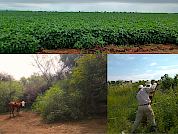
2. The objective of this study was to compare the effect of different land uses and soil textures on SOC storage in the Dry Chaco. Using the equivalent mass methodology, three production systems were compared: extensive agriculture, planted pastures, and forest with livestock. Data were obtained from soil samples taken at depths of 0–10 cm and 10-30 cm for each land use and texture.
3. The results showed no significant differences in SOC among the evaluated land uses; however, significant differences were observed across soil textures, suggesting that soil characteristics, environmental variability, and plot-level management play a significant role in SOC reserves.
4. Soil compaction and increased bulk density occur after deforestation. This situation does not occur in forest-livestock use (i.e., forest with livestock) , which, although not subject to deforestation, is susceptible to desertification and SOC loss, especially in coarse-textured soils.
5. The storage of SOC in fine-textured soils under planted pastures is noteworthy.
6. Implications. The potential of extensive agriculture and forest-livestock land uses to sequester carbon in finetextured soils through sustainable management practices is highlighted. Edaphic and environmental variability must be considered in future monitoring and management strategies for SOC in the region.
References
Abrahams, A. D., A. J. Parsons, and J. Wainwright. 1995. Effects of Vegetation Change on Interrill Runoff and Erosion, Walnut Gulch, Southern Arizona. Geomorphology 13:37-48. https://doi.org/10.1016/0169-555X(95)00027-3.
Abril, A., and L. B. Noe. 2007. Balance de carbono del suelo según el uso de la tierra en la región árida-semiárida central de Argentina. Pp. 191-202 en N. C. Verne (ed.). Forest Ecology Research Horizons. Nova Science Publishers, Inc. Nueva York.
Abril, A., P. Barttfeld, and E. H. Bucher. 2005. The effect of fire and overgrazing disturbes on soil carbon balance in the Dry Chaco forest. Forest Ecology and Management 206(1-3):399-405. https://doi.org/10.1016/j.foreco.2004.11.014.
Abril, A., and E. H. Bucher. 2001 Overgrazing and soil carbon dynamics in the western Chaco of Argentina. Applied Soil Ecology 16(3):243-249. https://doi.org/10.1016/S0929-1393(00)00122-0.
Amrhein, V., S. Greenland, and B. McShane. 2019. Scientists rise up against statistical significance. Nature 567(7748):305-307. https://doi.org/10.1038/d41586-019-00857-9.
Asociación Argentina de Productores en Siembra Directa (AAPRESID). 2023. Red de Brechas de Carbono: informe de resultados etapa 1. URL: tinyurl.com/ymv8dc9d.
Austin, A. T., L. Yahdjian, J. M. Stark, J. Belnap, A. Porporato, U. Norton, D. A. Ravetta, and S. M. Schaeffer. 2004. Water pulses and biogeochemical cycles in arid and semiarid ecosystems. Oecologia 141(2):221-235. https://doi.org/10.1007/s00442-004-1519-1.
Baldassini, P. 2018. Provisión de Servicios Ecosistémicos en el Chaco Semiárido: Efectos de los cambios en el uso del suelo y la variabilidad climática sobre la dinámica del carbono.
Baldassini, P., and J. M. Paruelo. 2020. Deforestation and current management practices reduce soil organic carbon in the semi-arid Chaco, Argentina. Agricultural Systems 178:102749. https://doi.org/10.1016/j.agsy.2019.102749.
Banegas, N., M. Maza, E. Viruel, J. Nasca, F. Canteros, R. Corbella, and D. Dos Santos. 2019. Long-term impact of grazing and tillage on soil quality in the semi-arid Chaco (Argentina). Spanish Journal of Soil Science 9:3504. https://doi.org/10.3232/SJSS.2019.V9.N1.02.
Beillouin, D., M. Corbeels, J. Demenois, D. Berre, A. Boyer, A. Fallot, F. Feder, and R. Cardinael. 2023. A global meta-analysis of soil organic carbon in the Anthropocene. Nature Communications 14(1):3700. https://doi.org/10.1038/s41467-023-39338-z.
Buol, S. W. 2013. Génesis y clasificación de suelos. 2a ed. México Trillas, 1990 (reimp. 2013).
Bünemann, E. K., G. Bongiorno, Z. Bai, R. E. Creamer, G. De Deyn, R. De Goede, L. Fleskens, V. Geissen, et al. 2018. Soil quality - A critical review. Soil Biology and Biochemistry 120:105-125. https://doi.org/10.1016/j.soilbio.2018.01.030.
Caruso, H., M. Camardelli, and S. Miranda. 2012. Efecto del método de desmonte sobre los indicadores de calidad del suelo y la condición de las pasturas en el Chaco Semiárido salteño. Agriscientia 29(2):99-105. https://doi.org/10.31047/1668.298x.v29.n2.3888.
Céspedes Flores, F. E., J. A. Fernández, L. Giménez, E. A. Leonhardt, and A. C. Bernardis. 2018. Carbono retenido por la hojarasca y raíces en diferentes usos del suelo en la región del chaco semiárido. Chilean Journal of Agricultural and Animal Sciences 34(2):165-172. https://doi.org/10.4067/S0719-38902018005000405.
Chalco Vera, J., and M. M. Acreche. 2024. Carbon-scaled nitrous oxide emissions better reflect the impacts of land use changes than raw nitrous oxide emissions in the Dry Chaco region. Agriculture, Ecosystems and Environment 373:109128. https://doi.org/10.1016/j.agee.2024.109128.
Ciancaglini, N. 2000. Guía para la determinación de textura de suelos por método organoléptico. Programa de servicios agrícolas provinciale (Prosap) 1-10.
Conti, G., N. Pérez-Harguindeguy, F. Quètier, L. D. Gorné, P. Jaureguiberry, G.A. Bertone, et al. 2014. Large changes in carbon storage under different land-use regimes in subtropical seasonally dry forests of southern South America. Agriculture, Ecosystems and Environment 197:68-76. https://doi.org/10.1016/j.agee.2014.07.025.
Córdoba, G. S., A. Guevara, S. Castrillo, and M. C. Camardelli. 2022. Estado de neutralidad en la degradación de la tierra en el Chaco Salteño entre 2001 y 2018. Ecología Austral 32(3):864-877. https://doi.org/10.25260/EA.22.32.3.0.1909.
Cotroneo, M. S., E. J. Jacobo, E. A. Bosio, U. O. Karlin, M. Brassiolo, and R. A. Golluscio. 2016. Bases e interrogantes para el manejo sostenible de los recursos forrajeros del bosque nativo en el Chaco semiárido santiagueño. Pp. 243-276 en Transformaciones Agrarias Argentinas Durante Las Últimas Décadas. Editorial Facultad de Agronomía UBA, Buenos Aires, Argentina.
De Gruyter. 2017. The Biology of Arid Soils. (eds) Steven, Blaire. Berlin, Boston. https://doi.org/10.1515/9783110419047.
Dixon, R. K., A. M. Solomon, S. Brown, R. A. Houghton, M. C. Trexier, and J. Wisniewski. 1994. Reservas de carbono y flujo de los ecosistemas forestales globales. Science 263(5144):185-190. https://doi.org/10.1126/science.263.5144.185.
Ellert, B. H., and J. R. Bettany. 1995. Calculation of organic matter and nutrients stored in soils under contrasting management regimes. Canadian Journal of Soil Science 75(4):529-538. https://doi.org/10.4141/cjss95-075.
FAO and ITPS. 2015. Status of the World’s Soil Resources (SWSR) - Technical Summary. Food and Agriculture Organization of the United Nations and Intergovernmental Technical Panel on Soils, Rome, Italy.
Fernández, F. E., M. B. Ciavattini, C. Luján Puccetti, and A. I. Zambrano. 2019. Deforestación en el Gran Chaco: Alternativas productivas potenciales para detener la degradación socioecológica. Anales Científicos 80(2):364. https://doi.org/10.21704/ac.v80i2.1454.
Gaitán, J. J., D. Bran, and C. Azcona. 2015. Tendencia del NDVI en el período 2000-2014 como indicador de la degradación de tierras en Argentina: Ventajas y limitaciones. AgriScientia 32(2):83-93. https://doi.org/10.31047/ 1668.298x.v32.n2.16559.
Gaitán, J. J., P. L. Peri, M. P. Barral, M. F. Accame, F. G. Alaggia, S. Albarracin, D. J. Álvarez Cortés, C. Álvarez, et al. 2025. Modelado y cartografía del almacenamiento de Carbono en los suelos de la República Argentina. Revista Ciencia del Suelo 43(2):268-289. https://doi.org/10.64132/cds.v43i2.920.
INTA GeoNODO. URL: tinyurl.com/mwxa9jx2.
Gimenez, D. A. M., and D. J. G. Moglia. 2017. Los bosques actuales del Chaco semiárido argentino: ecoanatomía y biodiversidad: una mirada propositiva. A. M. Giménez and J. G. Moglia (eds.).
Idesa. 2017. Suelos del NOA (Salta y Jujuy) - Clasificación Tax. USDA Sub Grupo. Adecuación a Un Sistema de Información Geográfica Del Estudio “Los Suelos Del NOA (Salta y Jujuy), Nadir A. - Chafatinos T., 1990” - Convenio INTA UNSA. Unidades Cartograficas - Asociaciones de Suelos - Escala 1:250000. URL: tinyurl.com/42jdkesr.
Instituto Nacional de Tecnología Agropecuaria (INTA). 2023. Protocolo de muestreo de suelos para el mapeo de las reservas de carbono orgánico del suelo. INTA Centro Regional Entre Ríos, EEA Paraná.
IPCC. 2003. Options to Inventory Emissions from Direct Human-induced Degradation of Forests and Devegetation of Other Vegetation Types. Hayama,Japón, Instituto para las Estrategias Ambientales Globales para el Grupo Intergubernamental de Expertos sobre el Cambio Climático. URL: tinyurl.com/8xcfwc98.
Lal, R. 2001. Potential of desertification control to sequester carbon and mitigate the greenhouse effect. Climatic Change 51(1):35-72. https://doi.org/10.1023/A:1017529816140.
Lal, R. 2005. Forest soils and carbon sequestration. Forest Ecology and Management 220(1-3):242-258. https://doi.org/10.1016/j.foreco.2005.08.015.
Nadir, A., and T. Chafatinos. 1990. Los Suelos del NOA (Salta y Jujuy). Tomo I, II y III. Argentina: Ediciones INTA.
MAyDS-PNUD. 2022. Manejo sustentable de tierras en las zonas secas de NOA y Cuyo/PNUD ARG/14/G55. República Argentina.
Martínez H., E., J. P. Fuentes, and E. Acevedo H. 2008. Carbono orgánico y propiedades del suelo. Revista de la Ciencia del Suelo y Nutrición Vegetal 8(1):68-96. https://doi.org/10.4067/S0718-27912008000100006.
Naldini, M. B., N. Pérez-Harguindeguy, and E. Kowaljow. 2023. La intensificación del uso de la tierra disminuye el carbono orgánico del suelo en bosques del Chaco Seco, Córdoba. Ecología Austral 33(3):674-683. https://doi.org/10.25260/EA.23.33.3.0.2072.
Nosetto, M. D., E. Balducci, J. Gaitán, M. Mastrángelo, G. M. Pastur, M. Pinazo, P. Villagra, M. G. Roglich, et al. 2024. Changes in soil organic carbon in native forests of Argentina related to land use change and environmental factors. Soil Use and Management 40(3):e13109. https://doi.org/10.1111/sum.13109.
Peri, P. L., and S. Vetter. 2022. Estimación de las reservas de carbono orgánico del suelo con plantaciones forestales y otros usos de la tierra, en distintas regiones de Argentina.
Plaza, C., C. Zaccone, K. Sawicka, A. M. Méndez, A. Tarquis, G. Gascó, G. B. M. Heuvelink, E. A. G. Schuur, and F. T. Maestre. 2018. Soil resources and element stocks in drylands to face global issues. Scientific Reports 8(1):13788. https://doi.org/10.1038/s41598-018-32229-0.
Prăvălie, R. 2016. Drylands extent and environmental issues. A global approach. Earth-Science Reviews 161:259-278. https://doi.org/10.1016/j.earscirev.2016.08.003.
Puchulu, M. E., and D. Fernández. 2017. Suelos representativos del Noroeste Argentino. Pp. 874-912 en C. M. Muruaga and P. Grosse (eds.). Ciencias de la Tierra y Recursos Naturales del NOA. Relatorio del XX Congreso Geológico Argentino, San Miguel de Tucumán.
Schulz, G. A. et al. 2023. Digital Soil Texture Maps of Argentina and Their Relationship to Soil-Forming Factors and Processes. En J. A. Zinck, G. Metternicht, H. F. del Valle and M. Angelini (eds.). Geopedology. https://doi.org/10.1007/978-3-031-20667-2_14.
Schulz, G. A., D. M. Rodríguez, M. E. Angelini, L. M. Moretti, G. F. Olmedo, L. M. Tenti Vuegen, J. C. Colazo, and M. Guevara. 2022. Digital soil texture maps of Argentina (2.0) [Data set]. Zenodo. https://doi.org/10.5281/zenodo.6312654.
Servicio Nacional de Sanidad y Calidad Agroalimentaria (SENASA). 2020. Existencias bovinos. Datos Argentina. URL: tinyurl.com/8cfk6nyd.
Simula, M. 2009. Hacia una definición de degradación de los bosques: análisis comparativo de las definiciones existentes. Roma, Italia: Departamento Forestal, Organización de las Naciones Unidas para la Alimentación y la Agricultura (FAO).
Simula, M., and E. Mansur. 2011. Un desafío mundial que reclama una respuesta local. Unasylva: Revista Internacional de Silvicultura e Industrias Forestales 62(238):3-7.
R Core Team. 2025. R: A Language and Environment for Statistical Computing. R Foundation for Statistical Computing, Vienna, Austria. URL: R-project.org.
Thien S. J. 1979. A flow diagram for teaching texture-by-feel analysis. J Agron Educ 8:54-55. https://doi.org/10.2134/jae.1979.0054.
Tiruneh, G. A., A. Hanjagi, M. Mumtaz, and J. M. Reichert. 2024. Prediction, mapping, and implication for better soil organic carbon management in Ethiopia. Soil Science Society of America Journal 88(3):753-763. https://doi.org/10.1002/saj2.20644.
Torrella, S. A., and J. Adamoli. 2005. Situación ambiental de la ecorregión del Chaco Seco. La situación ambiental Argentina 2005:75-82.
Vallejos, M., J. N. Volante, M. J. Mosciaro, L. M. Vale, M. L. Bustamante, and J. M. Paruelo. 2015. Transformation dynamics of the natural cover in the Dry Chaco ecoregion: a plot level geo-database from 1976 to 2012. Journal of Arid Environments 123:3-11. https://doi.org/10.1016/j.jaridenv.2014.11.009.
Villarino, S. H., E. Talab, L. Contisciani, C. Videla, P. Di Geronimo, M. E. Mastrángelo, K. Georgiou, R. B. Jackson, and G. Piñeiro. 2023. A large nitrogen supply from the stable mineral-associated soil organic matter fraction. Biol Fertil Soils 59:833-841. https://doi.org/10.1007/s00374-023-01755-z.
Von Haden, A.C., W. H. Yang, and E. H. DeLucia. 2020. Soils' dirty little secret: Depth-based comparisons can be inadequate for quantifying changes in soil organic carbon and other mineral soil properties. Glob Change Biol 26:3759-3770. https:doi.org/10.1111/gcb.15124.
Volante, J. N., D. Alcaraz-Segura, M. J. Mosciaro, E. F. Viglizzo, and J. M. Paruelo. 2012. Ecosystem functional changes associated with land clearing in NW Argentina. Agriculture, Ecosystems and Environment 154:12-22. https://doi.org/ 10.1016/j.agee.2011.08.012.
Wu, T., F. Wichern, M. Wiesmeier, F. Buegger, L. Shi, M. A. Dippold, C. Höschen, and C. W. Mueller. 2024. Organic carbon loading of soils determines the fate of added fresh plant-derived organic matter. Geoderma 443:116816. https://doi.org/10.1016/j.geoderma.2024.116816.
Xie, G., and Y. Steinberger. 2001. Temporal patterns of C and N under shrub canopy in a loessial soil desert ecosystem. Soil Biology and Biochemistry 33(10):1371-1379. https://doi.org/10.1016/S0038-0717(01)00042-6.
Downloads
Additional Files
Published
How to Cite
Issue
Section
License
Copyright (c) 2026 Carlos S. López Morillo, Laura M. Califano, Jorge Chalco Vera

This work is licensed under a Creative Commons Attribution 4.0 International License.
Authors retain their rights as follows: 1) by granting the journal the right to its first publication, and 2) by registering the published article with a Creative Commons Attribution License (CC-BY 4.0), which allows authors and third parties to view and use it as long as they clearly mention its origin (citation or reference, including authorship and first publication in this journal). Authors can make other non-exclusive distribution agreements as long as they clearly indicate their origin and are encouraged to widely share and disseminate the published version of their work.