Limnological features and zooplankton composition in high altitude lakes from Tierra del Fuego, Argentina
DOI:
https://doi.org/10.25260/EA.25.35.2.0.2528Keywords:
high altitude lakes, mesozooplankton, dissolved organic carbon, chlorophyll aAbstract
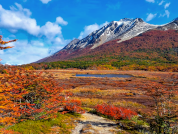
During the period encompassed between December 2022 and January 2023, 8 high altitude lakes (294-871 m a. s. l.) from the Andean Mountain Range in Tierra del Fuego were monitored to describe their limnological characteristics and mesozooplankton composition (copepods and cladocerans) during early summer. The lakes covered a gradient of dissolved organic carbon (DOC, 1-14 mg/L), color (a440, 8.1-19.6 m-1), total nitrogen (TN, 0.56-0.92 mg/L) and phytoplankton chlorophyll a (chl-a, 0.22-4.10 µg/L). Total species richness was 8 including all sites, ranging from 2 to 5 at each lake. The highest richness was observed in Óvalo, the lower elevation lake, most colored, with highest DOC, TN and Chl-a concentration. This finding allows us to hypothesize that larger resources content and photoprotection from colored organic matter allowed the development of a more diverse zooplankton community.
References
Adamczuk, M. 2016. Past, present, and future roles of small cladoceran Bosmina longirostris (O. F. Müller, 1785) in aquatic ecosystems. Hydrobiologia 767:1-11. https://doi.org/10.1007/s10750-015-2495-7.
Adrian, R., C. O’Reilly, H. Zagarese, S. B. Baines, D. O. Hessen, W. Keller, D. M. Livingstone, et al. 2009. Lakes as sentinels of climate change. Limnology and Oceanography 54(6/2):2283-2297. https://doi.org/10.4319/lo.2009.54.6_part_2.2283.
Aguilar Zurita, A., and P. Rodríguez. 2016. Relationship between phytoplankton and bacterioplankton production in vegetated humic shallow lakes. Ecología Austral 26(3):305-310. https://doi.org/10.25260/EA.16.26.3.0.223.
APHA. 2017. Standard Methods for the Examination of Water and Wastewater. Washington D.C., USA.
Balseiro, E., B. Modenutti, and C. Queimaliños. 2001. Feeding of Boeckella gracilipes (Copepoda, Calanoida) on ciliates and phytoflagellates in an ultraoligotrophic Andean lake. Journal of Plankton Research 23:849-857. https://doi.org/10.1093/plankt/23.8.849.
Balseiro, E., B. Modenutti, C. Laspoumaderes, L. Schenone, M. Bastidas Navarro, and N. Martyniuk. 2022. Stoichiometric constraints in plankton communities of Patagonian lakes: Implications for Parabroteas sarsi. Ecología Austral 32:638-649. https://doi.org/10.25260/EA.22.32.2.1.1841.
Balseiro, E., B. Modenutti, M. F. Gutiérrez, M. A. González Sagrario, and C. Laspoumaderes. 2023. Status of the zooplankton ecology in freshwater ecosystems from Argentina. Limnologica 100:126011. https://doi.org/10.1016/j.limno.2022.126011.
Biancalana, F., and A. Torres. 2011. Variations of mesozooplankton composition in a eutrophicated semi-enclosed system (Encerrada Bay, Tierra del Fuego, Argentina). Brazilian Journal of Oceanography 59:195-199. https://doi.org/10.1590/S1679-87592011000200008.
Bursztyn Fuentes, A., M. Granitto, M. C. Maluendez Testoni, M. V. Castro, and P. Rodríguez. 2022. Revisión y optimización metodológica para extraer clorofila-a fitoplanctónica en ambientes acuáticos. Ecología Austral 32:1019-1028. https://doi.org/10.25260/EA.22.32.3.0.2031.
Castro, M. V., P. E. García, M. C. Maluendez Testoni, and P. Rodríguez. 2023. Dissolved organic matter (DOM) characterization in subantarctic shallow lakes and beaver ponds. Aquatic Sciences 85(3):72. https://doi.org/10.1007/s00027-023-00969-5.
Coronato, A., E. Mazzoni, M. Vázquez, and F. Coronato. 2017. Patagonia. Una síntesis de su Geografía Física. Editorial UNPA. Río Gallegos.
De los Ríos, P., A. Mancilla, and M. Vega. 2010. Species co-occurrences based on a presence/absence null model. Biologia 65(6):1019-1027. https://doi.org/10.2478/s11756-010-0123-6.
García, P. E., R. D. García, M. C. Marinone, V. Casa, G. C. González Garraza, and G. Mataloni. 2017. Aquatic microinvertebrate abundance and species diversity in peat bogs of Tierra del Fuego (Argentina). Limnology 18:85-96. https://doi.org/10.1007/s10201-016-0492-9.
Hylander, S. 2020. Mycosporine-like amino acids (MAAs) in zooplankton. Marine Drugs 18(2):72. https://doi.org/10.3390/md18020072.
Jespersen, A. M., and K. Christoffersen. 1987. Measurements of chlorophyll-a from phytoplankton using ethanol as extraction solvent. Archiv für Hydrobiologie 109:445-454. https://doi.org/10.1127/archiv-hydrobiol/109/1987/445.
José de Paggi, S. B., M. C. Marinone, G. C. Kuppers, M. C. Claps, and J. C. Paggi. 2023. Taxonomic diversity of the freshwater Zooplankton in Argentina: A review. Limnologica 100:126029. https://doi.org/10.1016/j.limno.2022.126029.
Kirk, J. T. O. 2011. Light and photosynthesis in aquatic ecosystems. Second edition. Cambridge University Press, Cambridge, UK. https://doi.org/10.1017/CBO9780511623370.
Menu Marque, S. 2003. Las especies del género Boeckella (Copepoda, Calanoida, Centropagidae) de la República Argentina y taxa afines. Tesis Doctoral. Facultad de Ciencias Exactas y Naturales, Universidad de Buenos Aires.
Menu Marque, S., J. J. Morrone, and C. Locascio de Mitrovich. 2000. Distributional patterns of the South American species of Boeckella (Copepoda: Centropagidae): a track analysis. Journal of Crustacean Biology 20(2):262-272. https://doi.org/10.1163/20021975-99990038.
Mariazzi, A. A., V. H Conzonno, J. Ulibarrena, J. C. Paggi, and J. L. Donadelli. 1987. Limnological investigation in Tierra del Fuego, Argentina. Biología Acuática 10:1-80.
Modenutti, B., E. Balseiro, C. Queimaliños, D. Añón Suárez, M. C. Diéguez, and R. Albariño. 1998. Structure and dynamics of food webs in Andean lakes. Lakes and Reservoirs: Research and Management 3:179-186. https://doi.org/10.1046/j.1440-1770.1998.00071.x.
Modenutti, B., G. Pérez, E. Balseiro, and C. Queimaliños. 2000. The relationship between light attenuation, chlorophyll a and total suspended solids in a Southern Andes glacial lake. Internationale Vereinigung für theoretische und angewandte Limnologie: Verhandlungen 27(5):2648-2651. https://doi.org/10.1080/03680770.1998.11898147.
Modenutti, B., C. Queimaliños, and E. Balseiro. 2003. Impact of different zooplankton structures on the microbial food web of a South Andean oligotrophic lake. Acta Oecologica 24:S289-S298. https://doi.org/10.1016/S1146-609X(03)00030-4.
Modenutti, B., R. Albariño, M. Bastidas Navarro, V. Días Villanueva, M. S. Souza, C. Trochine, et al. 2010. Structure and dynamic of food webs in Andean North Patagonian freshwater systems: organic matter, light and nutrient relationships. Ecología Austral 20:95-114.
Moore, D. M. 1983. Flora of Tierra del Fuego. Anthony Nelson - Missouri Botanical Garden, London.
Morris, D. P., H. Zagarese, C. E. Williamson, E. Balseiro, B. R. Hargreaves, B. Modenutti, R. Moeller, and C. Queimalinos. 1995. The attenuation of solar UV radiation in lakes and the role of dissolved organic carbon. Limnology and Oceanography 40(8):1381-1391. https://doi.org/10.4319/lo.1995.40.8.1381.
Quiroga, M. V., F. Unrein, G. C. González Garraza, G. Kueppers, R. Lombardo, M. C. Marinone, S. Menu Marque, A. Vinocur, and G. Mataloni, G. 2013. The plankton communities from peat bog pools: structure, temporal variation and environmental factors. Journal of Plankton Research 35(6):1234-1253. https://doi.org/10.1093/plankt/fbt082.
Quirós, R., and E. Drago. 1999. The environmental state of Argentinean lakes: An overview. Lakes and Reservoirs: Research and Management 4:55-64. https://doi.org/10.1046/j.1440-1770.1999.00076.x.
Reissig, M., B. Modenutti, E. Balseiro, and C. Queimalinos. 2004. The role of the predaceous copepod Parabroteas sarsi in the pelagic food web of a large deep Andean lake. Hydrobiologia 524:67-77. https://doi.org/10.1023/B:HYDR.0000036120.33105.05.
Rodríguez, P., G. González Garraza, V. García, M. Granitto, and J. Escobar. 2020. Beaver dam effect on phytoplankton and periphyton composition and hydrology in streams from Tierra del Fuego (Argentina). Hydrobiologia 847:1461-1477. https://doi.org/10.1007/s10750-020-04201-5.
Saad, J. F., M. R. Schiaffino, A. Vinocur, I. O’Farrell, G. Tell, and I. Izaguirre. 2013. Microbial planktonic communities of freshwater environments from Tierra del Fuego: dominant trophic strategies in lakes with contrasting features. Journal of Plankton Research 35(6):1220-1233. https://doi.org/10.1093/plankt/fbt075.
Solomon, C. T., S. E. Jones, B. Weidel, I. Buffam, M. L. Fork, J. Karlsson, S. Larsen, J. T. Lennon, J. S. Read, S. Sandro, and J. E. Saros. 2015. Ecosystem consequences of changing inputs of terrestrial dissolved organic matter to lakes: current knowledge and future challenges. Ecosystems 18:376-389. https://doi.org/10.1007/s10021-015-9848-y.
San Martín, C. N., J. F. Ponce, and A. Coronato. 2021. Lakes and glaciers from Fuegian Andes. Morphology, distribution and origin. Pp. 173-188 en R. D. Acevedo (ed.). Geological resources of Tierra del Fuego. Springer Geology, Springer International Publishing. https://doi.org/10.1007/978-3-030-60683-1_10.
Sieburth, J. M., V. Smetacek, and J. Lenz. 1978. Pelagic ecosystem structure: Heterotrophic compartments of the plankton and their relationship to plankton size fractions 1. Limnology and Oceanography 23(6):1256-1263. https://doi.org/10.4319/lo.1978.23.6.1256.
Sterner, R. W. 2009. Role of zooplankton in aquatic ecosystems. Pp. 678-688 en Encyclopedia of inland waters. Elsevier Inc. https://doi.org/10.1016/B978-012370626-3.00153-8.
Tartarotti, B., R. Sommaruga, and N. Saul. 2019. Contrasting diurnal patterns in antioxidant capacities, but not in expression of stress protein genes among copepod populations from clear versus glacially fed alpine and subalpine lakes. Journal of Plankton Research 41(6):897-908. https://doi.org/10.1093/plankt/fbz061.
Tóth, L., and K. Kato. 1997. Size-selective grazing of bacteria by Bosmina longirostris—an image-analysis study. Journal of Plankton Research 19(10):1477-1493. https://doi.org/10.1093/plankt/19.10.1477.
Tuhkanen, S., I. Kuokka, J. Hyvönen, S. Stenroos, and J. Niemelä. 1989. Tierra del Fuego as a target for biogeographical research in the past and present. Anales del Instituto de la Patagonia 19:5-107.
Valderrama, J. C. 1981. The simultaneous analysis of total nitrogen and total phosphorus in natural waters. Marine chemistry 10(2):109-122. https://doi.org/10.1016/0304-4203(81)90027-X.
Wetzel, R. G. 2001. Limnology, Lake and River Ecosystems. Academic Press, San Diego.
Williamson, C. E., D. P. Morris, M. L. Pace, and O. G. Olson. 1999. Dissolved organic carbon and nutrients as regulators of lake ecosystems: Resurrection of a more integrated paradigm. Limnology and Oceanography 44(3/2):795-803. https://doi.org/10.4319/lo.1999.44.3_part_2.0795.
Downloads
Additional Files
Published
How to Cite
Issue
Section
License
Copyright (c) 2025 Patricia Rodríguez, Laura Wolinski, Soledad Diodato

This work is licensed under a Creative Commons Attribution 4.0 International License.
Authors retain their rights as follows: 1) by granting the journal the right to its first publication, and 2) by registering the published article with a Creative Commons Attribution License (CC-BY 4.0), which allows authors and third parties to view and use it as long as they clearly mention its origin (citation or reference, including authorship and first publication in this journal). Authors can make other non-exclusive distribution agreements as long as they clearly indicate their origin and are encouraged to widely share and disseminate the published version of their work.