Asynchronous response of aboveground net primary productivity to rainfall in two shrub steppes of the Dry Puna in north-western Argentina
DOI:
https://doi.org/10.25260/EA.25.35.3.0.2579Keywords:
biomass, natural grasslands, drylands, Andes, climate variabilityAbstract
1. The productive base of communities inhabiting drylands is usually extensive livestock farming on natural grasslands. These environments are subject to high climatic variability, which affects forage availability. In the Argentine Puna, it is not known how aboveground net primary productivity (ANPP) responds to changing rainfall, and even less is known about the importance of water and productive legacies for its interannual dynamics.
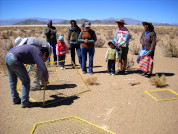
2. Based on a decade of monitoring in two shrub steppes with different vegetation composition in the Dry Puna Region of north-western Argentina, we evaluated average productivity, described its interannual variation associated with rainfall and analysed the influence of current and past rain and the previous year’s ANPP.
3. The ANPP of the herbaceous/shrubby steppe with steep relief was, on average, 751.84 kg DM.ha-1.year-1 (CV=67.66%). In the shrubby steppe of the plains was 480.65 kg DM.ha-1.year-1 (CV=40.27%). The former responded mainly to rainfall in the biomass harvest year; the latter, on rainfall in the year prior to harvest. In no case was the previous year’s ANPP a significant predictor in the models that considered rainfall. This suggests that, for the lowland shrub steppe, water legacies are more relevant than productivity legacies.
4. Implications. These findings highlight the importance of considering the functional composition of vegetation and rainfall in different periods to predict forage availability in the studied steppes. It is suggested that these prediction tools, together with local knowledge, would enable more efficient use of grassland. Shepherds, extension workers and policy makers could optimise livestock management planning, helping to strengthen the resilience of the pastoral system in the face of climate change.
References
Baldassini, P., J. N. Volante, L. M. Califano, and J. M. Paruelo 2012. Caracterización regional de la estructura y de la productividad de la vegetación de la Puna mediante el uso de imágenes MODIS. Ecología Austral 22(1):22-32. URL: tinyurl.com/mv89h87k.
Bianchi A. R., and C. E. Yañez 1992. Las precipitaciones en el noroeste argentino. Segunda edición. Instituto Nacional de Tecnología Agropecuaria. Estación Experimental Agropecuaria Salta.
Bianchi, A. R., C. E. Yáñez, and L. R. Acuña. 2005. Base de datos mensuales de precipitaciones del noroeste argentino. Proyecto Riesgo Agropecuario. Convenio INTA - SAGPyA. URL: tinyurl.com/42y5ptn9.
Boman, E. 1992. Antigüedades de la región andina de la República Argentina y del desierto de Atacama. Tomo II. Puna argentina, desierto de Atacama y provincia de Jujuy. UNJu, Jujuy. Traducción del original en francés: Antiquités de la Région Andine de la République Argentine et du désert d’Atacama. Imprimerie Nationale, París, 1908.
Bucci, S. J., F. G. Scholz, P. A. Iogna, and G. Goldstein. 2011. Economía del agua de especies arbustivas de las Estepas Patagónicas. Ecología Austral 21:43-60. URL: tinyurl.com/2vcbw4by.
Defossé, G., and M. Bertiller. 1991. Comparison of four methods of grassland productivity assessment based on Festuca pallescens phytomass data. Journal of Range Management 44(3):199-203. https://doi.org/10.2307/4002940.
Domínguez-Gómez, T. G., H. González-Rodríguez, R. G. Ramírez-Lozano, I. Cantú-Silva, et al. 2013. Nutritional Profile of Four Shrub Species, Northeastern Mexico. International Journal of Bio-Resource and Stress Management 4(1):1-8.
Du, Y., Y. Wang, D. Hui, F. Su, and J. Yan. 2022. Significant effects of precipitation frequency on soil respiration and its components - A global synthesis. Global Change Biology 29:1188-1205. https://doi/10.1111/gcb.16532.
Fang, G. H., J. Yang, Y. N. Chen, and C. Zammit. 2015. Comparing bias correction methods in downscaling meteorological variables for a hydrologic impact study in an arid area in China. Hydrol Earth Syst Sci 19:2547-2559. https://doi:10.5194/hess-19-2547-2015.
FAO. 2021. Pastoralism - Making variability work. FAO Animal Production and Health Paper No. 185. Rome. https://doi.org/10.4060/cb5855en.
Felton, A. J., I. J. Slette, M. D. Smith, and A.K. Knapp. 2019. Precipitation amount and event size interact to reduce ecosystem functioning during dry years in a mesic grassland. Global Change Biology 26:658-668. https://doi.org/10.1111/gcb.14789.
Gaitán, J., N. Ciano, G. Oliva, D. Bran, L. Butti, G. Cariac, et al. 2021. La variación temporal del índice NDVI predice los cambios temporales de la cobertura vegetal en las tierras secas de la Patagonia argentina. Ecosistemas 30(3):2229. https://doi.org/10.7818/ECOS.2229.
Gaitán, J. J., and L. Biancari. 2024. Nueva base de datos de precipitaciones mensuales de la República Argentina (PMRAv1), 2000-2022. Meteorológica 49:e032. https://doi.org/10.24215/1850468Xe032.
Huss, D. L., A. Bernardon, D. L. Anderson, and J. M. Braun. 1982. Manual de Capacitación en Manejo de Pastizales Naturales. INTA, Buenos Aires.
Li, T., J. Hu, L. Li, J. Liang, D. Li, and Q. Liu. 2024. Temporal Variation and Factors Influencing the Stability of NPP in Chinese Shrubland Ecosystems. Forests 15:531. https://doi.org/10.3390/f15030531.
Lüdecke, D., M. S. Ben-Shachar, I. Patil, P. Waggone, and D. Makowski. 2021. performance: An R Package for Assessment, Comparison and Testing of Statistical Models. Journal of Open-Source Software 6(60):3139. https://doi.org/10.21105/joss.03139.
Milner, C., and R. E. Hughes. 1968. Methods for the measurement of the Primary Production of Grassland. International Biological Program, Blackwell Scientific Publications, Oxford and Edinburgh.
Ministerio de Ambiente y Desarrollo Sostenible de la República Argentina, Secretaría de Cambio Climático, Desarrollo Sostenible e Innovación. 2022. Plan Nacional de Adaptación y Mitigación al Cambio Climático. Pp. 1285. Buenos Aires, Argentina. URL: tinyurl.com/3x7637w7.
Morales, M., A. C. Duncan, R. Neukom, F. Rojas, R. Villalba, et al. 2018. Variabilidad hidroclimática en el sur del Altiplano: pasado, presente y futuro. Pp. 75-91 en R. Grau, A. Izquierdo, J. Babot and A. Grau. (eds.). La Puna argentina geografía y ecología natural y cultural. Serie de Conservación de la Naturaleza 24, Ed. Fundación Miguel Lillo, San Miguel de Tucumán, Argentina. Libro digital, descarga y online: ISBN 978-950-668-032-9.
Ogle, K., and F. Reybolds. 2004. Plant responses to precipitation in desert ecosystems: integrating functional types, pulses, thresholds, and delays. Oecologia 141:282-294. https://doi.org/10.1007/s00442-004-1507-5.
Osem, Y., A. Perevolotsky, and J. Kigel. 2002. Grazing effect on diversity of annual plant communities in a semi-arid rangeland: interactions with small-scale spatial and temporal variation in primary productivity. Journal of Ecology 90:936-946. https://doi.org/10.1046/j.1365-2745.2002.00730.x.
Oesterheld, M., J. Loreti, M. Semmartin, and O. Sala. 2001. Inter-annual variation in primary production of semi-arid grassland related to the previous-year production. Journal of Vegetation Science 12:137-142. https://doi.org/10.1111/j.1654-1103.2001.tb02624.x.
Paruelo, J., R. Golluscio, J. Guerschman, A. Cesa, V. Jouve, and M. Garbulsky. 2004. Regional scale relationships between ecosystem structure and functioning: the case of the Patagonian steppes. Global Ecology and Biogeography 13:385-395. https://doi.org/10.1111/j.1466-822X.2004.00118.x.
Pezzani, F., F. Lezama, F. Gallego, L. López-Mársico, E. Leoni, B. Costa, G. Parodi, and A. L. Mello. 2017. El método de corte de biomasa genera mayores diferencias en la estimación de la productividad de pastizales que el tipo de pastizal. Rev. Argentina de Producción Animal 37 (1):21-32.
Quiroga Mendiola, M. 2015. Donde no se puede sembrar. La triple espacialidad pastoril en Suripujio, Puna de Jujuy, Argentina. Pp. 227-256 en A. Benedetti and J. Tomasi (comps.). Espacialidades altoandinas. Nuevos aportes desde la Argentina. Tomo I: Miradas hacia lo local, lo comunitario, lo doméstico. Editorial de la Facultad de Filosofía y Letras de la UBA. Buenos Aires, Argentina.
R Core Team. 2024. R: A Language and Environment for Statistical Computing. R Foundation for Statistical Computing, Vienna, Austria. URL: R-project.org.
Sala, O. E., L. A. Gherardi, L. Reichmann, E. Jobbágy, and D. Peters. 2012. Legacies of precipitation fluctuations on primary production: theory and data synthesis. Philosophical Transactions of the Royal Society B: Biological Sciences 367(1606):3135-3144. https://doi: 10.1098/rstb.2011.0347.
Sala, O. E., and F. T. Maestre. 2014. Grass-woodland transitions: determinants and consequences for ecosystem functioning and provisioning of services. J Ecol 102:1357-1362. https://doi.org/10.1111/1365-2745.12326.
Sandoval-Calderón, A. P., N. Rubio Echazarra, M. van Kuijk, P. A. Verweij, M. Soons, and Y. Hautier. 2024. The effect of livestock grazing on plant diversity and productivity of mountainous grasslands in South America - A meta-analysis. Ecology and Evolution 2024:14:e11076. https://doi.org/10.1002/ece3.11076.
Schaub. S., F. Finger, F. Leiber, S. Probst, M. Kreuzer, A. Weigelt, N. Buchmann, and M. Scherer-Lorenzen. 2020. Plant diversity effects on forage quality, yield and revenues of semi-natural grasslands. Nature Communications 1:768. https://doi.org/10.1038/s41467-020-14541-4.
Schwinning, S., O. E. Sala, M. E. Loik, and J. R. Ehleringer. 2004.Thresholds, memory, and seasonality: understanding pulse dynamics in arid/semi-arid ecosystems. Oecologia 141:191-193. https://doi.org/10.1007/s00442-004-1683-3.
Vorano, A. E., and J. R. Vargas Gil. 2002. Evaluación de la situación actual de los procesos de desertificación de la puna salto-jujeña. Instituto Nacional de Tecnología Agropecuaria (INTA). Estación Experimental Agropecuaria Salta (E.E.A. SALTA).
Wickham, H. 2017. ggplot2: Elegant Graphics for Data Analysis. Springer-Verlag New York. https://doi.org/10.18637/jss.v077.b02.
Yahdjian, L., and O. E. Sala. 2008. Climate Change Impacts on South American Rangelands. Rangelands 30(3). https://doi.org/10.2458/azu_rangelands_v30i3_yahdjian.
Yan, H., C. Liang, Z. Li, Z. Liu, B. Miao, C. He, et al. 2015. Impact of Precipitation Patterns on Biomass and Species Richness of Annuals in a Dry Steppe. PLoS ONE 10(4):e0125300. https://doi:10.1371/Journal.pone.0125300.
Zhan, W., X. Lian, J. Liu, and P. Gentine. 2022. Inappropriateness of space-for-time and variability-for-time approaches to infer future dryland productivity changes. Front Environ Sci 10:1010269. https://doi.org/10.3389/fenvs.2022.1010269.
Zhu, Y., H. Shen, D. Akinyemi, P. Zhang, Y. Feng, M. Zhao, J. Kang, X. Zhao, H. Hu, and J. Fang. 2022. Increased precipitation attenuates shrub encroachment by facilitating herbaceous growth in a Mongolian grassland. Functional Ecology 36:2356-2366. https://doi.org/10.1111/1365-2435.14100.
Downloads
Published
How to Cite
Issue
Section
License
Copyright (c) 2025 Mariana Quiroga Mendiola, Andrés Tálamo, Juan A. Quiroga Roger, Eduardo Ochner

This work is licensed under a Creative Commons Attribution 4.0 International License.
Authors retain their rights as follows: 1) by granting the journal the right to its first publication, and 2) by registering the published article with a Creative Commons Attribution License (CC-BY 4.0), which allows authors and third parties to view and use it as long as they clearly mention its origin (citation or reference, including authorship and first publication in this journal). Authors can make other non-exclusive distribution agreements as long as they clearly indicate their origin and are encouraged to widely share and disseminate the published version of their work.