Trifolium resupinatum maintains the flowering and the efficiency of arbuscular mycorrhizal symbiosis under water excess
DOI:
https://doi.org/10.25260/EA.26.36.2.0.2598Keywords:
persian clover, water stress, phosphorus uptake, arbuscular mycorrhizal colonizationAbstract
1. Phosphorus deficiency, water stress and the low frequency of legumes in the Salado River basin (Buenos Aires) affect forage production and, thus, livestock activity. Trifolium resupinatum L. may be considered a promising forage alternative.
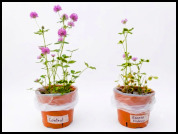
2. This study evaluated the tolerance of Trifolium resupinatum at the flowering stage to water excess, focusing on phosphorus mobilization in plant tissues and on the dynamics of its association with arbuscular mycorrhizal fungi. A greenhouse trial was conducted in pots with typical Natracuol soil, comparing adult plants subjected to waterlogging (water level 1 cm above the soil surface) with a control (80% of field capacity) for 27 days.
3. Waterlogging reduced shoot and root biomass by 34% and 29%, respectively, compared to control plants. Relative shoot and root growth rates decreased by 25% and 33%, respectively, under this stress, while specific root length increased by 48%.
4. A decrease in the number of leaves per pot and a 173% increase in root phosphorus concentration were also observed under waterlogging.
5. Arbuscules decreased by 44%, while vesicles and hyphae increased by 53% and 35%, respectively, under waterlogging.
6. Implications. These results indicate that Trifolium resupinatum develops adaptive responses that allow it to tolerate water excess in typical Natracuol soils, positioning it as a viable forage alternative for the Salado River basin region.
References
Antonelli, C. J., P. I. Calzadilla, J. M. Vilas, M. P. Campestre, F. J. Escaray, and O. A. Ruiz. 2019. Physiological and anatomical traits associated with tolerance to long‐term partial submergence stress in the Lotus genus: Responses of forage species, a model and an interspecific hybrid. Journal of Agronomy and Crop Science 205:65-76. https://doi.org/10.1111/jac.12303.
Barta, A. L. 1980. Regrowth and alcohol dehydrogenase activity in waterlogged alfalfa and birdsfoot trefoil 1. Agronomy Journal 72:1017-1020. https://doi.org/10.2134/agronj1980.00021962007200060036x.
Basavaraj, P. S., K. K. Jangid, R. Babar, V. M. Gangana Gowdra, A. Gangurde, S. Shinde, and M. Prabhakar. 2024. Adventitious root formation confers waterlogging tolerance in cowpea (Vigna unguiculata (L.) Walp.). Frontiers in Sustainable Food Systems 8:1373183. https://doi.org/10.3389/fsufs.2024.1373183.
Chippano, T., I. García, N. Cofré, and R. Mendoza. 2020. Forage biomass yield and arbuscular mycorrhizal symbiosis in a legume and C3 and C4 grasses under increasing soil phosphorus availability. Crop and Pasture Science 71:907-915. https://doi.org/10.1071/cp20030.
Chippano, T., R. Mendoza, N. Cofré, and I. García. 2021. Divergent root P uptake strategies of three temperate grassland forage species. Rhizosphere 17:100312. https://doi.org/10.1016/j.rhisph.2021.100312.
Colmer, T. D., and L. A. C. J. Voesenek. 2009. Flooding tolerance: suites of plant traits in variable environments. Functional Plant Biology 36:665-681. https://doi.org/10.1071/FP09144.
Dalle Carbonare, L., J. D. L. C. Jimenez, S. Lichtenauer, and H. van Veen. 2023. Plant responses to limited aeration: advances and future challenges. Plant Direct 7:e488. https://doi.org/10.1002/pld3.488.
Denton, M. D., D. R. Coventry, P. J. Murphy, J. G. Howieson, and W. D. Bellotti. 2002. Competition between inoculant and naturalised Rhizobium leguminosarum bv. trifolii for nodulation of annual clovers in alkaline soils. Australian Journal of Agricultural Research 53:1019-1026. https://doi.org/10.1071/AR01138.
Di Bella, C. E., P. A. García-Parisi, F. A. Lattanzi, M. Druille, H. Schnyder, and A. A. Grimoldi. 2019. Grass to legume facilitation in saline-sodic steppes: influence of vegetation seasonality and root symbionts. Plant and Soil 443:509-523. https://doi.org/10.1007/s11104-019-04247-y.
Diagne, N., M. Ngom, P. I. Djighaly, D. Fall, V. Hocher, and S. Svistoonoff. 2020. Roles of arbuscular mycorrhizal fungi on plant growth and performance: importance in biotic and abiotic stressed regulation. Diversity 12:370. https://doi.org/10.3390/d12100370.
Elzenga, J. T. M., and H. van Veen. 2010. Waterlogging and plant nutrient uptake. Pp. 23-35 en S. Mancuso and S. Shabala (eds.). Waterlogging signalling and tolerance in plants. Berlin, Heidelberg: Springer. https://doi.org/10.1007/978-3-642-10305-6_2.
Enkhbat, G., M. H. Ryan, P. G. Nichols, K. J. Foster, Y. Inukai, and W. Erskine. 2022. Petiole length reduction is an indicator of waterlogging stress for Trifolium subterraneum ssp. yanninicum. Plant and Soil 475:645-667. https://doi.org/10.1007/s11104-022-05404-6.
Enkhbat, G., Y. Inukai, P. G. Nichols, J. Pang, W. Erskine, K. J. Foster, and M. H. Ryan. 2023. Response to water‐deficit following waterlogging varies among ecotypes of subterranean clover (Trifolium subterraneum ssp. yanninicum), a waterlogging‐tolerant annual pasture legume. Annals of Applied Biology 183:287-301. https://doi.org/10.1111/aab.12856.
Fougnies, L., S. Renciot, F. Muller, C. Plenchette, Y. Prin, S. M. De Faria, and A. M. Bâ. 2007. Arbuscular mycorrhizal colonization and nodulation improve flooding tolerance in Pterocarpus officinalis Jacq. seedlings. Mycorrhiza 17:159-166. https://doi.org/10.1007/s00572-006-0085-2.
García, I. 2025. Lotus tenuis in association with arbuscular mycorrhizal fungi is more tolerant to partial submergence than to high-intensity defoliation. International Journal of Plant Biology 16:47. https://doi.org/10.3390/ijpb16020047.
García, I. V. 2021. Lotus tenuis and Schedonorus arundinaceus co-culture exposed to defoliation and water stress. Revista de la Facultad de Ciencias Agrarias UNCuyo 53:100-108. https://doi.org/10.48162/rev.39.044.
García, I., and R. Mendoza. 2014. Lotus tenuis seedlings subjected to drought or waterlogging in a saline sodic soil. Environmental and Experimental Botany 98:47-55. https://doi.org/10.1016/j.envexpbot.2013.10.002.
García, I., R. Mendoza, and M. C. Pomar. 2008. Deficit and excess of soil water impact on plant growth of Lotus tenuis by affecting nutrient uptake and arbuscular mycorrhizal symbiosis. Plant and Soil 304:117-131. https://doi.org/10.1007/s11104-007-9526-8.
Gibberd, M. R., and P. S. Cocks. 1997. Effect of waterlogging and soil pH on the micro-distribution of naturalised annual legumes. Australian Journal of Agricultural Research 48:223-230. https://doi.org/10.1071/A96074.
Gibberd, M. R., J. D. Gray, P. S. Cocks, and T. D. Colmer. 2001. Waterlogging tolerance among a diverse range of Trifolium accessions is related to root porosity, lateral root formation and ‘aerotropic rooting’. Annals of Botany 88:579-589. https://doi.org/10.1006/anbo.2001.1506.
Hiler, E. A., C. H. M. Van Babel, M. M. Hossain, and W. R. Jordan. 1972. Sensitivity of Southern peas to plant water deficit at three growth stages. Agronomy Journal 64:60-64. https://doi.org/10.2134/agronj1972.00021962006400010020x.
Jackson, M. L. 1958. Soil chemical analysis. Pp. 80 en C. A. Black, D. D. Evans, J. R. White, G. E. Ensminger and F. E. Clarck (eds.). Method of soil analysis. Part 2. Chemical and microbiological properties. Prentice Hall, Englewood Cliffs.
Jacobo, E. J., Rodríguez, A. M., Bartoloni, N., and V. A. Deregibus. 2006. Rotational grazing effects on rangeland vegetation at a farm scale. Rangeland Ecology and Management 59(3):249-257. https://doi.org/10.2111/05-129R1.1.
Konnerup, D., G. Toro, O. Pedersen, and T. D. Colmer. 2018. Waterlogging tolerance, tissue nitrogen and oxygen transport in the forage legume Melilotus siculus: a comparison of nodulated and nitrate-fed plants. Annals of Botany 121:699-709. https://doi.org/10.1093/aob/mcx202.
Loo, W. T., K. O. Chua, P. Mazumdar, A. Cheng, N. Osman, and J. A. Harikrishna. 2022. Arbuscular mycorrhizal symbiosis: a strategy for mitigating the impacts of climate change on tropical legume crops. Plants 11:2875. https://doi.org/10.3390/plants11212875.
McGonigle, T. P., M. H. Miller, D. G. Evans, G. L. Fairchild, and J. A. Swan. 1990. A new method which gives an objective measure of colonization of roots by vesicular-arbuscular mycorrhizal fungi. New Phytologist 115:495-501. https://doi.org/10.1111/j.1469-8137.1990.tb00476.x.
Mendoza, R. E., I. V. García, L. de Cabo, C. F. Weigandt, and A. F. de Iorio. 2015. The interaction of heavy metals and nutrients present in soil and native plants with arbuscular mycorrhizae on the riverside in the Matanza-Riachuelo River Basin (Argentina). Science of the Total Environment 505:555-564. https://doi.org/10.1016/j.scitotenv.2014.09.105.
Mendoza, R., M. Bailleres, I. García, and O. Ruiz. 2016. Phosphorus fertilization of a grass-legume mixture: effect on plant growth, nutrients acquisition and symbiotic associations with soil microorganisms. Journal of Plant Nutrition 39:691-701. https://doi.org/10.1080/01904167.2015.1087032.
Mendoza, R., V. Escudero, and I. García. 2005. Plant growth, nutrient acquisition and mycorrhizal symbioses of a waterlogging tolerant legume (Lotus glaber Mill.) in a saline-sodic soil. Plant and Soil 275:305-315. https://doi.org/10.1007/s11104-005-2501-3.
Nguyen, T. T., S. Navarrete, D. J. Horne, D. J. Donaghy, and P. D. Kemp. 2022. Incorporating plantain with perennial ryegrass-white clover in a dairy grazing system: dry matter yield, botanical composition, and nutritive value response to sowing rate, plantain content and season. Agronomy 12:2789. https://doi.org/10.3390/agronomy12112789.
Orchard, S., R. J. Standish, D. Nicol, V. V. S. R. Gupta, and M. H. Ryan. 2016. The response of fine root endophyte (Glomus tenue) to waterlogging is dependent on host plant species and soil type. Plant and Soil 403:305-315. https://doi.org/10.1007/s11104-016-2804-6.
Pampana, S., A. Masoni, and I. Arduini. 2016. Response of cool-season grain legumes to waterlogging at flowering. Canadian Journal of Plant Science 96:597-603. https://doi.org/10.1139/cjps-2015-0268.
Phillips, J. M., and D. S. Hayman. 1970. Improved procedures for clearing roots and staining parasitic and vesicular-arbuscular mycorrhizal fungi for rapid assessment of infection. Transactions of the British Mycological Society 55:158-IN18. https://doi.org/10.1016/S0007-1536(70)80110-3.
Ryan, M. H., M. E. McCully, and C. X. Huang. 2003. Location and quantification of phosphorus and other elements in fully hydrated, soil‐grown arbuscular mycorrhizas: a cryo‐analytical scanning electron microscopy study. New Phytologist 160:429-441. https://doi.org/10.1007/s11104-004-1611-7.
Seguí, M. 2020. Evaluación de la respuesta a la fertilización otoñal en la Estepa de Halófitas de un pastizal de la Cuenca del Salado. Tesis doctoral, Universidad Nacional de La Plata. Pp. 4-6.
Smith, J. T., B. W. Allred, C. S. Boyd, K. W. Davies, A. R. Kleinhesselink, S. L. Morford, and D. E. Naugle. 2023. Fire needs annual grasses more than annual grasses need fire. Biological Conservation 286:110299. https://doi.org/10.1016/j.biocon.2023.110299.
Smith, S. E., and D. J. Read. 2008. Mycorrhizal symbiosis. Academic Press.
Spara, A. F. 2001. Evaluación agronómica de tres especies del género Trifolium de reciente introducción en la Argentina. I: Determinación de la producción de forraje. II: Estimación de la capacidad simbiótica. Ingeniero Agrónomo (tesis doctoral). Universidad Nacional de Luján. Pp. 5-6.
Striker, G. G., and T. D. Colmer. 2017. Flooding tolerance of forage legumes. Journal of Experimental Botany 68:1851-1872. https://doi.org/10.1093/jxb/erw239.
Tian, J., G. Boitt, A. Black, S. Wakelin, L. M. Condron, and L. Chen. 2017. Accumulation and distribution of phosphorus in the soil profile under fertilized grazed pasture. Agriculture Ecosystems and Environment 239:228-235. https://doi.org/10.3390/biology10020158.
Tian, J., G. Dong, R. Karthikeyan, L. Li, and R. D. Harmel. 2017. Phosphorus dynamics in long-term flooded, drained, and reflooded soils. Water 9(7):531. https://doi.org/10.3390/w9070531.
Downloads
Published
How to Cite
Issue
Section
License
Copyright (c) 2026 Yudith García-Ramírez, Noelia Cofré, Ileana García

This work is licensed under a Creative Commons Attribution 4.0 International License.
Authors retain their rights as follows: 1) by granting the journal the right to its first publication, and 2) by registering the published article with a Creative Commons Attribution License (CC-BY 4.0), which allows authors and third parties to view and use it as long as they clearly mention its origin (citation or reference, including authorship and first publication in this journal). Authors can make other non-exclusive distribution agreements as long as they clearly indicate their origin and are encouraged to widely share and disseminate the published version of their work.