Effects of the presence and the chemical control of Ulmus pumila L. on the oribatid mite community: Implications for conservation
DOI:
https://doi.org/10.25260/EA.26.36.2.0.2639Keywords:
invasive alien species, herbicides, glyphosate, aminopyralid, triclopyr, bioindicatorAbstract
1. Invasive alien species (IAS) are one of the main factors contributing to the decline of biodiversity and ecosystem services worldwide. These plant species have profound effects on the structure and functioning of ecosystems, including significant alterations in soil communities. Given this scenario, chemical control is one of the primary tools for managing these species, although its application raises questions about potential adverse effects on non-target organisms. Ulmus pumila L. (Siberian elm) is present in Argentina; it is a woody IAS with a history of invasion in various countries. However, the impacts that it causes on the environments it invades remain poorly understood.
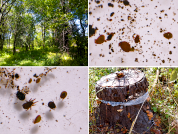
2. This study evaluated the effect of the presence of U. pumila and the application of chemical control techniques on the abundance of oribatid mites, which are used as an indicator of soil health. Soil samples were collected in native forests and in areas with Siberian elm trees of various ages. Samples were also collected at sites where chemical control techniques were applied and at sites where herbicide spill accidents were simulated.
3. The results showed that forests with adult U. pumila individuals had a higher abundance of oribatid mites compared to native forests, which could be associated with changes in the quantity and quality of the litter.
4. Proper herbicide application did not affect the abundance of these organisms.
5. Implications. This study provides key evidence for the management of U. pumila and other woody invasive alien species in ecological restoration contexts.
References
Abgrall, C., E. Forey, and M. Chauvat. 2019. Soil fauna responses to invasive alien plants are determined by trophic groups and habitat structure: a global meta-analysis. Oikos 128(10):1390-1401. https://doi.org/10.1111/oik.06493.
Andreasen, C., K. Høgh, and M. L. Jensen. 2020. The effect of foliar and soil application of Flufenacet and Prosulfocarb on Italian ryegrass (Lolium multiflorum L.) control. Agriculture 10(11):552. https://doi.org/10.3390/agriculture10110552.
Arana, M., E. Natale., N. Ferretti, G. Romano, A. Oggero, et al. 2021. Esquema biogeográfico de la República Argentina. Primera edición. Fundación Miguel Lillo. Tucumán, Argentina. Archivo Digital: 978-950-668-039-8.
Barker, A., and F. Dayan. 2019. Fate of glyphosate during production and processing of glyphosate-resistant sugar beet. Journal of Agricultural and Food Chemistry 67(7):2061-2065. https://doi.org/10.1021/acs.jafc.8b05672.
Bartz, R., and I. Kowarik. 2019. Assessing the environmental impacts of invasive alien plants: a review of assessment approaches. NeoBiota 43:69-99. https://doi.org/10.3897/neobiota.43.30122.
Beaumelle, L., L. Tison, N. Eisenhauer, J. Hines, S. Malladi, et al. 2023. Pesticide effects on soil fauna communities - A meta-analysis. Journal of Applied Ecology 60:1239-1253. https://doi.org/10.1111/1365-2664.14437.
Bedano, J. C., L. Sacchi, E. Natale, and H. Reinoso. 2014. Saltcedar (Tamarix ramosissima) invasion alters decomposer fauna and plant litter decomposition in a temperate xerophytic deciduous forest. Advances in Ecology 2014:519297. https://doi.org/10.1155/2014/519297.
Bedano, J. C., M. Cantú, and M. Doucet. 2006. Influence of three different land management practices on soil mite (Arachnida: Acari) densities in relation to a natural soil. Applied Soil Ecology 32(3):293-304. https://doi.org/10.1016/j.apsoil.2005.07.009.
Bellard, C., P. Genovesi, and J. M. Jeschke. 2016 Global patterns in threats to vertebrates by biological invasions. Proc R Soc B 283:20152454. https://doi.org/10.1098/rspb.2015.2454.
Bergeron, P., and R. Schmidt-Jeffris. 2023. Herbicides harm key orchard predatory mites. Insects 14(5):480. https://doi.org/10.3390/insects14050480.
Bertolasi, B., C. Leonarduzzi, A. Piotti, S. Leonardi, L. Zago, et al. 2015. A last stand in the Po valley: genetic structure and gene flow patterns in Ulmus minor and U. pumila. Annals of Botany 115(4):683-692. https://doi.org/10.1093/aob/mcu256.
Brunet, J., J. E. Zalapa, F. Peccori, and A. Santini. 2013. Hybridization and introgression between exotic Siberian elm, Ulmus pumila, and the native Field elm, U. minor, in Italy. Biological Invasions 15:2717-2730. https://doi.org/10.1007/s10530-013-0486-z.
Cabra-Rivas, I., P. Castro Díez, and A. Saldaña López. 2015. Análisis de la invasión del hábitat ribereño por tres árboles exóticos en España. Ecosistemas 24(1):18-28. https://doi.org/10.7818/ECOS.2015.24-1.04.
Capitanelli, R. 1979. Clima. Pp. 45-138 en J. B. Vázquez, R. A. Miatello R.A. and M. E. Roqué (eds.). Geografía física de la Provincia de Córdoba. Editorial Boldt, Córdoba. Argentina.
Coyle, D. R., J. Nagendra, M. K. Taylor, J. H. Campbell, C. E. Cunard, et al. 2017. Soil fauna responses to natural disturbances, invasive species, and global climate change: Current state of the science and a call to action. Soil Biology and Biochemistry 110:116-133. https://doi.org/10.1016/j.soilbio.2017.03.008.
Cuevas, Y. A., and S. M. Zalba. 2010. Recovery of Native Grasslands after Removing Invasive Pines Restoration Ecology 18(5):711-716. https://doi.org/10.1111/j.1526-100X.2008.00506.x.
Di Marzio, W., M. E. Sáenz, J. Alberdi, N. Fortunato, M. Tangorra, et al. 2009. Estrategia de manejo de acacia negra (Gleditsia triacanthos) en la cuenca del río Luján. Evaluación ecotoxicológica del herbicida Togar BT. Revista Argentina de Ecotoxicología y Contaminación Ambiental 1(1):1-7.
Di Rienzo, J. A., F. Casanoves, M. G. Balzarini, L. González, and M. Tablada. 2020. InfoStat versión estudiantil [Software]. Grupo InfoStat, FCA, Universidad Nacional de Córdoba, Córdoba, Argentina. URL: https://bit.ly/42R8fVj.
Díaz, S., J. Settele, E. Brondízio, H. Ngo, J. Agard, et al. 2019. Pervasive human-driven decline of life on Earth points to the need for transformative change. Science 366(6471):eaax3100. https://doi.org/10.1126/science.aax3100.
Doublet, J., L. Mamy, and E. Barriuso. 2009. Delayed degradation in soil of foliar herbicides glyphosate and sulcotrione previously absorbed by plants: consequences on herbicide fate and risk assessment. Chemosphere 77(4):582-589. https://doi.org/10.1016/j.chemosphere.2009.06.044.
Fadin, D., V. Tornisielo, A. Barroso, S. Ramos, F. Dos Reis, et al. 2018. Absorption and translocation of glyphosate in Spermacoce verticillata and alternative herbicide control. Weed Research 58(5):389-396. https://doi.org/10.1111/wre.12329.
Fanin, N., S. Bezaud, J. Sarneel, S. Cecchini, M. Nicolas, et al. 2019. Relative importance of climate, soil and plant functional traits during the early decomposition stage of standardized litter. Ecosystems 23:1004-1018. https://doi.org/10.1007/s10021-019-00452-z.
Gainer, A., N. Hogan, and S. Siciliano. 2019. Soil invertebrate avoidance behavior identifies petroleum hydrocarbon contaminated soils toxic to sensitive plant species. Journal of Hazardous Materials 361:338-347. https://doi.org/10.1016/j.jhazmat.2018.08.086.
Gann, G., T. McDonald, B. Walder, J. Aronson, C. Nelson, et al. 2019. International principles and standards for the practice of ecological restoration. Second Edition. Restoration Ecology 27(S1):S1-S46. https://doi.org/10.1111/rec.13035.
Gergócs, V., and L. Hufnagel. 2016. The effect of microarthropods on litter decomposition depends on litter quality. European Journal of Soil Biology 75:24-30. https://doi.org/10.1016/j.ejsobi.2016.04.008.
Gergócs, V., and L. Hufnagel. 2017. Comparing the natural variation of oribatid mite communities with their changes associated with anthropogenic disturbance. Environmental Monitoring and Assessment 189:203. https://doi.org/10.1007/s10661-017-5897-3.
Gioria, M., P. Hulme, D. Richardson, and P. Pyšek. 2023. Why are Invasive plants successful? Annual Review of Plant Biology 74:635-670. https://doi.org/10.1146/annurev-arplant-070522-071021.
González Ortega, E., and M. H. Fuentes Ponce. 2022. Dinámica del glifosato en el suelo y sus efectos en la microbiota. Revista Internacional de Contaminación Ambiental 38:127-144. https://doi.org/10.20937/RICA.54197.
Gutiérrez-López, M., E. Ranera, M. Novo, R. Fernández, and D. Trigo. 2014. Does the invasion of the exotic tree Ailanthus altissima affect the soil arthropod community? The case of a riparian forest of the Henares River (Madrid). European Journal of Soil Biology 62:39-48. https://doi.org/10.1016/j.ejsobi.2014.02.010.
Hasegawa, M. 2001. The relationship between the organic matter composition of a forest floor and the structure of a soil arthropod community. European Journal of Soil Biology 37(4):281-284. https://doi.org/10.1016/S1164-5563(01)01099-8.
Haubrock, P. J., M. Novello, N. Angelo Abreo, D. Błońska, A. C. Sampaio Franco, et al. 2025. A global account of established non-native fish species. Global Change Biology 31:e70451. https://doi.org/10.1111/gcb.70451.
INBIAR. 2021. Segundo Inventario Nacional de Bosques Nativos. Ministerio de Ambiente y Desarrollo Sostenible. URL: tinyurl.com/4tfkxujr.
IDECOR. 2025. Cartas de suelos de Córdoba. Hoja 3363-19 “Río Cuarto”. Ministerio de Bioagroindustria, Provincia de Córdoba. URL: tinyurl.com/3unpjhfw.
Isbell, F., P. Balvanera, A. Mori, J. He, J. Bullock, et al. 2023. Expert perspectives on global biodiversity loss and its drivers and impacts on people. Frontiers in Ecology and the Environment 21(2):94-103. https://doi.org/10.1002/fee.2536.
Jaureguiberry, P., N. Titeux, M. Wiemers, D. Bowler, L. Coscieme, et al. 2022. The direct drivers of recent global anthropogenic biodiversity loss. Science Advances 8:eabm9982. https://doi.org/10.1126/sciadv.abm9982.
Jimmo, A., K. Isbister, E. Lamb, S. Siciliano, and K. J. Stewart. 2018. Linking herbicide dissipation to soil ecological risk along transmission rights‐of‐way in the Yukon Territory, Canada. Journal of Environmental Quality 47(6):1356-1364. https://doi.org/10.2134/jeq2018.01.0053.
Junggebauer, A., C. Bluhm, G. Erdmann, S. Bluhm, M. Pollierer, et al. 2024. Temporal variation of soil microarthropods in different foresttypes and regions of central Europe. Oikos:e10513. https://doi.org/10.1111/oik.10513.
Kohyt, J., and P. Skubała. 2020. Oribatid mite (Acari: Oribatida) communities reveal the negative impact of the red oak (Quercus rubra L.) on soil fauna in Polish commercial forests. Pedobiologia - Journal of Soil Ecology 79:150594. https://doi.org/10.1016/j.pedobi.2019.150594.
Kooch, Y., M. Tavakoli, and M. Akbarinia. 2018. Tree species could have substantial consequences on topsoil fauna: a feedback of land degradation/restoration. European Journal of Forest Research 137(12). https://doi.org/10.1007/s10342-018-1140-1.
Koudela, M., M. Soukupová, E. Jablonská, T. Šmrhová, T. Engl, et al. 2025. Ability of soil microorganisms to degrade aminopyralid and its effect on their growth. Plant, Soil and Environment 71:58-65. https://doi.org/10.17221/586/2024-PSE.
Lamers, J. P., C. Martius, A. Khamzina, M. Matkarimova, D. Djumaeva, et al. 2010. Green foliage decomposition in tree plantations on degraded, irrigated croplands in Uzbekistan, Central Asia. Nutrient Cycling in Agroecosystems 87(2):249-260. https://doi.org/10.1007/s10705-009-9336-x.
Lehmitz, R., D. Russell, K. Hohberg, A. Christian, and W. E. Xylander. 2012. Active dispersal of oribatid mites into young soils. Applied Soil Ecology 55:10-19. https://doi.org/10.1016/j.apsoil.2011.12.003.
Lussenhop, J. 1992. Mechanisms of microarthropod-microbial interactions in soil. Advances in Ecological Research 23:1-33. https://doi.org/10.1016/S0065-2504(08)60145-2.
Maaß, S., T. Caruso, and M.C. Rillig. 2015. Functional role of microarthropods in soil aggregation. Pedobiologia 58(2-3):59-63. https://doi.org/10.1016/j.pedobi.2015.03.001.
Manu, M., V. Honciuc, A. Neagoe, R. Băncilă, V. Iordache, et al. 2019. Soil mite communities (Acari: Mesostigmata, Oribatida) as bioindicators for environmental conditions from polluted soils. Scientific Reports 9:20250. https://doi.org/10.1038/s41598-019-56700-8.
McCary, M., and D.H. Wise. 2019. Plant invader alters soil food web via changes to fungal resources. Oecologia 91(3):587-599. https://doi.org/10.1007/s00442-019-04510-0.
McGeoch, M. A., D. Clarke, N. Avinash Mungi, and A. Ordonez. 2024. A nature-positive future with biological invasions: theory, decision support and research needs. Philosophical Transactions of The Royal Society B 379:20230014. https://doi.org/10.1098/rstb.2023.0014.
McGrath, D.A., and M.A. Binkley. 2009. Microstegium vimineum invasion changes soil chemistry and microarthropod communities in Cumberland Plateau forests. Southeastern Naturalist 8(1):141-156. https://doi.org/10.1656/058.008.0113.
Mehdizadeh, M., W. Mushtaq, S. Siddiqui, S. Ayadi, P. Kaur, et al. 2021. Herbicide residues in agroecosystems: fate, detection and effect on non-target plants. Reviews in Agricultural Science 9:157-167. https://doi.org/10.7831/ras.9.0157.
Mito, T., and T. Uesugi. 2004. Invasive Alien Species in Japan: The status quo and the new regulation for prevention of their adverse effects. Global Environmental Research 8(1):1-14.
Mohammed, A. M., O. Umeozor, and T. Gbarakoro. 2017. The effects of Glyphosate and Multrazine on the abundance and diversity of soil microarthropods at the University Park, University of Port-Harcourt, Nigeria. European Journal of Experimental Biology 7(1:2). https://doi.org/10.21767/2248-9215.100002.
Morgado, R., S. Loureiro, and M. N. González-Alcaraz. 2018. Chapter 3—Changes in soil ecosystem structure and functions due to soil contamination. Pp. 59-87 en A. C. Duarte, A. Cachada and T. Rocha-Santos (eds.). Soil pollution. Academic Press, Elsevier. https://doi.org/10.1016/B978-0-12-849873-6.00012-1.
Motard, E., S. Dusz, B. Geslin, M. Akpa-Vinceslas, C. Hignard, et al. 2015. How invasion by Ailanthus altissima transforms soil and litter communities in a temperate forest ecosystem. Biological Invasions 17:1817-1832. https://doi.org/10.1007/s10530-014-0838-3.
Muratore, M. N. 2025. Evaluación del potencial de Azospirillum en la mitigación de impactos ambientales negativos de las técnicas de control químico para especies exóticas invasoras. Tesis doctoral. Universidad Nacional de Río Cuarto, Córdoba, Argentina. Pp. 30. URL: tinyurl.com/ks9ejzxm.
Natale, E., M. Arana, G. Villalba, H. Reinoso, M. de la Reta, and A. Oggero. 2019. Caracterización y Estado de Conservación de la vegetación ribereña de la cuenca media del río Cuarto (Córdoba, Argentina). Boletín de la Sociedad Argentina de Botánica 54:105-123. https://doi.org/10.31055/1851.2372.v54.n1.23589.
Nyssen, B., J. Ouden, A. Bindewald, P. Brancalion, K. Kremer, et al. 2024. Established invasive tree species offer opportunities for forest resilience to climate change. Current Foresty Reports 10:456-486. https://doi.org/10.1007/s40725-024-00232-6.
Ojala, R., and V. Huhta. 2001. Dispersal of microarthropods in forest soil. Pedobiologia 45(5):443-450. https://doi.org/10.1078/0031-4056-00098.
Pearson, B., M. Minor, A. Robertson, A. Clavijo McCormick. 2024. Plant invasion down under: exploring the below-ground impact of invasive plant species on soil properties and invertebrate communities in the Central Plateau of New Zealand. Biological Invasions 26:4215-4228. https://doi.org/10.1007/s10530-024-03441-z.
Pelosi, C. S. Barot, Y. Capowiez, M. Hedde, and F. Vandenbulcke. 2014. Pesticides and earthworms. A review. Agronomy for Sustainable Development 34:199-228. https://doi.org/10.1007/s13593-013-0151-z.
Pyšek, P., P. E. Hulme, D. Simberloff, S. Bacher T. M. Blackburn, et al. 2020. Scientists’ warning on invasive alien species. Biological Reviews 95:1511-1534. https://doi.org/10.1111/brv.12627.
R Core Team. 2022. R: A language and environment for statistical computing. R. Foundation for Statistical Computing, Vienna, Austria. URL: bit.ly/3KMv4Dm.
Richardson, D. M., C. Hui, M. A. Nuñez, and A. Pauchard. 2014. Tree invasions: patterns, processes, challenges and opportunities. Biological Invasions 16:473-81. https://doi.org/10.1007/s10530-013-0606-9.
Rodgers, V. L., S. Scanga, M. Kolozsvary, D. Garneau, J. Kilgore, et al. 2022. Where is garlic mustard? Understanding the ecological context for invasions of Alliaria petiolata. BioScience 72(6):521-537. https://doi.org/10.1093/biosci/biac012.
Sandler, R. V., L. B. Falco, C. Di Ciocco, R. De Luca, and C. E. Coviella. 2010. Eficiencia del embudo Berlese-Tullgren para extracción de artrópodos edáficos en suelos Argiudoles típicos de la provincia de Buenos Aires. Ciencia del Suelo 28(1):1-7. Versión On-line ISSN 1850-2067.
Sharma, A., A. Shukla, K. Attri, M. Kumar, P. Kumar, et al. 2020. Global trends in pesticides: A looming threat and viable alternatives. Ecotoxicology and Environmental Safety 201:110812. https://doi.org/10.1016/j.ecoenv.2020.110812.
Southwood, T. R., and P. A. Henderson. 2000. Ecological methods. Third edition. Blackwell Science, Oxford, UK.
Spalazzi, M., T. Milani, C. Nuñez, M. A. Nuñez, and F. Teste. 2024. Injection-based approaches for controlling Douglas-fir (Pseudotsuga menziesii) invasion in conservation efforts of the Patagonian forest. Invasive Plant Science and Management 17(2):104-113. https://doi.org/10.1017/inp.2024.11.
St. John, M. G., K. H. Orwin, and I. A. Dickie. 2011. No ‘home’ versus ‘away’ effects of decomposition found in a grassland-forest reciprocal litter transplant study. Soil Biology and Biochemistry 43(7):1482-1489. https://doi.org/10.1016/j.soilbio.2011.03.022.
Stinner, B. R., and G. J. House. 1990. Arthropods and other invertebrates in conservation-tillage agriculture. Annual Review of Entomology 35:299-318. https://doi.org/10.1146/annurev.en.35.010190.001503.
Strayer, D., V. Eviner, J. Jeschke, and M. Pace. 2006. Understanding the long-term effects of species invasions. Trends in Ecology and Evolution 21(11):645-651. https://doi.org/10.1016/j.tree.2006.07.007.
Strayer, D. L. 2020. Non-native species have multiple abundance-impact curves. Ecology and Evolution 10:6833-6843. https://doi.org/10.1002/ece3.6364.
Tu, M., C. Hurd, R. Robison, and J. M. Randall. 2001. Triclopyr. Pp. 7k1-7k7 en J. M. Randall and M. Hoshovsky (eds.). Weed control methods handbook: Tools and techniques for use in natural areas. The Nature Conservancy. All U.S. Government Documents (Utah Regional Depository). URL: digitalcommons.usu.edu/govdocs/533.
United States Department of Agriculture. 2017. Field guide for managing Siberian Elm in the Southwest. URL: http://bit.ly/484kxx6.
University of Hertfordshire. 2026. Aminopyralid (XDE 750). Pesticide Properties DataBase. URL: tinyurl.com/4evzupjf.
Voinorosky, C., K. Standen, and K. Stewart. 2022. Environmental impact of triclopyr on habitat quality in boreal rights‐of‐way. Environmental Toxicology and Chemistry 41(12):2955-2967. https://doi.org/10.1002/etc.5475.
Wehner, K., M. Heethoff, and A. Brückner. 2018. Seasonal fluctuation of oribatid mite communities in forest microhabitats. PeerJ 6:e4863. https://doi.org/10.7717/peerj.4863.
Weidlich, E. W., F. Flórido, T. Sorrini, and P. Brancalion. 2020. Controlling invasive plant species in ecological restoration: A global review. Journal of Applied Ecology 57:1806-1817. https://doi.org/10.1111/1365-2664.13656
Wesche, K., D. Walther, H. von Wehrden, and E. Hensen. 2011. Trees in the desert: Reproduction and genetic structure of fragmented Ulmus pumila forests in Mongolian drylands. Flora 206(2):91-99. https://doi.org/10.1016/j.flora.2010.01.012.
Wiatrowska, B., P. Kurek, T. Rutkowski, A. Napierała, P. Sienkiewicz, et al. 2024. Consequences of Spiraea tomentosa invasion in Uropodina mite (Acari: Mesostigmata) communities in wet Meadows. Experimental and Applied Acarology 93:609-626. https://doi.org/10.1007/s10493-024-00951-2
Wickham, H. 2016. ggplot2: Elegant Graphics for Data Analysis. Springer. https://doi.org/10.1007/978-0-387-98141-3.
Yang, R., J. Dong, C., C. Li, L. Wang, Q. Quan, et al. 2021. The decomposition process and nutrient release of invasive plant litter regulated by nutrient enrichment and water level change. PLoS ONE 16(5):e0250880. https://doi.org/10.1371/journal.pone.0250880.
Zaller, J. G., F. Heigl, L. Ruess, and A. Grabmaier. 2014. Glyphosate herbicide affects belowground interactions between earthworms and symbiotic mycorrhizal fungi in a model ecosystem. Scientific Reports 4:5634. https://doi.org/10.1038/srep05634.
Zeballos, S. R., M. A. Giorgis, M. R. Cabido, A. T. Acosta, M. R. Iglesias, et al. 2018. The lowland seasonally dry subtropical forests in central Argentina: Vegetation types and a call for conservation. Applied Vegetation Science 21(2):315-329. https://doi.org/10.1111/avsc.12355.
Zhang, P., B. Li, J. Wu, and S. Hu. 2018. Invasive plants differentially affect soil biota through litter and rhizosphere pathways: a meta-analysis. Ecology Letters. https://doi.org/10.1111/ele.13181.
Ziska, L. H. 2016. The role of climate change and increasing atmospheric carbon dioxide on weed management: Herbicide efficacy. Agriculture, Ecosystems and Environment 231(1):304-309. https://doi.org/10.1016/j.agee.2016.07.014.
Downloads
Additional Files
Published
How to Cite
Issue
Section
License
Copyright (c) 2026 Melina N. Muratore, Héctor J. Escudero, José C. Bedano, Claudia N. Travaglia, Evangelina S. Natale

This work is licensed under a Creative Commons Attribution 4.0 International License.
Authors retain their rights as follows: 1) by granting the journal the right to its first publication, and 2) by registering the published article with a Creative Commons Attribution License (CC-BY 4.0), which allows authors and third parties to view and use it as long as they clearly mention its origin (citation or reference, including authorship and first publication in this journal). Authors can make other non-exclusive distribution agreements as long as they clearly indicate their origin and are encouraged to widely share and disseminate the published version of their work.