What do we know about invasive alien arthropods in northeastern Argentina? Bibliographic records and knowledge gaps
DOI:
https://doi.org/10.25260/EA.26.36.3.0.2678Keywords:
invasive alien species, NEA Region, insects, biological invasionsAbstract
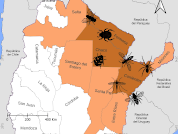
1. Invasive alien species (IAS) are organisms that rapidly expand beyond their original range, generating ecological, economic and social impacts. In the case of arthropods, their effects on human health, food production and the economy are often underestimated, despite being one of the taxonomic groups with the highest number of invasive species worldwide. The aim of this study is to assess the state of knowledge on invasive and potentially invasive arthropods in three provinces of the Northeastern Argentina Region (NEA), through the integration of official records and scientific literature.
2. Bibliographic searches were conducted based on the official list of IAS and academic search engines to determine the distribution of invasive exotic arthropods, focusing on three provinces in northeastern Argentina: Chaco, Corrientes and Formosa. Additionally, both adjacent provinces and other regions were considered due to the high invasion potential of certain arthropod species.
3. A total of 45 invasive alien arthropod species was recorded, representing ~6% of the official list. These species belong to four taxonomic classes (Cirripedia, Copepoda, Malacostraca and Insecta), with Insecta being the most represented. The review identified 13 new records for the region, resulting in a total of 19 invasive and potentially invasive species in the studied provinces.
4. Implications. This work highlights the importance of a regional approach to the problem and suggests the need to develop tools and early detection mechanisms to reduce the introduction of unwanted species. It promotes collaboration among scientists, citizens and management agencies. These actions are necessary to support decision-making and establishment of management priorities at regional and national levels.
References
Agnolin, F., A. Agnolin, J. García-Marsà, and N. Olejnik. 2020. Invertebrados exóticos nuevos o poco conocidos (Tricladida, Gastropoda, Diplopoda, Symphyla, Isopoda, Arachnida) en la Ciudad de Buenos Aires, Argentina. Acta Zoológica Lilloana 64(1):13-29. https://doi.org/10.30550/j.azl/2020.64.1/2.
Bambaradeniya, C. N. B., and F. P. Amarasinghe. 2003. Biodiversity associated with the rice field agroecosystem in Asian countries: A brief review. Working Paper, International Water Management Institute, Sri Lanka.
Barahona-Segovia, R., and A. Zúñiga-Reinoso. 2021. An overview of Neotropical arthropod conservation efforts using risk assessment list. Journal of Insect Conservation 25:361-376. https://doi.org/10.1007/s10841-021-00306-x.
Binimelis, R., I. Monterroso, and B. Rodríguez-Labajos. 2007. A Social Analysis of the Bioinvasions of Dreissena polymorpha in Spain and Hydrilla verticillata in Guatemala. Environmental Management 40:555-566. https://doi.org/10.1007/s00267-006-0206-x.
Blackburn, T. M., P. Pyšek, S. Bacher, J. T. Carlton, R. P. Duncan, et al. 2011. A proposed unified framework for biological invasions. Trends in Ecology and Evolution 26(7):333-339. https://doi.org/10.1016/j.tree.2011.03.023.
Bright, E. G., and E. A. Bergey. 2015. Spatial distribution of resting stages of crustaceans and other aquatic invertebrates in playa wetlands. Journal of Crustacean Biology 35:515-521. https://doi.org/10.1163/1937240X-00002347.
Brown, P. M., and H. E. Roy. 2018. Native ladybird decline caused by the invasive harlequin ladybird Harmonia axyridis: evidence from a long‐term field study. Insect Conservation and Diversity 11(3):230-239. https://doi.org/10.1111/icad.12266.
Capdevila Argüelles, L., A. Iglesias García, J. Orueta, and B. Zilleti. 2006. Especies Exóticas Invasoras: diagnóstico y bases para la prevención y el manejo. Ministerio de Medio Ambiente, Madrid. Pp. 289.
Clarke, D. A., P. H. York, M. A. Rasheed, and T. D. Northfield. 2017. Does Biodiversity—Ecosystem Function Literature Neglect Tropical Ecosystems? Trends in Ecology and Evolution 32(5):320-323. https://doi.org/10.1016/j.tree.2017.02.012.
Clout, M. N., and M. De Poorter. 2005. International Initiatives Against Invasive Alien Species. Weed Technology 19(3):523-527. https://doi.org/10.1614/WT-04-126.1.
De Silva, S. S., T. T. Nguyen, G. M. Turchini, U. S. Amarasinghe, and N. W. Abery. 2009. Alien species in aquaculture and biodiversity: a paradox in food production. Ambio: A Journal Of The Human Environment 38(1):24-28. https://doi.org/10.1579/0044-7447-38.1.24.
Duboscq-Carra, V. G., R. D. Fernández, P. J. Haubrock, R. D. Dimarco, E. Angulo, et al. 2021. Economic impact of invasive alien species in Argentina: a first national synthesis. NeoBiota 67:329-348. https://doi.org/10.3897/neobiota.67.63208.
Engelkes, T., and N. J. Mills. 2011. A conceptual framework for understanding arthropod predator and parasitoid invasions. BioControl 56:383-393. https://doi.org/10.1007/s10526-011-9377-3.
Fernando, C. H. 1993. Rice field ecology and fish culture - an overview. Hydrobiologia 259:91-113. https://doi.org/10.1007/BF00008375.
Ferreira, V. G., J. Rosa, N. M. Almeida, J. S. Pereira, L. M. Sabater, et al. 2023. A comparison of three main scientific literature databases using a search in aquatic ecology. Hydrobiologia 850:1477-1486. https://doi.org/10.1007/s10750-022-05067-5.
Galina, C. S., J. F Martínez, and B. D. Murphy. 2023. Constraints on research in biological and agricultural science in developing countries: The example of Latin America. Publications 11(2):22. https://doi.org/10.3390/publications11020022.
Grilli, M. P., M. A. Bruno, M. L. Pedemonte, and A. T. Showler. 2012. Boll weevil invasion process in Argentina. Journal of Pest Science 85(1):47-54. https://doi.org/10.1007/s10340-011-0389-7.
IPBES. 2023. Summary for Policymakers of the Thematic Assessment Report on Invasive Alien Species and their Control of the Intergovernmental Science-Policy Platform on Biodiversity and Ecosystem Services. En H. E. Roy, A. Pauchard, P. Stoett, T. Renard Truong, et al. (eds.). IPBES Secretariat, Bonn, Germany. https://doi.org/10.5281/zenodo.7430692.
Jaksic, F. M., and S. A. Castro. 2021. Biological Invasions in the South American Anthropocene. Global Causes and Local Impacts. Springer Nature, Cham, Switzerland. https://doi.org/10.1007/978-3-030-56379-0.
Kenis, M., and M. Branco. 2010. Impact of alien terrestrial arthropods in Europe. Pp. 51-71 en A. Roques, M. Kenis, D. C. Lees, C. Lopez Vaamonde, W. Rabitsch, J. Rasplus and D. B. Roy (eds.). Alien terrestrial arthropods of Europe. BioRisk. https://doi.org/10.3897/biorisk.4.42.
Lampo, M. 2021. Las invasiones biológicas a través de dos casos: el sapo común (Rhinella marina) y el hongo causante de la quitridiomicosis cutánea (Batrachochytrium dendrobatidis). Boletín de la Academia de Ciencias Físicas, Matemáticas y Naturales 81:1-29.
Livoreil, B., J. Glanville, N. R. Haddaway, H. Bayliss, A. Bethel, et al. 2017. Systematic searching for environmental evidence using multiple tools and sources. Environmental Evidence 6(1):23. https://doi.org/10.1186/s13750-017-0099-6.
Martín, M. E., A. C. Alonso, J. Faraone., M. Stein, and E. L. Estallo. 2022. Aedes aegypti and Aedes albopictus abundance, landscape coverage and spectral indices effects in a subtropical city of Argentina. BioRxiv 2022-01.
Moreyra, S., and M. Lozada. 2025. Foraging Patterns of Two Sympatric Wasp Species: The Worldwide Invasive Polistes dominula and the Native Hypodynerus labiatus. Insects 17(1):38. https://doi.org/10.3390/insects17010038.
Panov, V. E., and C. Cáceres. 2007. Role of diapause in dispersal of aquatic invertebrates. Pp. 187-195 en V. R. Alekseev, B. T. Stasio and J. J. Gilbert (eds.). Diapause in Aquatic Invertebrates Theory and Human Use. Springer Dordrecht. https://doi.org/10.1007/978-1-4020-5680-2.
Rabitsch, W., and K. P. Zulka. 2023. The insect decline syndrome. Pp. 47-80 en J. Rodríguez, P. Pyšek and A. Novoa (eds.). Biological invasions and global insect decline. Academic Press. https://doi.org/10.1016/C2021-0-00548-4.
Resolución 109 de 2021 [Ministerio de Ambiente y Desarrollo Sostenible]. 2021. Lista de especies exóticas invasoras, potencialmente invasoras y criptogénicas. 12 de abril de 2021. Anexo 1.
Robertson, P. A., A. Mill, A. Novoa, J. M. Jeschke, F. Essl, et al. 2020. A proposed unified framework to describe the management of biological invasions. Biological Invasions 22:2633-2645. https://doi.org/10.1007/s10530-020-02298-2.
Roderick, G. K., and M. M. Navajas. 2015. Invasions of terrestrial arthropods: mechanisms, pathways and dynamics. Pp. 75-87 en J. Canning-Clode (ed.). Biological Invasions in Changing Ecosystems. Vectors, Ecological Impacts, Management and Predictions. De Gruyter Open, Poland. https://doi.org/10.1515/9783110438666.
Roig-Juñent, S., L. E. Claps, and J. J. Morrone. 2020. Biodiversidad de Artrópodos Argentinos. Vol. 4. Editorial INSUE - UNT, San Miguel de Tucumán, Argentina.
Rothlisberger, J. D., W. L. Chadderton, J. McNulty, and D. M. Lodge. 2010. Aquatic invasive species transport via trailered boats: What is being moved, who is moving it, and what can be done. Fisheries 35:121-132. https://doi.org/10.1577/1548-8446-35.3.121.
Sabater, L. M., M. C. Franceschini, J. Higuti, and A. P. Pérez. 2025. Exploring Biodiversity Hotspots in Argentina: Contributions and New Reports on the Freshwater Ostracods (Ostracoda-Crustacea). Aquatic Conservation: Marine and Freshwater Ecosystems 35(9):e70221. https://doi.org/10.1002/aqc.70221.
Savini, D., A. Occhipinti-Ambrogi, A. Marchini, E. Tricarico, F. Gherardi, et al. 2010. The top 27 animal alien species introduced into Europe for aquaculture and related activities. Journal of Applied Ichthyology 26:1-7. https://doi.org/10.1111/j.1439-0426.2010.01503.x.
Seebens, H., L. A. Meyerson, D. M. Richardson, B. Lenzner, E. Tricarico, et al. 2025. Biological invasions: a global assessment of geographic distributions, long-term trends, and data gaps. Biological Reviews 100(6):2542-2583. https://doi.org/10.1111/brv.70058.
Smith, R. J., D. Zhai, S. Savatenalinton, T. Kamiya, and N. Yu. 2018. A Review of Rice Field Ostracods (Crustacea) With a Checklist of Species. Journal of Limnology 77(1):1-16. https://doi.org/10.4081/jlimnol.2017.1648.
Thomaz, S. M. 2025. Asexual reproduction of aquatic macrophytes via stem fragments: A review on determinants of plant fragmentation and propagule dispersal. Hydrobiologia 1-33. https://doi.org/10.1007/s10750-025-05942-x.
Titley, M. A., J. L. Snaddon, and E. C. Turner. 2017. Scientific research on animal biodiversity is systematically biased towards vertebrates and temperate regions. PLoS ONE 12(12):e0189577. https://doi.org/10.1371/journal.pone.0189577.
Troudet, J., P. Grandcolas, A. Blin, R. Vignes-Lebbe, and F. Legendre. 2017. Taxonomic bias in biodiversity data and societal preferences. Scientific Reports 7:9132. https://doi.org/10.1038/s41598-017-09084-6.
Van Driesche, R., M. Hoddle, and T. D. Center. 2007. Control de plagas y malezas por enemigos naturales. US Department of Agriculture, US Forest Service, Forest Health Technology Enterprise Team, Washington. Pp. 751.
Venette, R. C., and W. D. Hutchison. 2021. Invasive Insect Species: Global Challenges, Strategies and Opportunities. Frontiers in Insect Science 1:650520. https://doi.org/10.3389/finsc.2021.650520.
Vilà, M., F. Valladares, A. Traveset, L. Santamaría, and P. Castro. 2008. Invasiones Biológicas. Consejo Superior de Investigaciones Científicas, Madrid. Pp. 215.
Vilà, M., P. González-Moreno, and A. Montero-Castaño. 2015. Las invasiones biológicas bajo un escenario de cambio climático. Pp. 313-318 en A. Herrero and M. A. Zabala (eds.). Los bosques y la biodiversidad frente al cambio climático: impactos, vulnerabilidad y adaptación en España. Ministerio de Agricultura, Alimentación y Medio Ambiente, Madrid.
Zhao, Z., C. Hui, S. Peng, S. Yi, Z. Li, et al. 2023. The world's 100 worst invasive alien insect species differ in their characteristics from related non-invasive species. Journal of Applied Ecology 60:1929-1938. https://doi.org/10.1111/1365-2664.14485.
Zilio, M. I. 2019. El impacto económico de las invasiones biológicas en Argentina: cuánto cuesta no proteger la biodiversidad. LIV Reunión Anual de la Asociación Argentina de Economía Política.
Downloads
Published
How to Cite
Issue
Section
License
Copyright (c) 2026 Mariano G. Santajuliana, Lara M. Sabater, Ivo Zanone, María C. Franceschini

This work is licensed under a Creative Commons Attribution 4.0 International License.
Authors retain their rights as follows: 1) by granting the journal the right to its first publication, and 2) by registering the published article with a Creative Commons Attribution License (CC-BY 4.0), which allows authors and third parties to view and use it as long as they clearly mention its origin (citation or reference, including authorship and first publication in this journal). Authors can make other non-exclusive distribution agreements as long as they clearly indicate their origin and are encouraged to widely share and disseminate the published version of their work.