Effects of shrub removal practices in livestock systems of the Arid Chaco, Argentina
DOI:
https://doi.org/10.25260/EA.26.36.3.0.2707Keywords:
woodland, livestock production, roller-chopping, hand-cutting, woody plantsAbstract
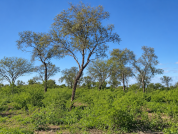
1. The increasing abundance of native shrubs (shrub encroachment), driven by factors such as intensive logging and overgrazing, affects forests and grasslands. In the Arid Chaco, this process reduces forage availability, leading to the use of shrub-removal practices and the sowing of exotic grasses to compensate for this reduction. However, little is known about the effects of these practices on vegetation structure and the relationship between grasses and woody plants.
2. We evaluated the effects of roller-chopping and hand-cutting on tree, shrub and grass cover, the population structure of woody plants, and the relationship between woody plant density and grass cover. We considered four land-cover types: reference forest, degraded shrubland, roller-chopping areas and hand-cutting areas. The latter two were sown with Cenchrus ciliaris L. (buffel grass).
3. Roller-chopping and hand-cutting areas showed lower tree cover than the reference forest and differed from each other in shrub and grass cover. Hand-cutting areas showed lower shrub cover and higher grass cover, whereas roller-chopped areas showed intermediate grass cover and shrub cover similar to that of the reference forest and degraded shrubland. The reference forest had a higher density of tree seedlings and, together with the degraded shrubland, a higher density of adult trees. Among shrubs, adult density was lower under hand-cutting.
4. Grass cover decreased with increasing woody plant density, which explained 61% of its variation. The segmented model identified a breakpoint at 1527±314 woody individuals/ha, with a steeper decline below this value. The relationship was stronger with adult shrub density (R²=0.59) than with tree density (R²=0.30). 5. Implications. Hand-cutting favours grasses but simplifies woody vegetation, whereas roller-chopping allows greater coexistence between the woody and herbaceous layers, although without promoting the recovery of the tree component.
References
Adamoli, J., E. Sennhauser, J. M. Acero, and A. Rescia. 1990. Stress and disturbance: vegetation dynamics in the dry Chaco region of Argentina. Journal of Biogeography 17:491-500. https://doi.org/10.2307/2845381.
Alvarez, J. A., P. E. Villagra, M. A. Cony, E. M. Cesca, and J. A. Boninsegna. 2006. Estructura y estado de conservación de los bosques de Prosopis flexuosa D.C. (Fabaceae, subfamilia: Mimosoideae) en el noreste de Mendoza (Argentina). Revista Chilena de Historia Natural 79:75-87. https://doi.org/10.4067/S0716-078X2006000100007.
Ansley, R. J., T. Zhang, and C. Cooper. 2018. Soil moisture, grass production and mesquite resprout architecture following mesquite above-ground mortality. Water 10:1243. https://doi.org/10.3390/w10091243.
Archer, S. R., E. M. Andersen, K. I. Predick, S. Schwinning, R. J. Steidl, and S. R. Woods. 2017. Woody plant encroachment: causes and consequences. Pp. 25-84 en D. D. Briske (eds.). Rangeland systems. Springer International Publishing. https://doi.org/10.1007/978-3-319-46709-2_2.
Barchuk, A. H., and M. del Pilar Díaz. 1999. Regeneration and structure of Aspidosperma quebracho-blanco Schl. in the Arid Chaco (Córdoba, Argentina). Forest Ecology and Management 118:31-36. https://doi.org/10.1016/S0378-1127(98)00484-8.
Barchuk, A. H., A. Valiente-Banuet, and M. del Pilar Díaz. 2005. Effect of shrubs and seasonal variability of rainfall on the establishment of Aspidosperma quebracho-blanco in two edaphically contrasting environments. Austral Ecology 30:695-705. https://doi.org/10.1111/j.1442-9993.2005.01511.x.
Barchuk, A. H., E. B. Campos, C. Oviedo, and M. del Pilar Díaz. 2006a. Supervivencia y crecimiento de plántulas de especies leñosas del Chaco Árido sometidas a remoción de la biomasa aérea. Ecología Austral 16:47-61.
Barchuk, A. H., M. R. Iglesias, and C. Oviedo. 2006b. Rebrote basal de Aspidosperma quebracho-blanco en estado de plántula: mecanismo de persistencia en el Chaco Árido. Ecología Austral 16:197-205.
Barchuk, A. H., M. R. Iglesias, and M. N. Boetto. 2008. Spatial association of Aspidosperma quebracho-blanco juveniles with shrubs and conspecific adults in the Arid Chaco, Argentina. Austral Ecology 33:775-783. https://doi.org/10.1111/j.1442-9993.2008.01846.x.
Bellingham, P. J., and A. D. Sparrow. 2000. Resprouting as a life history strategy in woody plant communities. Oikos 89:409-416. https://doi.org/10.1034/j.1600-0706.2000.890224.x.
Biurrun, F. N., M. Cabido, and L. J. Blanco. 2015. Consideraciones sobre la vegetación de La Rioja y su estado de conservación. Pp. 485-503 en R. Casas y G. Albarracín (eds.). El deterioro del suelo y del ambiente en la Argentina. FECIC-PROSA, Buenos Aires, Argentina.
Blanco, L. J., C. A. Ferrando, F. N. Biurrun, E. L. Orionte, P. Namur, D. J. Recalde, et al. 2005. Vegetation responses to roller chopping and buffelgrass seeding in Argentina. Rangeland Ecology and Management 58:219-224. https://doi.org/10.2111/1551-5028(2005)58[219:VRTRCA]2.0.CO;2.
Blanco, L., P. R. Namur, C. Ferrando, A. Rettore, P. Namur, R. Ávila, et al. 2013. Evolución de la vegetación después del rolado y siembra de pastos nativos en La Rioja. Revista de la Facultad de Agronomía UNLPam 22 (Supl. 2):17-22. Congreso de Pastizales. Santa Rosa, La Pampa, Argentina.
Blanco, L. J. 2017. Patrones espaciales y temporales de la productividad primaria neta aérea herbácea y leñosa en el Chaco Árido (Argentina). Tesis doctoral. Universidad de Buenos Aires, Buenos Aires, Argentina.
Blanco, L., P. R. Namur, A. Adaro, S. Pizarro, C. Ferrando, R. Ávila, J. Molina, E. Luna Toledo, et al. 2020. Respuesta forrajera del pastizal natural al ajuste de carga ganadera y al manejo rotativo con pasturas: caso “La Yesera” (La Rioja). Pp. 392-395 en M. F. Filippini and S. Greco (eds.). Actas del Primer Congreso Argentino de Agroecología. Universidad Nacional de Cuyo, Mendoza, Argentina.
Bregaglio, N., U. Karlin, and R. Coirini. 2001. Efecto del desmonte selectivo sobre la regeneración de la masa forestal y la producción de pasturas en el Chaco Árido de la provincia de Córdoba, Argentina. Multequina 10:17-24.
Calella, H. F., and R. R. Corzo. 2006. El Chaco Árido de La Rioja: vegetación y suelos. INTA, Buenos Aires, Argentina.
Cavallero, L., C. A. Carranza, M. Ledesma, and D. R. López. 2018. Dinámica de reclutamiento de algarrobo en bosques del Chaco Árido: relación entre etapas de regeneración y resiliencia ecológica. Pp. 494-507 en V. Rusch, G. Caballé, S. Varela and J. P. Diez (eds.). Actas del IV Congreso Nacional de Sistemas Silvopastoriles. Ediciones INTA, San Carlos de Bariloche, Argentina.
Coria, D. R., C. R. Kunst, A. Anríquez, and S. J. Bravo. 2023. Management of grassland/savannas encroached by woody plants in the South American semiarid Chaco: ecological restoration vs. African grasses introduction. Ecología Austral 33:489-506. https://doi.org/10.25260/EA.23.33.2.0.2156.
Del Corro, F. I., L. Enrico, and S. Bravo. 2026. Effect of anthropogenic disturbances on leaf traits of woody species from a subtropical dry forest of Argentina. Forest Systems 35:21001. https://doi.org/10.5424/fs/2026351-21001.
Ding, J., and D. J. Eldridge. 2019. Contrasting global effects of woody plant removal on ecosystem structure, function and composition. Perspectives in Plant Ecology, Evolution and Systematics 39:125460. https://doi.org/10.1016/j.ppees.2019.125460.
Ding, J., and D. J. Eldridge. 2023. The success of woody plant removal depends on encroachment stage and plant traits. Nature Plants 9:58-67. https://doi.org/10.1038/s41477-022-01307-7.
Duarte, Y. J., B. Guida-Johnson, L. M. Alvarez, M. A. Aranda, B. L. A. Ríos, and P. E. Villagra. 2025. Natural regeneration of native woodlands in drylands subjected to disturbances: a basis for their ecological restoration. Forest Ecology and Management 597:123142. https://doi.org/10.1016/j.foreco.2025.123142.
Eldridge, D. J., M. A. Bowker, F. T. Maestre, E. Roger, J. F. Reynolds, and W. G. Whitford. 2011. Impacts of shrub encroachment on ecosystem structure and functioning: towards a global synthesis. Ecology Letters 14:709-722. https://doi.org/10.1111/j.1461-0248.2011.01630.x.
Eldridge, D. J., and S. Soliveres. 2015. Are shrubs really a sign of declining ecosystem function? Disentangling the myths and truths of woody encroachment in Australia. Australian Journal of Botany 62:594-608. https://doi.org/10.1071/BT14137.
Eldridge, D. J., G. Beecham, and J. B. Grace. 2015. Do shrubs reduce the adverse effects of grazing on soil properties? Ecohydrology 8:1503-1513. https://doi.org/10.1002/eco.1600.
Eldridge, D. J., and J. Ding. 2021. Limited long-term effectiveness of roller-chopping for managing woody encroachment. Restoration Ecology 29:e13274. https://doi.org/10.1111/rec.13274.
Fernández, R. J., and P. H. Maseda. 2006. Ecofisiología de arbustivas: reconocimiento de síndromes para un mejor diagnóstico de la situación de arbustización. Pp. 47-55 en Jornadas de actualización técnica de control y manejo del renoval. INTA-CREA, Universidad Nacional de Santiago del Estero, Santiago del Estero, Argentina.
Fernández, P. D., N. I. Gasparri, T. N. Rojas, N. R. Banegas, J. A. Nasca, E. G. Jobbágy, et al. 2024. Silvopastoral management for lowering trade-offs between beef production and carbon storage in tropical dry woodlands. Science of the Total Environment 912:168973. https://doi.org/10.1016/j.scitotenv.2023.168973.
Fernández, M. C., J. P. Molina, L. Guzmán, and P. E. Villagra. 2025. Efecto de diferentes intensidades de rolado sobre la regeneración de especies arbóreas del Chaco Árido. Póster. Pp. 178 en Libro de resúmenes del XI Congreso Internacional de Ecología-Argentina, Chile y Uruguay. Mendoza, Argentina.
Ferrenberg, S., M. Rabinowich, and S. R. Lee. 2025. Nurse plant shading is more important than soil fertility for dryland plant recruitment and diversity. Journal of Ecology 113:2639-2651. https://doi.org/10.1111/1365-2745.70119.
Filip, I. D., P. L. Peri, P. Fernández, D. Loto, S. Kees, N. R. Banegas, et al. 2026. Modelling woody carbon dynamics in tropical dry forests: a case study of the Dry Chaco Region. Ecological Modelling 512:111401. https://doi.org/10.1016/j.ecolmodel.2025.111401.
Guevara, A., I. Garzarón, S. A. Castrillo, E. J. Condori, G. S. Córdoba, M. Méndez, et al. 2024. Sustainable dry forest management for cattle ranching: effects of deschampado practices on the shrub layer and the light environment in comparison to roller chopping. Forest Ecology and Management 560:121826. https://doi.org/10.1016/j.foreco.2024.121826.
Guzmán, L. M., P. E. Villagra, R. E. Quiroga, D. I. Pereyra, M. E. Pelliza, A. R. Ricarte, and R. J. Blanco. 2023. In search of sustainable livestock management in the Dry Chaco: effect of different shrub-removal practices on vegetation. The Rangeland Journal 44:193-202. https://doi.org/10.1071/RJ22040.
Guzmán, L. M. 2024. Efectos del control mecánico y manual de arbustos sobre la vegetación y el suelo en Los Llanos de La Rioja (Argentina). Tesis de doctoral. Universidad de Buenos Aires, Buenos Aires, Argentina.
Guzmán, L. M., P. E. Villagra, R. E. Quiroga, D. I. Pereyra, and E. Pelliza. 2025. Shrub removal practices in livestock environments of the Argentine Arid Chaco: changes on soil physicochemical properties. Rangeland Ecology and Management 103:319-328. https://doi.org/10.1016/j.rama.2025.09.008.
Guzmán, L. M., L. Enrico, N. Pérez-Harguindeguy, R. E. Quiroga, and P. E. Villagra. 2026. Functional diversity of woody plants as a response to shrub removal practices in degraded woodlands of central Argentina. Forest Ecology and Management 619:124082. https://doi.org/10.1016/j.foreco.2026.124082.
Huxman, T. E., B. P. Wilcox, D. D. Breshears, R. L. Scott, K. A. Snyder, E. E. Small, et al. 2005. Ecohydrological implications of woody plant encroachment. Ecology 86:308-319. https://doi.org/10.1890/03-0583.
Instituto de Botánica Darwinion. 2026. Flora Argentina: Flora vascular de la República Argentina y del Cono Sur. CONICET-ANCEFN, Buenos Aires, Argentina. URL: buscador.floraargentina.edu.ar.
Kerleng Marin, R. N., L. Butti, and M. Álvarez Redondo. 2024. Efecto de distintas frecuencias de rolado selectivo sobre la capacidad de rebrote de Neltuma flexuosa (DC.) C. E. Hughes and G. P. Lewis en el ecotono Caldenal-Monte Occidental, región central de Argentina. Semiárida 34(1):27-34. https://doi.org/10.19137/semiarida.2024(1).27-34.
Kunst, C., R. Ledesma, M. Basán, G. Angella, D. Prieto, and J. Godoy. 2003. rolado de fachinales e infiltración de agua en el suelo en el Chaco occidental argentino. Revista de Investigaciones Agropecuarias 32:105-126.
Kunst, C., R. Ledesma, and M. Navall. 2008. rolado selectivo de baja intensidad. INTA, Santiago del Estero, Argentina.
Kunst, C., R. Ledesma, S. Bravo, A. Albanesi, A. Anríquez, H. van Meer, et al. 2012. Disrupting woody steady states in the Chaco region (Argentina): responses to combined disturbance treatments. Ecological Engineering 42:42-53. https://doi.org/10.1016/j.ecoleng.2012.01.025.
Kunst, C. R. G., J. M. Navall, R. Ledesma, J. E. Silberman, A. L. Anríquez, R. D. Coria, et al. 2016. Silvopastoral systems in the western Chaco region, Argentina. Pp. 63-87 en P. L. Peri, F. Dube and A. Varella (eds.). Silvopastoral systems in Southern South America. Springer International Publishing, Switzerland. https://doi.org/10.1007/978-3-319-24109-8_4.
Ledesma, R., F. Saracco, J. G. Silvetti, G. Gerlero, E. Díaz Falú, U. I. Wolf Celoné, et al. 2025. Efecto y persistencia de tratamientos químicos y mecánico sobre arbustos de un sistema pastoril del sudeste de Santiago del Estero, Argentina. Semiárida 35(2):55-68. https://doi.org/10.19137/semiarida.2025(2).55-68.
Ledesma, R., S. Bravo, C. Kunst, A. Elías, J. Godoy, and V. Navarrete. 2022. Grass-shrub coexistence: understanding root distribution in ecological sites of the Semiarid Chaco, Argentina. Arid Land Research and Management 36:331-343. https://doi.org/10.1080/15324982.2021.2017074.
Ledesma, R., A. Elías, C. Kunst, V. Navarrete, and J. Godoy. 2018. Efecto del rolado de baja intensidad (RBI) sobre la distribución radical de pastos y arbustos en un bosque del Chaco occidental. Revista de Investigaciones Agropecuarias 44:121-128.
Maestre, F. T., D. J. Eldridge, and S. Soliveres. 2016. A multifaceted view on the impacts of shrub encroachment. Applied Vegetation Science 19:369-370. https://doi.org/10.1111/avsc.12254.
Magliano, P. N., R. J. Fernández, R. Giménez, V. A. Marchesini, R. A. Páez, and E. G. Jobbágy. 2016. Cambios en la partición de flujos de agua en el Chaco Árido al reemplazar bosques por pasturas. Ecología Austral 26:95-106. https://doi.org/10.25260/EA.16.26.2.0.148.
Meglioli, P. A., M. A. Morsucci Labiano, S. Mora, L. M. Alvarez, G. Zalazar, P. L. Peri, et al. 2025. Fire and roller-chopping effects on forage production, plant diversity, and carbon storage in Neltuma woodlands of the Central Monte, Argentina. Agriculture, Ecosystems and Environment 394:109873. https://doi.org/10.1016/j.agee.2025.109873.
Monegi, P., N. R. Mkhize, T. J. Tjelele, D. Ward, and Z. Tsvuura. 2022. The impact of tree removal on standing grass biomass, seedling establishment and growth of woody species. The Rangeland Journal 44:25-32. https://doi.org/10.1071/RJ21003.
Morello, J., L. A. Sancholuz, and C. A. Blanco. 1985. Estudio macroecológico de los Llanos de La Rioja. Administración de Parques Nacionales, Buenos Aires, Argentina.
Namur, P., J. M. Tessi, R. E. Ávila, H. A. Retore, and C. A. Ferrando. 2014. Buffel grass: generalidades, implantación y manejo para recuperación de áreas degradadas. Ediciones INTA, La Rioja, Argentina.
Natenzon, C. E., and G. Olivera. 1994. La tala del bosque en los Llanos de La Rioja (1900-1960). Desarrollo Económico 34:263-284. https://doi.org/10.2307/3467319.
Páez, S. A., and D. E. Marco. 2000. Seedling habitat structure in dry Chaco forest (Argentina). Journal of Arid Environments 46:57-68. https://doi.org/10.1006/jare.2000.0648.
Passera, C. B., A. D. Dalmaso, and O. Borsetto. 1983. Método del point quadrat modificado. Pp. 135-152 en Taller de arbustos forrajeros. Actas del II Taller de Arbustos Forrajeros. FAO-IADIZA, Mendoza, Argentina.
Pérez-Harguindeguy, N., A. M. Cingolani, L. Enrico, M. V. Vaieretti, M. A. Giorgis, M. L. Moreno, et al. 2022. How human-induced transitions from forest to treeless ecosystems affect litter decomposition. Ecología Austral 32:716-733. https://doi.org/10.25260/EA.22.32.2.1.1887.
Peri, P. L., G. Martínez-Pastur, and T. Schlichter. 2021. Uso sostenible del bosque: aportes desde la silvicultura argentina. Ministerio de Ambiente y Desarrollo Sostenible, Buenos Aires, Argentina.
Peri, P. L., Y. M. Rosas, D. R. López, M. V. Lencinas, L. Cavallero, and G. Martínez-Pastur. 2022. Conceptual framework to define strategies for silvopastoral systems in native forests. Ecología Austral 32:749-766. https://doi.org/10.25260/EA.22.32.2.1.1872.
Rejžek, M., R. D. Coria, C. R. Kunst, M. Svátek, J. Kvasnica, J. M. Navall, et al. 2017. To chop or not to chop? Tackling shrub encroachment by roller-chopping preserves woody plant diversity and composition in a dry subtropical forest. Forest Ecology and Management 402:29-36. https://doi.org/10.1016/j.foreco.2017.07.032.
R Core Team. 2025. R: A language and environment for statistical computing. R Foundation for Statistical Computing, Vienna, Austria. URL: R-project.org.
Sala, O. E., and F. T. Maestre. 2014. Grass-woodland transitions: determinants and consequences for ecosystem functioning and provisioning of services. Journal of Ecology 102:1357-1362. https://doi.org/10.1111/1365-2745.12326.
Soliveres, S., F. T. Maestre, D. J. Eldridge, M. Delgado-Baquerizo, J. L. Quero, M. A. Bowker, and A. Gallardo. 2014. Plant diversity and ecosystem multifunctionality peak at intermediate levels of woody cover in global drylands. Global Ecology and Biogeography 23:1408-1416. https://doi.org/10.1111/geb.12215.
Sousa, W. P. 1984. The role of disturbance in natural communities. Annual Review of Ecology and Systematics 15:353-391. https://doi.org/10.1146/annurev.es.15.110184.002033.
Steinaker, D. F., E. G. Jobbágy, J. P. Martini, D. N. Arroyo, J. L. Pacheco, and V. A. Marchesini. 2016. Vegetation composition and structure changes following roller-chopping deforestation in central Argentina woodlands. Journal of Arid Environments 133:19-24. https://doi.org/10.1016/j.jaridenv.2016.05.005.
Szymañski, C. R., P. E. Villagra, V. Aschero, and J. A. Alvarez. 2022. Interactive effects of chronic anthropogenic disturbances on Prosopis woodland structure in the Central Monte, Argentina. Ecología Austral 32:108-121. https://doi.org/10.25260/EA.22.32.1.0.1800.
Tálamo, A., and S. M. Caziani. 2003. Variation in woody vegetation among sites with different disturbance histories in the Argentine Chaco. Forest Ecology and Management 184:79-92. https://doi.org/10.1016/S0378-1127(03)00150-6.
Tálamo, A., A. H. Barchuk, L. A. Garibaldi, C. E. Trucco, S. Cardozo, and F. Mohr. 2015. Disentangling the effects of shrubs and herbivores on tree regeneration in a dry Chaco forest (Argentina). Oecologia 178:847-854. https://doi.org/10.1007/s00442-015-3269-7.
Van Auken, O. W. 2000. Shrub invasions of North American semiarid grasslands. Annual Review of Ecology and Systematics 31:197-215. https://doi.org/10.1146/annurev.ecolsys.31.1.197
Vera, G., and D. Vera. 2019. Actores sociales que componen el territorio del INTA EEA La Rioja. Tecnoárido 1:35-42.
Villagra, P. E., J. A. Boninsegna, J. A. Alvarez, M. A. Cony, E. M. Cesca, and R. Villalba. 2005. Dendroecology of Prosopis flexuosa woodlands in the Monte desert: implications for their management. Dendrochronologia 22:209-213. https://doi.org/10.1016/j.dendro.2005.05.005.
Villagra, P. E., and J. A. Alvarez. 2019. Determinantes ambientales y desafíos para el ordenamiento forestal sustentable en los algarrobales del Monte, Argentina. Ecología Austral 29:146-155. https://doi.org/10.25260/EA.19.29.1.0.752.
Villagrán, E. 2009. El proceso de innovación tecnológica en áreas productivas marginales. El caso de la pastura de buffel grass en los establecimientos ganaderos del Departamento Chamical en los Llanos de La Rioja. Tesis de maestría. FLACSO, Buenos Aires, Argentina.
Zarovali, M. P., M. D. Yiakoulaki, and V. P. Papanastasis. 2007. Effects of shrub encroachment on herbage production and nutritive value in semi-arid Mediterranean grasslands. Grass and Forage Science 62:355-363. https://doi.org/10.1111/j.1365-2494.2007.00590.x.
Zeballos, S. R., A. T. Acosta, W. D. Agüero, R. J. Ahumada, M. G. Almirón, D. S. Argibay, et al. 2023. Vegetation types of the Arid Chaco in central western Argentina. Vegetation Classification and Survey 4:167-188. https://doi.org/10.3897/VCS.100532.
Downloads
Additional Files
Published
How to Cite
Issue
Section
License
Copyright (c) 2026 Luis M. Guzmán, Raúl E. Quiroga, Lisandro J. Blanco, María C. Fernández, Pablo E. Villagra

This work is licensed under a Creative Commons Attribution 4.0 International License.
Authors retain their rights as follows: 1) by granting the journal the right to its first publication, and 2) by registering the published article with a Creative Commons Attribution License (CC-BY 4.0), which allows authors and third parties to view and use it as long as they clearly mention its origin (citation or reference, including authorship and first publication in this journal). Authors can make other non-exclusive distribution agreements as long as they clearly indicate their origin and are encouraged to widely share and disseminate the published version of their work.