From Mexico to Argentina: Predicting the distribution of the invasive weed Tithonia tubaeformis beyond its native range using niche modelling
DOI:
https://doi.org/10.25260/EA.26.36.3.0.2712Keywords:
biological invasion, ecological niche, invasion risk, model transferability, species distribution modelsAbstract
1. Biological invasions are a major driver of global change, affecting biodiversity, ecosystem functioning and agricultural productivity. Tithonia tubaeformis (Asteraceae) is a weed native to Mexico that has become invasive in several regions worldwide, including Argentina, where it threatens crop systems. Here, we compared species distribution models trained with native- and invaded-range occurrences to estimate the potential distribution of T. tubaeformis in Argentina. We also developed an invasion risk map to support prevention and management strategies.
2. Environmental predictors included 19 bioclimatic variables, elevation, and a Human Influence Index (HII). Models were calibrated using native- and invaded-range occurrences with MaxEnt, testing multiple regularisation multipliers and feature class combinations, with and without HII. The best-performing models were projected onto Argentina to estimate potential distribution and assess model transferability and environmental niche overlap between ranges.
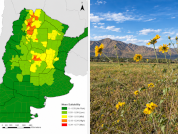
3. Models showed good performance, and including HII improved model accuracy and explained a large portion of the predicted distribution. The native-trained model projected a broader potential range than the invasive-trained model, suggesting that T. tubaeformis has not yet occupied all suitable habitats in Argentina. Most invasive occurrences fell within the environmental space predicted using the native-trained model, although some records indicated a slight niche expansion under previously unoccupied conditions. The risk map identified northern Argentina as highly suitable for invasion, highlighting priority areas for monitoring and prevention.
4. Implications. Our findings demonstrate that native-range trained models can anticipate the spread of emerging weeds and that incorporating anthropogenic factors enhances predictive performance. These results contribute to understanding invasion processes and provide a practical tool for risk assessment and management planning in human-modified landscapes.
References
Aguirre-Gutiérrez, J., L. G. Carvalheiro, C. Polce, E. E. van Loon, N. Raes, et al. 2013. Fit-for-purpose: species distribution model performance depends on evaluation criteria - Dutch hoverflies as a case study. PLoS ONE 8:e63708. https://doi.org/10.1371/journal.pone.0063708.
Berruezo, L., G. Cárdenas, C. Machado, and M. Galván. 2023. Diagnóstico de malezas, posibles hospederas de virosis en el cultivo de tabaco. IV Congreso Argentino de Malezas, Buenos Aires.
Brown, J. L., J. R. Bennett, and C. M. French. 2017. SDMtoolbox 2.0: the next generation Python-based GIS toolkit for landscape genetic, biogeographic and species distribution model analyses. PeerJ 5:e4095. https://doi.org/10.7717/peerj.4095.
D’Antonio, C. M. 1993. Mechanisms controlling invasion of coastal plant communities by the alien succulent Carpobrotus edulis. Ecology 74(1):83-95. https://doi.org/10.2307/1939503.
De Andrada, N., H. Robinet, O. Arce, B. Díaz, S. Guillen, et al. 1995. Relevamiento y determinación de la distribución de malezas frecuentes en la zona sojera del noreste de Tucumán. XII Congreso Latinoamericano de Malezas, Uruguay.
Díaz-Medina, L. K., V. Colín-Navarro, C. M. Arriaga-Jordán, L. Brunett-Pérez, B. R. Vázquez-de-Aldana, et al. 2021. In vitro nutritional quality and antioxidant activity of three weed species as feed additives for sheep in the Central Highlands of Mexico. Tropical Animal Health and Production 53(3):394. https://doi.org/10.1007/s11250-021-02819-8.
Gómez, G. C., M. L. F. Salinas, and M. J. Barrionuevo. 2020. Ciclo de vida de Chlosyne lacinia saundersii (Lepidoptera: Nymphalidae) sobre Tithonia tubaeformis (Jacq.) Cass. en condiciones controladas de laboratorio. Revista de la Sociedad Entomológica Argentina 79(4):31-38. https://doi.org/10.25085/rsea.790405.
González‐Moreno, P., J. M., Diez, I. Ibáñez, X. Font, and M. Vilà. 2014. Plant invasions are context‐dependent: multiscale effects of climate, human activity and habitat. Diversity and Distributions 20(6):720-731. https://doi.org/10.1111/ddi.12206.
Guisan, A., and W. Thuiller. 2005. Predicting species distribution: offering more than simple habitat models. Ecology Letters 8(9):993-1009. https://doi.org/10.1111/j.1461-0248.2005.00792.x.
Fan, J. Y., N. X. Zhao, M. Li, W. F. Gao, M. L. Wang, et al. 2018. What are the best predictors for invasive potential of weeds? Transferability evaluations of model predictions based on diverse environmental data sets for Flaveria bidentis. Weed Research 58(2):141-149. https://doi.org/10.1111/wre.12292.
Fick, S. E., and R. J. Hijmans. 2017. WorldClim 2: new 1 km spatial resolution climate surfaces for global land areas. International Journal of Climatology 37(12):4302-4315. https://doi.org/10.1002/joc.5086.
Fonteyne, S., A. J. Leal González, L. Osorio Alcalá, J. Villa Alcántara, C. Santos Rodríguez, et al. 2022. Weed management and tillage effect on rainfed maize production in three agro‐ecologies in Mexico. Weed Research 62(3):224-239. https://doi.org/10.1111/wre.12530.
Huarte, H. R., P. D. Vargas, G. D. Puglia, and A. Sánchez-Ducca. 2025. Seed dormancy release and germination ecophysiology of wild Mexican sunflower (Tithonia tubaeformis). Weed Science 73(e49):1-10. https://doi.org/10.1017/wsc.2025.19.
Juárez, V. D., and A. V. Cazón. 2003. Autotoxicity in Tithonia tubaeformis as a mechanism of invasion control. Ecología Austral 13(2):133-138.
Larenas-Parada, G., M. L. De Viana, T. Chafatinos, and N. E. Escobar. 2004. Relación suelo-especie invasora (Tithonia tubaeformis) en el sistema ribereño del río Arenales, Salta, Argentina. Ecología Austral 14(1):19-29.
López-Caamal, A., R. Reyes-Chilpa, and E. Tovar-Sánchez. 2018. Hybridization between Tithonia tubaeformis and T. rotundifolia (Asteraceae) evidenced by nSSR and secondary metabolites. Plant Systematics and Evolution 304(3):313-326. https://doi.org/10.1007/s00606-017-1478-8.
López-Caamal, A., and E. Tovar-Sánchez. 2021. Comparing the population history of Neotropical annual species: the role of climate change and hybridization between Tithonia tubaeformis and T. rotundifolia (Asteraceae). Plant Biology 23(6):962-973. https://doi.org/10.1111/plb.13313.
MAyDS (Ministerio de Ambiente y Desarrollo Sostenible de la Nación). 2021. Resolución 109/2021: Lista de especies exóticas invasoras, potencialmente invasoras y criptogénicas de la República Argentina. Boletín Oficial de la República Argentina. URL: shorturl.at/S8UfI.
Mashele, B., C. Mafuwane, M. C. Moshobane, and D. O. Simelane. 2017. Mexican sunflower (Tithonia tubaeformis): a new threat to food security in South Africa. SAPIA News 46:4-6.
Mawela, K. V., and D. O. Simelane. 2021. Biological control of Tithonia spp. (Asteraceae) in South Africa: challenges and possibilities. African Entomology 29(3):896-904. https://doi.org/10.4001/003.029.0896.
Muoghalu, J. I., and D. K. Chuba. 2005. Seed germination and reproductive strategies of Tithonia diversifolia (Hemsl.) Gray and Tithonia rotundifolia (P.M.) Blake. Applied Ecology and Environmental Research 3(1): 39-46. https://doi.org/10.15666/aeer/0301_039046.
Novara, L., and D. G. Gutiérrez. 2010. Asteraceae-Tribu 5. Heliantheae. Aportes Botánicos de Salta - Serie Flora 9(6):1-201.
Oerke, E. C. 2006. Crop losses to pests. The Journal of agricultural science 144(1):31-43. https://doi.org/10.1017/S0021859605005708.
Peterson, A. T. 2003. Predicting the geography of species’ invasions via ecological niche modelling. The Quarterly Review of Biology 78(4):419-433. https://doi.org/10.1086/378926.
Phillips, S. J., R. P. Anderson, and R. E. Schapire. 2006. Maximum entropy modelling of species geographic distributions. Ecological Modelling 190:231-259. https://doi.org/10.1016/j.ecolmodel.2005.03.026.
Phillips, S. J., and M. Dudík. 2008. Modelling of species distributions with Maxent: new extensions and a comprehensive evaluation. Ecography 31(2):161-175. https://doi.org/10.1111/j.0906-7590.2008.5203.x.
Pyšek, P., P. E. Hulme, D. Simberloff, S. Bacher, T. M. Blackburn, et al. 2020. Scientists’ warning on invasive alien species. Biological Reviews 95(6):1511-1534. https://doi.org/10.1111/brv.12627.
R Core Team. 2021. R: A language and environment for statistical computing. Vienna: R Foundation for Statistical Computing.
Radosavljevic, A., and R. P. Anderson. 2014. Making better Maxent models of species distributions: complexity, overfitting and evaluation. Journal of Biogeography 41(4):629-643. https://doi.org/10.1111/jbi.12227.
Ren, Z., Y. Ai, M. S. Heinz, J. Liu, X. Yuan, et al. 2025. Climatic, human-induced and biodiversity factors differently shape the suitable areas of Bidens pilosa. Journal of Plant Ecology 18(2):rtaf032. https://doi.org/10.1093/jpe/rtaf032.
Richardson, D. M., P. Pyšek, M. Rejmánek, M. G. Barbour, F. D. Panetta, et al. 2000. Naturalization and invasion of alien plants: concepts and definitions. Diversity and Distributions 6(2):93-107. https://doi.org/10.1046/j.1472-4642.2000.00083.x.
Ricciardi, A., M. F. Hoopes, M. P. Marchetti, and J. L. Lockwood. 2013. Progress toward understanding the ecological impacts of nonnative species. Ecological monographs 83(3):263-282. https://doi.org/10.1890/13-0183.1.
Sánchez-Ducca, A., P. D. Vargas, S. Sabaté, M. López, and E. R. Romero. 2019. Pasto cubano: nueva maleza problema para Tucumán. Avance Agroindustrial 40(2):26-27.
Srivastava, V., W. Liang, M. A. Keena, A. D. Roe, R. C. Hamelin, et al. 2020. Assessing niche shifts and conservatism by comparing the native and post-invasion niches of major forest invasive species. Insects 11(8):479. https://doi.org/10.3390/insects11080479.
Srivastava, V., A. D. Roe, M. A. Keena, R. C. Hamelin, and V. C. Griess. 2021. Oh the places they’ll go: improving species distribution modelling for invasive forest pests in an uncertain world. Biological Invasions 23(1):297-349. https://doi.org/10.1007/s10530-020-02372-9.
Thapa, S., V. Chitale, S. J. Rijal, N. Bisht, and B. B. Shrestha. 2018. Understanding the dynamics in distribution of invasive alien plant species under predicted climate change in Western Himalaya. PLoS ONE 13(4):e0195752. https://doi.org/10.1371/journal.pone.0195752.
Václavík, T., and R. K. Meentemeyer. 2012. Equilibrium or not? Modelling potential distribution of invasive species in different stages of invasion. Diversity and Distributions 18(1):73-83. https://doi.org/10.1111/j.1472-4642.2011.00854.x.
Vilà, M., J. L. Espinar, M. Hejda, P. E. Hulme, V. Jarošík, et al. 2011. Ecological impacts of invasive alien plants: a meta-analysis of their effects on species, communities and ecosystems. Ecology Letters 14(7):702-708. https://doi.org/10.1111/j.1461-0248.2011.01628.x
Vibrans, H. 1999. Epianthropochory in Mexican weed communities. American Journal of Botany 86(4):476-481. https://doi.org/10.2307/2656808.
Wildlife Conservation Society (WCS), and Center for International Earth Science Information Network (CIESIN) - Columbia University. 2005. Last of the Wild Project, Version 2, 2005 (LWP-2): Global Human Influence Index (HII) Dataset (Geographic). Palisades, NY: ESDIS. https://doi.org/10.7927/H4BP00QC.
Witt, A. B. R., R. T. Shackleton, T. Beale, W. Nunda, and B. W. Van Wilgen. 2019. Distribution of invasive alien Tithonia (Asteraceae) species in eastern and southern Africa and the socio-ecological impacts of T. diversifolia in Zambia. Bothalia 49(1):a2356. https://doi.org/10.4102/abc.v49i1.2356.
Zepeda-Bastida, A., M. Ayala Martínez, and S. Soto-Simental. 2019. Carcass and meat quality of rabbits fed Tithonia tubaeformis weed. Revista Brasileira de Zootecnia 48:e20190074. https://doi.org/10.1590/rbz4820190074.
Downloads
Additional Files
Published
How to Cite
Issue
Section
License
Copyright (c) 2026 Pablo Gorostiague, Manuela Urtasun, Pablo Ortega-Baes

This work is licensed under a Creative Commons Attribution 4.0 International License.
Authors retain their rights as follows: 1) by granting the journal the right to its first publication, and 2) by registering the published article with a Creative Commons Attribution License (CC-BY 4.0), which allows authors and third parties to view and use it as long as they clearly mention its origin (citation or reference, including authorship and first publication in this journal). Authors can make other non-exclusive distribution agreements as long as they clearly indicate their origin and are encouraged to widely share and disseminate the published version of their work.