Seasonal homogenization of bird communities in the Buenos Aires Metropolitan Area, Argentina, due to urbanization
DOI:
https://doi.org/10.25260/EA.26.36.3.0.2763Keywords:
biotic homogenization, global south, gradient, seasonality, taxonomic diversity, urbanizationAbstract
1. Cities in temperate regions typically show seasonal stabilization of resources for birds. This stabilization is linked to less seasonal variation in bird communities. However, such analysis is rare in the Pampas Region.
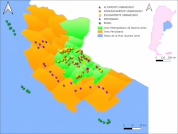
2. The goal of this study was to examine seasonal changes in bird diversity and composition along the urbanrural gradient of the Buenos Aires Metropolitan Area, the second-largest city in South America. Bird counts were carried out along transects during the breeding (spring-summer) and non-breeding (autumn-winter) seasons across five levels of urbanization.
3. Bird richness negatively correlated with urbanization during the breeding season, while it reached its peak at scarce levels of urbanization during the non-breeding season. The change in species richness between seasons was greatest in the rural sector, while the sparsely urbanized sector showed no significant change. The largest change in species composition between stages occurred in the rural sector, while the smallest change was seen in the moderately urbanized sector.
4. Implications. The findings support the idea of seasonal homogenization of bird communities in urban areas. However, this study revealed seasonal variations in the more urbanized area, indicating that the homogenizing impact of urbanization on bird communities is not a straightforward process.
References
Baldi, G., and J. M. Paruelo. 2008. Land-use and land cover dynamics in South American temperate grasslands. Ecology and Society 13(2). https://doi.org/10.5751/ES-02481-130206.
Barco, G., G. Peralta, A. Díaz, and S. I. Peluc. 2024. Características reproductivas de Zenaida auriculata (Aves: Columbidae) en ambientes urbanos de la ciudad de Córdoba, Argentina. Ecología Austral 34(1):001-009. https://doi.org/10.25260/EA.24.34.1.0.2236.
Barsky, A. 2005. El periurbano productivo, un espacio en constante transformación. Introducción al estado del debate, con referencias al caso de Buenos Aires. Scripta Nova 9. URL: tinyurl.com/3pnmjc2w.
Batáry, P., K. Kurucz, M. Suarez‐Rubio, and D. E. Chamberlain. 2018. Non‐linearities in bird responses across urbanization gradients: A meta‐analysis. Global Change Biology 24(3):1046-1054. https://doi.org/10.1111/gcb.13964.
Bates, D., M. Mächler, B. Bolker, and S. Walker. 2015. Fitting linear mixed-effects models using lme4. Journal of Statistical Software 67:1-48. https://doi.org/10.18637/jss.v067.i01.
Bocelli, M. L., F. Morelli, Y. Benedetti, and L. M. Leveau. 2023. Dinámica estacional de la comunidad de aves en parques urbanos y cementerios de Buenos Aires, Argentina. Ecología Austral 33(2):469-478. https://doi.org/10.25260/EA.23.33.2.0.2019.
Bolar, K. 2019. Package “stats”. Interactive Document for Working with Basic Statistical Analysis.
Bray, J. R., and J. T. Curtis. 1957. An ordination of the upland forest communities of Southern Wisconsin. Ecological Monographs 27(4):325-349. https://doi.org/10.2307/1942268.
Burkart, R., N. O. Bárbaro, R. O. Sánchez, and D. A. Gómez. 1999. Ecorregiones de la Argentina. In Administración de Parques Nacionales.
Cabrera, A. L. 1971. Fitogeografía de la República Argentina. Boletín de La Sociedad Argentina de Botánica 14:1-42.
Catterall, C. P., M. B. Kingston, K. Park, and S. Sewell. 1998. Deforestation, urbanisation and seasonality: interacting effects on a regional bird assemblage. Biological Conservation 84:65-81. https://doi.org/10.1016/S0006-3207(97)00076-1.
Caula, S., P. Marty, and J. L. Martin. 2008. Seasonal variation in species composition of an urban bird community in Mediterranean France. Landscape and Urban Planning 87(1):1-9. https://doi.org/10.1016/j.landurbplan.2008.03.006.
Chao, A. 1984. Nonparametric estimation of the number of classes in a population. Scandinavian Journal of Statistics 265-270. https://doi.org/10.2307/4615964.
Clarke, K. R. 1993. Non‐parametric multivariate analyses of changes in community structure. Australian Journal of Ecology 18(1):117-143. https://doi.org/10.1111/j.1442-9993.1993.tb00438.x.
Clergeau, P., J. P. L. Savard, G. Mennechez, and G. Falardeau. 1998. Bird abundance and diversity along an urban-rural gradient: a comparative study between two cities on different continents. The Condor 100:413-425. https://doi.org/10.2307/1369707.
Cueto, V. R., and J. Lopez de Casenave. 2000. Seasonal changes in bird assemblages of coastal woodlands in east-central Argentina. Studies on Neotropical Fauna and Environment 35(3):173-177. https://doi.org/10.1076/snfe.35.3.173.8859.
de la Peña, M. R. 2010. Los alimentos de las aves [CD-ROM]. Santa Fe, Argentina: Universidad Nacional del Litoral.
de la Peña, M. R. 2013. Nidos y reproducción de las aves argentinas. In Ediciones Biológica. Serie Naturaleza, Conservación y Sociedad N° 8. Ediciones Biológica.
Di Pace, M., and H. Caride Bartrons (eds.). 2012. Ecología urbana. Universidad Nacional General Sarmiento, Los Polvorines.
Domínguez Roca, L., F. Sabassi, and R. Apaolaza. 2024. Expansión urbana reciente de la aglomeración Gran Buenos Aires: ¿hacia un cuarto proceso de suburbanización? Estudios Socioterritoriales 35(2):9-32. https://doi.org/10.37838/unicen/est.35-2-101.
Filloy, J., and M. I. Bellocq. 2007. Patterns of bird abundance along the agricultural gradient of the Pampean region. Agriculture, Ecosystems and Environment 120(2-4):291-298. https://doi.org/10.1016/j.agee.2006.09.013.
Fjeldså, J., and N. Krabbe. 1990. Birds of the high Andes. University of Copenhagen and Apollo Books, Svendborg, Denmark.
Gaston, K. J., P. H. Warren, K. Thompson, and R. M. Smith. 2005. Urban domestic gardens (IV): The extent of the resource and its associated features. Biodiversity and Conservation 14(14):3327-3349. https://doi.org/10.1007/s10531-004-9513-9.
Germain, P., Y. A. Cuevas, C. D. C. Sanhueza, F. R. Tizón, A. Loydi, A. E. de Villalobos, et al. 2008. Ensamble de aves en zonas con diferente grado de urbanización en la ciudad de Bahía Blanca. BioScriba 1(2):35-45.
Grimm, N. B., S. H. Faeth, N. E. Golubiewski, C. L. Redman, J. Wu, X. Bai, and J. M. Briggs. 2008. Global Change and the Ecology of Cities. Science 319(5864):756-760. https://doi.org/10.1126/science.1150195.
Haag, L. M., A. Jáuregui, E. González, M. A. Colombo, and L. N. Segura. 2020. Efecto de la alteración del hábitat en la comunidad de aves de la localidad balnearia de Cariló, Argentina. El Hornero 35(1):36-46. https://doi.org/10.56178/eh.v35i1.456.
Herrera, C. M. 1981. Organización temporal de las comunidades de aves. Doñana, Acta Vertebrata 8:79-101.
Hurlbert, A. H. 2004. Species-energy relationships and habitat complexity in bird communities. Ecology Letters 7(8):714-720. https://doi.org/10.1111/j.1461-0248.2004.00630.x.
Hurlbert, A. H., and J. P. Haskell. 2003. The effect of energy and seasonality on avian species richness and community composition. The American Naturalist 161(1):83-97. https://doi.org/10.1086/345459.
Instituto Nacional de Estadística y Censos (INDEC). 2010. Estadísticas básicas. Total de personas en el hogar. Censo de Población, Hogares y Viviendas 2010. URL: tinyurl.com/2kt2ukx5.
Juri, M. D., and J. M. Chani. 2009. Variación estacional en la composición de las comunidades de aves en un gradiente urbano. Ecología Austral 19(3):175-184.
La Sorte, F. A., M. W. Tingley, and A. H. Hurlbert. 2014. The role of urban and agricultural areas during avian migration: an assessment of within‐year temporal turnover. Global Ecology and Biogeography 23(11):1225-1234. https://doi.org/10.1111/geb.12199.
Lenth, R. V., P. Buerkner, M. Herve, J. Love, H. Riebl, and H. Singmann. 2021. Package “emmeans”: Estimated Marginal Means, aka Least-Squares Means. URL: tinyurl.com/47u47xuw.
Lepczyk, C. A., C. H. Flather, V. C. Radeloff, A. M. Pidgeon, R. B. Hammer, and J. Liu. 2008. Human impacts on regional avian diversity and abundance. Conservation Biology 22(2):405-416. https://doi.org/10.1111/j.1523-1739.2008.00881.x.
Leveau, C. M., and L. M. Leveau. 2005. Avian community response to urbanization in the Pampean region, Argentina. Ornitologia Neotropical 16:503-510.
Leveau, L. M. 2013. Relaciones aves-hábitat en el sector suburbano de Mar del Plata, Argentina. Ornitologia Neotropical 24:201-212.
Leveau, L. M. 2018. Urbanization, environmental stabilization and temporal persistence of bird species: a view from Latin America. PeerJ 6:e6056. https://doi.org/10.7717/peerj.6056.
Leveau, L. M. 2019. Primary productivity and habitat diversity predict bird species richness and composition along urban-rural gradients of central Argentina. Urban Forestry and Urban Greening 43:126349. https://doi.org/10.1016/j.ufug.2019.05.011.
Leveau, L. M. 2021. Consistency in bird community assembly over medium-term along rural-urban gradients in Argentina. Ecological Processes 10(1):34. https://doi.org/10.1186/s13717-021-00302-8.
Leveau, L. M. 2023. Estacionalidad en la presencia de la Torcaza (Zenaida auriculata) en un gradiente urbano de Mar del Plata, Argentina. El Hornero 38(1):5-5. https://doi.org/10.56178/eh.v38i1.1423.
Leveau, L. M., and C. M. Leveau. 2004a. Riqueza y abundancia de aves en agroecosistemas pampeanos durante el período post-reproductivo. Ornitología Neotropical 15(3), Art. 10. URL: tinyurl.com/3ww4kew4.
Leveau, L. M., and C. M. Leveau. 2004b. Comunidades de aves en un gradiente urbano de la ciudad de Mar del Plata, Argentina. El Hornero 19(1):13-21. https://doi.org/10.56178/eh.v19i1.840.
Leveau, L. M., and C. M. Leveau. 2011. Uso de bordes de cultivo por aves durante invierno y primavera en la pampa austral. El Hornero 26(2):159-161. https://doi.org/10.56178/eh.v26i2.685.
Leveau, L. M., F. I. Isla, and M. I. Bellocq. 2015. Urbanization and the temporal homogenization of bird communities: a case study in central Argentina. Urban Ecosystems 18(4):1461-1476. https://doi.org/10.1007/s11252-015-0469-1.
Leveau, L. M., F. I. Isla, and M. I. Bellocq. 2018. Predicting the seasonal dynamics of bird communities along an urban-rural gradient using NDVI. Landscape and Urban Planning 177:103-113. https://doi.org/10.1016/j.landurbplan.2018.04.007.
Leveau, L. M., J. Jokimäki, and M. L. Kaisanlahti‐Jokimäki. 2021. Urbanization buffers seasonal change in composition of bird communities: A multi‐continental meta‐analysis. Journal of Biogeography 48(10):2391-2401. https://doi.org/10.1111/jbi.14236.
Lokatis, S., and J. M. Jeschke. 2022. Urban biotic homogenization: Approaches and knowledge gaps. Ecological Applications 32(8):e2703. https://doi.org/10.1002/eap.2703.
McKinney, M. L. 2006. Urbanization as a major cause of biotic homogenization. Biological Conservation 127(3):247-260. https://doi.org/10.1016/j.biocon.2005.09.005.
Morello, J., G. D. Buzai, C. A. Baxendale, A. F. Rodríguez, S. D. Matteucci, R. E. Godagnone, and R. R. Casas. 2000. Urbanization and the consumption of fertile land and other ecological changes: the case of Buenos Aires. Environment and Urbanization 12(2):119-131. https://doi.org/10.1177/095624780001200210.
O’Connor, T., J. A. Paz, M. V. Castano, S. B. Román, M. M. Hernández, and F. Zumpano. 2024. Diversidad de aves y caracterización de la vegetación en Sierra los Difuntos, Buenos Aires, Argentina: implicancia de la estacionalidad y la topografía. El Hornero 39(1):5-5. https://doi.org/10.56178/eh.v39i1.1483.
Oksanen, J., F. G. Blanchet, M. Friendly, R. Kindt, P. Legendre, D. Mcglinn, P. R. Minchin, et al. 2020. Package “vegan”. Community ecology package. URL: github.com/vegandevs/vegan.
Oyarzabal, M., J. Clavijo, L. Oakley, F. Biganzoli, P. Tognetti, I. Barberis, H. M. Maturo, et al. 2018. Unidades de vegetación de la Argentina. Ecología Austral 28:40-63. https://doi.org/10.25260/ea.18.28.1.0.399.
Park, C. R., and W. S. Lee. 2000. Relationship between species composition and area in breeding birds of urban woods in Seoul, Korea. Landscape and Urban Planning 51(1):29-36. https://doi.org/10.1016/S0169-2046(00)00094-3.
Peel, M. C., B. L. Finlayson, and T. A. McMahon. 2007. Updated world map of the Köppen-Geiger climate classification. Hydrology and Earth System Sciences 11:1633-1644. https://doi.org/10.5194/hess-11-1633-2007.
Pretelli, M. G., A. V. Baladrón, D. A. Cardoni, and J. P. Isacch. 2018. Bandadas otoño-invernales en agroecosistemas del sudeste de la Región Pampeana, Argentina. Ornitología Neotropical 29:259-269. https://doi.org/10.58843/ornneo.v29i1.396.
R Development Core Team. 2020. R: a Language and Environment for Statistical Computing. version 4.4.2. R Foundation for Statistical Computing, Vienna.
Ralph, C. J., G. R. Geupel, P. Pyle, T. E. Martin, D. F. Desante, and B. Milá. 1996. Manual de métodos de campo para el monitoreo de aves terrestres. Pacific Southwest Res Station For Serv U.S. Dep Agric Albany, CA.
Rashid, G. M., A. Butt, T. Sattar, A. Qadir, and M. H. Ali. 2026. Sub-tropical bird responses to seasonal variations and urbanization pressures along rural-urban gradient in Gujranwala. Environmental Monitoring and Assessment 198(9):927. https://doi.org/10.1007/s10661-026-15710-6.
Remsen, J. V. Jr., J. I. Areta, E. Bonaccorso, S. Claramunt, D. F. Lane, L. N. Naka, M. B. Robbins, et al. 2026. A classification of the bird species of South America. American Ornithologists’ Union, Farmington, New Mexico, USA. URL: tinyurl.com/34rwtnuu.
Robb, G. N., R. A. McDonald, D. E. Chamberlain, and S. Bearhop. 2008. Food for thought: supplementary feeding as a driver of ecological change in avian populations. Frontiers in Ecology and the Environment 6(9):476-484. https://doi.org/10.1890/060152.
Shanahan, D. F., M. W. Strohbach, P. S. Warren, and R. A. Fuller. 2014. The challenges of urban living. Avian Urban Ecology 3-20.
Shochat, E., P. S. Warren, S. H. Faeth, N. E. McIntyre, and D. Hope. 2006. From patterns to emerging processes in mechanistic urban ecology. Trends in Ecology and Evolution 21(4):186-191. https://doi.org/10.1016/j.tree.2005.11.019.
Webb, C. O., D. D. Ackerly, M. A. McPeek, and M. J. Donoghue. 2002. Phylogenies and Community Ecology. Annual Review of Ecology and Systematics 33(1):475-505. https://doi.org/10.1146/annurev.ecolsys.33.010802.150448.
Weng, Q. 2011. Remote sensing of impervious surfaces in the urban areas: Requirements, methods and trends. Remote Sensing of Environment 117:34-49. https://doi.org/10.1016/j.rse.2011.02.030.
Xie, Z., H. Duan, B. Zhang, M. Zhou, L. Zhang, J. Yu, and J. He. 2025. Urbanization alters the seasonality of bird communities across China. Avian Research 100314. https://doi.org/10.1016/j.avrs.2025.100314.
Zhou, D., and L. M. Chu. 2014. Do avian communities vary with season in highly urbanized Hong Kong. The Wilson Journal of Ornithology 126(1):69-80. https://doi.org/10.1676/13-097.1.
Downloads
Additional Files
Published
How to Cite
Issue
Section
License
Copyright (c) 2026 Florencia E. Curzel, M. Isabel Bellocq, Lucas M. Leveau

This work is licensed under a Creative Commons Attribution 4.0 International License.
Authors retain their rights as follows: 1) by granting the journal the right to its first publication, and 2) by registering the published article with a Creative Commons Attribution License (CC-BY 4.0), which allows authors and third parties to view and use it as long as they clearly mention its origin (citation or reference, including authorship and first publication in this journal). Authors can make other non-exclusive distribution agreements as long as they clearly indicate their origin and are encouraged to widely share and disseminate the published version of their work.