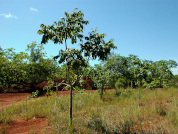
Recuperación de la capa vegetal en una zona desnuda degradada del Cerrado, la sabana brasileña
DOI:
https://doi.org/10.25260/EA.26.36.1.0.2521Palabras clave:
vegetación espontánea, síndromes de dispersión, área degradada, FabaceaeResumen
1. Desde la década de 1960, grandes extensiones del bioma del Cerrado se han destinado a la agricultura, la ganadería, la infraestructura y la minería. Esto fragmentó y degradó gravemente el ecosistema. La construcción de centrales hidroeléctricas intensifica estos impactos al eliminar la vegetación y el suelo, dejando a menudo al descubierto capas de subsuelo compactadas de hasta 10 m de profundidad, lo cual limita la regeneración natural y exige estrategias de recuperación activas.
2. Este estudio evaluó la recuperación de una zona muy degradada del Cerrado mediante el movimiento mecánico del suelo y la incorporación de residuos orgánicos (macrofitas y biocarbón), combinados con la introducción de plántulas autóctonas. Se estudiaron las especies vegetales espontáneas 12 y 36 meses después del inicio del proceso de recuperación, y se evaluó la eficacia en función de la riqueza de especies y el origen de las plantas.
3. Los estudios de vegetación realizados después de 12 y 36 meses revelaron una colonización sustancial, con un total de 72 especies vegetales establecidas en los tres años siguientes a las intervenciones de recuperación.
4. De las especies registradas, 65 eran autóctonas y 7 no autóctonas. La colonización se vio favorecida por la ruptura de la superficie sellada, la reducción de la compactación del suelo y la introducción de plántulas, así como por la dispersión zoocórica y la aportación de propágulos procedentes de fragmentos de vegetación cercanos.
5. Implicancias. En general, los métodos de recuperación aplicados demuestran que la mecanización del suelo, combinada con la incorporación de residuos orgánicos, puede iniciar eficazmente procesos ecológicos y acelerar la recuperación de la vegetación en zonas de subsuelo degradadas del bioma del Cerrado.
Citas
Alves, M. C., V. do Nascimento, and Z. M. de Souza. 2012. Recuperação em área de empréstimo usada para construção de usina hidrelétrica. Rev Bras Eng Agríc Ambient 16(8):887-893. https://doi.org/10.1590/S1415-43662012000800011.
Azevedo, G. A., K. L. Maltoni, F. A. da Silva, G. A. Faria, A. M. R. Cassiolato, and J. R. Azevedo. 2022. Compostagem e vermicompostagem de macrófitas aquáticas para uso agronômico. Research, Society and Development 11(13):e440111329024-e440111329024. https://doi.org/10.33448/rsd-v11i13.29024.
SEPLANCT/MS-Secretaria de Planejamento e coordenação geral do Mato Grosso do Sul. 1990. Atlas multireferencial. SEPLANCT/MS, Campo Grande, MS. Pp. 16-17.
Barbosa, L. M. 2017. Lista de espécies indicadas para restauração ecológica para diversas regiões do Estado de São Paulo. CTP, São Paulo. Pp. 344.
Ben-Dor, E., and A. Banin. 1989. Determination of Organic Matter Content in Arid Zone Soils Using a Simple “Loss-on-Ignition” Method. Commun. Soil Sci Plant Anal 20:1675-1695. https://doi.org/10.1080/00103628909368175.
Bettiol, W. 2023. Entendendo a matéria orgânica do solo em ambientes tropical e subtropical. Brasília, Embrapa. Pp. 788.
Bezemer, T., C. S. Lawson, K. Hedlund, A. R. Edwards, A. J. Brook, J. M. Igual, S. R., Mortimer, and W. H. van Der Putten. 2006. Plant species and functional group effects on abiotic and microbial soil properties and plant-soil feedback responses in two grasslands. J Ecol 94(5):893-904. https://doi.org/10.1111/j.1365-2745.2006.01158.x.
Bienes, R., M. J. Marques, B. Sastre, A. García-Díaz, and M. Ruiz-Colmenero. 2016. Eleven years after shrub revegetation in semiarid eroded soils. Influence in soil properties. Geoderma 273:106-114. https://doi.org/10.1016/j.geoderma.2016.03.023.
Bittar, I. M. B. 2011. Modernização do cerrado brasileiro e desenvolvimento sustentável: revendo a história. Revista Verde Agroecologia e Desenvolvimento Sustentável 6(1):26-38.
Buisson, E., S. Le Stradic, F. A. O. Silveira, G. Durigan, G. E. Overbeck, A. Fidelis, G. W. Fernandes, et al. 2019. Resilience and restoration of tropical and subtropical grasslands, savannas, and grassy woodlands. Biol Rev 94(2):590-609. https://doi.org/10.1111/brv.12470.
Calgaro, H. F., J. Cambuim, A. M. Silva, M. C. Alves, S. Buzetti, M. A. Moraes, S. L. Carvalho, L. P. M. Miranda, and M. L. T. Moraes. 2015. Distribuição natural de espécies arbóreas em áreas com diferentes níveis de antropização. Atributos físicos do solo. Cultura Agronômica 24(2):327-344. https://doi.org/10.32929/2446-8355.2015v24n3p327-344.
Chazdon, R. L. 2013. Tropical Forest Regeneration. Pp. 277-286 in Encyclopedia of Biodiversity. Elsevier. https://doi.org/10.1016/B978-0-12-384719-5.00377-4.
Convention on Biological Diversity. 2020. The Clearing-House Mechanism of the Convention on Biological Diversity. Brasil. 6th National Report for the Convention on Biological Diversity. URL: cbd.int/doc/nr/nr-06/br-nr-06-en.pdf.
Correa, R. S., B. Mélo-Filho, C. Q. Pinheiro, and P. F. Santos. 2015. Floristic woody composition of revegetated mining sites in the Brazilian Federal District. Bioscience Journal 31(3):908-922. https://doi.org/10.14393/BJ-v31n3a2015-22986.
Costa, C. D. O., and M. C. Alves. 2016. Regeneração natural de espécies em uma área degradada sob processo de reabilitação. Revista de Ciências Ambientais 10(2):129-139. https://doi.org/10.18316/1981-8858.16.35.
Costa, I. R., F. S. Araújo, and L. W. Lima-Verde. 2004. Flora e aspectos autoecológicos de um encrave de cerrado na chapada do Araripe, Nordeste do Brasil. Acta Bot Bras 18(4):759-770. https://doi.org/10.1590/S0102-33062004000400006.
Dechoum, M. S., R. B. Sühs, S. M. Futada, and S. R. Ziller. 2021. Distribution of invasive alien species in Brazilian ecoregions and protected areas. Pp. 24-42 in T. Pullaiah and M. R. Ielmini (eds.). Invasive alien species: Observations and issues from around the world. John Wiley and Sons Ltd. https://doi.org/10.1002/9781119607045.ch35.
Deng, L., W. Yan, Y. Zhang, and Z. Shangguan. 2016. Severe depletion of soil moisture following land-use changes for ecological restoration: evidence from northern China. Forest Ecol Manag 366(4):1-10. https://doi.org/10.1016/j.foreco.2016.01.026.
Durigan, G., A. C. G Melo, W. A. Contieri, and H. Nakata. 2004. Regeneração natural da vegetação de cerrado sob florestas plantadas com espécies nativas e exóticas. pp. 349-362 in O. Vilas Boas and G. Durigan (orgs.). Pesquisas em conservação e recuperação ambiental no Oeste Paulista. Páginas e Letras Editora e Gráfica, São Paulo. URL: tinyurl.com/333dtett.
Durigan, G., A. C. G. Melo, J. C. M. Max, O. V. Boas, W. A. Contieri, and V. S. Ramos. 2011. Manual for recovery of Cerrado vegetation, 3rd ed. revised and updated. SMA, São Paulo, Brasil. Pp. 19.
Eiten, G. 1972. The cerrado vegetation of Brazil. The Botanical Review 38(2):201-341. https://doi.org/10.1007/BF02859158.
FAO (Food and Agriculture Organization of the United Nations). 2017. Proceedings of the Global Symposium on Soil Organic Carbon. 2017. FAO, Rome, Italy. Pp. 534.
Ferreira, W. C., A. S. Botelho, A. C. Davide, J. M. R. Faria, D. F. Ferreira. 2010. Regeneração natural como indicador de recuperação de área degradada a jusante da usina hidrelétrica de Camargos. Revista Árvore 34:651-660. https://doi.org/10.1590/S0100-67622010000400009.
Ferreira, M. C., S. B. Rodrigues, and D. L. M. Vieira. 2017. Regeneration through resprouting after clear-cutting and topsoil stripping in a tropical dry forest in central Brazil. Revista Árvore 41:e410218. https://doi.org/10.1590/1806-90882017000200018.
Flora do Brasil, 2018. Jardim Botânico do Rio de Janeiro. URL: floradobrasil.jbrj.gov.br.
Gaikwad, A. S., P. B. Margal, and N. S. Titirmare. 2023. Soil Degradation and Remediation: Strategies for Restoring Soil Quality. Pp. 349-390 in S. A. Chaware, et al. (eds.). Advances in Soil Science, vol. 1(16). Bright Sky Publications, New Delhi. https://doi.org/10.5281/zenodo.8330919.
Gee, G. W., and D. Or. 2002. Particle-size analysis. Pp. 255-293 in J. H. Dane and G. C. Topp (eds.). Methods of Soil Analysis. Soil Science Society of America, Madison. https://doi.org/10.2136/sssabookser5.4.c12.
Giam, X. 2017. Global biodiversity loss from tropical deforestation. Proc Natl Acad Sci 114:5775-5777. https://doi.org/10.1002/ldr.2158.
Hobbs, R. J., and J. A. Harris. 2001. Restoration ecology: repairing the earth’s ecosystems in the new millennium. Restor Ecol 9:239-246. https://doi.org/10.1046/j.1526-100x.2001.009002239.x.
Ilunga, E. I. W., G. Mahy, J. Piqueray, M. Séleck, M. N. Shutcha, P. Meerts, and M. P. Faucon. 2015. Plant functional traits as a promising tool for the ecological restoration of degraded tropical metal-rich habitats and revegetation of metal-rich bare soils: A case study in copper vegetation of Katanga, DRC. Ecol Eng 82:214-221. https://doi.org/10.1016/j.ecoleng.2015.04.084.
INPE - Instituto Nacional de Pesquisas Espaciais, 2020. Plataforma Terra Brasilis. URL: tinyurl.com/hb243dn5.
Jesus, E.M., T. S. Santos, G. T. Ribeiro, M. D. R. Orge, V. O. Amorim, and R. C. R. C. Batista. 2016. Regeneração natural de espécies vegetais em jazidas revegetadas. Floresta e Ambiente 23:191-200. https://doi.org/10.1590/2179-8087.115914.
Khan, M. A. S. A., K. Grant, C. Beierkuhnlein, J. Kreyling, and A. Jentsch. 2014. Climatic extremes lead to species-specific legume facilitation in an experimental temperate grassland. Plant and Soil 379:161-175. doi:10.1007/s11104-014-2050-8.
Kiehl, E. F. 1979. Manual de edafologia: relações solo-planta. Agronômica Ceres, São Paulo. Pp. 262.
Kozlowski, T. T. 1999. Soil-plant-water relations. 2nd ed. Academic Press, San Diego. Pp. 398.
Kuhlmann, M., and J. F. Ribeiro. 2016. Evolution of seed dispersal in the Cerrado biome: ecological and phylogenetic considerations. Acta Bot Bras 30:271-282. https://doi.org/10.1590/0102-33062015abb0331.
Kumar, A., R. Raghuwanshi, and R. Upadhyay. 2010. Arbuscular mycorrhizal technology in reclamation and revegetation of coal mine spoils under various revegetation models, Engineering. 2(9):683-689. https://doi.org/10.4236/eng.2010.29088.
Le, H. D., C. Smith, and J. Herbohn. 2014. What drives the success of reforestation projects in tropical developing countries? The case of the Philippines. Global Environ Change 24:334-348. https://doi.org/10.1016/j.gloenvcha.2013.09.010.
Liao, Y., L. Dong, A. Li, W. Lv, J. Wu, H. Zhang, R. Bai, Y. Liu, J. Li, Z. Shangguan, and L. Deng. 2023. Soil physicochemical properties and crusts regulate the soil infiltration capacity after land-use conversions from farmlands in semiarid areas. J Hydrol 626(A):130283. https://doi.org/10.1016/j.jhydrol.2023.130283.
Lima, V. S., A. L. B. Sartori, and V. A. Assunção. 2015. Floristic consistency patterns in Chaco communities: Fabaceae species representativeness in restrictive soils. Acta Botanica Brasilica 29(3):559-569. https://doi.org/10.1590/0102-33062015abb0306.
Liu X., M. R. Rashti, A. Dougall, M. Esfandbod, L. van Zwieten, and C. Chen. 2018. Subsoil application of compost improved sugarcane yield through enhanced supply and cycling of soil labile organic carbon and nitrogen in an acidic soil at tropical Australia. Soil Tillage Res 180:73-81. https://doi.org/10.1016/j.still.2018.02.013.
Mantovani, A., A. Reis, A. Anjos, A. Siminski, A. C. Fantini, and A. Puchalski. 2005. Inventário e manejo florestal: amostragem, caracterização de estádios sucessionais na vegetação catarinense e manejo do palmiteiro (Euterpe edulis) em regime de rendimento sustentável. NPFT - Núcleo de Pesquisas em Florestas Tropicais, Florianópolis, Brasil.
Martins, C. R., J. D. V. Hay, M. Scaléa, and J. V. Malaquias. 2017. Management techniques for the control of Melinis minutiflora P. Beauv. (molasses grass): ten years of research on an invasive grass species in the Brazilian Cerrado. Acta Botanica Brasilica 31(4):546-554. https://doi.org/10.1590/0102-33062016abb0433.
McLean, E. O., D. Adams, and R. E. Franklin. 1956. Cation exchange capacities of plant roots as related to their nitrogen contents. Soil Sci Soc Am J 20:345-347. https://doi.org/10.2136/sssaj1956.03615995002000030013x.
Meira-Neto, J. A. A., G. S. Tolentino, M. C. N. A Silva, A. V. Neri, M. Gastauer, L. F. S., Magnago, et al. 2017. Functional antagonism between nitrogen-fixing leguminous trees and calcicole-drought-tolerant trees in the Cerrado. Acta Bot Bras 31(1):11-18. https://doi.org/10.1590/01047760201521021405.
Munhoz, C. B. R., and G. M. Araújo. 2011. Métodos de amostragem do estrato herbáceo-subarbustivo. Pp. 213-230 in J. M. Felfili, P.V. Eisenlohr, M. M. R. F. Melo, L. A. Andrade and J. A. A. Meira Neto (eds.). Fitossociologia no Brasil: métodos e estudos de casos. Editora UFV, Viçosa, Brasil.
Neto, M. J., H. C. B. Otsubo, and A. M. R. Cassiolato. 2010. Plantas ruderais. Editora UFMS, Campo Grande, Brasil. Pp. 358.
Niang, D., H. Yacouba, C. V. Doto, H. Karambiri, and R. Lahmar. 2015. Land degradation impact on water transfer of soil-plant-atmosphere continuum in the Burkinabe Sahel. Larhyss J 24:109-127.
Ochoa, P.A., A. Fries, D. Mejía, J. I. Burneo, J. D. Ruíz-Sinoga, and A. Cerdà. 2016. Effects of climate, land cover and topography on soil erosion risk in a semiarid basin of the Andes. Catena 140:31-42. https://doi.org/10.1016/j.catena.2016.01.011.
Oliveira, A. K. M., U. M. Resende, and E. J. D. Schleder. 2014. Espécies vegetais e suas síndromes de dispersão em um remanescente de cerrado (sentido restrito) do município de Campo Grande, Mato Grosso do Sul. Ambiência 10(2):565-580. https://doi.org/10.5935/ambiencia.2014.02.10.
Parente, L., S. Nogueira, L. Baumann, C. Almeida, L. Maurano, A. G. Affonso, and L. Ferreira. 2021. Quality assessment of the PRODES Cerrado deforestation data. Remote Sens Appl Soc Environ 21:100444. https://doi.org/10.1016/j.rsase.2020.100444.
Peixoto, D. S., da Silva, L. D. C. M., de Melo, L. B. B., Azevedo, R. P., Araújo, B. C. L., de Carvalho, T. S., et al. 2020. Occasional tillage in no-tillage systems: A global meta-analysis. Science Of The Total Environment 745:140887. https://doi.org/10.1016/j.scitotenv.2020.140887.
Pellizzaro, K. F., A. O. Cordeiro, M. Alves, et al., 2017. “Cerrado” restoration by direct seeding: field establishment and initial growth of 75 trees, shrubs and grass species. Braz J Bot 40(3):681-693. https://doi.org/10.1007/s40415-017-0371-6.
Pilon, N. A. L., and G. Durigan. 2013. Critérios para indicação de espécies prioritárias para a restauração da vegetação de cerrado. Sci For 41(99):389-399. URL: tinyurl.com/rdwurjk6.
Pilon, N. A. L., M. G. B. Cava, W. A. Hoffmann, R. C. R. Abreu, A. Fidelis, and G. Durigan. 2021. The diversity of postfire regeneration strategies in the Cerrado ground layer. J Ecol 109(1):154-166. https://doi.org/10.1111/1365-2745.13456.
Polhill, R. M., and P. H. Raven. 1981. Advances in Legume Systematics. Royal Botanic Gardens, Kew, UK.
Pouteau, R., M. van Kleunen, and D. Strasberg. 2023. Closely related aliens lead to greater extinction risk. Bio Conserv 284:110148. https://doi.org/10.1016/j.biocon.2023.110148.
Ratter, J. A., S. Bridgewater, and J. F. Ribeiro. 2001. Espécies lenhosas da fitofisionomia cerrado sentido amplo em 170 localidades do bioma Cerrado. Bol Herb Ezechias Paulo Heringer 7:1-138.
Ratter, J. A., S. Bridgewater, and J. F. Ribeiro. 2003. Analysis of the floristic composition of the Brazilian cerrado vegetation III: comparison of the woody vegetation of 376 areas. Edinburgh J Bot 60(1):57-109. https://doi.org/10.1017/S0960428603000064.
Reid, J. L., K. D. Holl, and R. A. Zahawi. 2015. Seed dispersal limitations shift over time in tropical forest restoration. Ecol Appl 25:1072-1082. https://doi.org/10.1890/14-1399.1.
Rodrigues, G. B., K. L. Maltoni, and A. M. R. Cassiolato. 2007. Dinâmica da regeneração do subsolo de áreas degradadas dentro do bioma cerrado. Rev Bras Eng Agríc Ambient 11(1):73-80. https://doi.org/10.1590/S1415-43662007000100010.
Russell, J. M., and D. Ward. 2016. Historical land-use and vegetation change in northern Kwazulu-Natal, South Africa. Land Degrad Develop 27:1691-1699. https://doi.org/10.1002/ldr.2476.
Sano, E. E., A. A. Rodrigues, E. S. Martins, G. M. Bettiol, M. M. C. Bustamante, A. S. Bezerra, et al. 2019. Cerrado ecoregions: a spatial framework to assess and prioritize Brazilian savanna environmental diversity for conservation. J Environ Manag 15(232):818-828. https://doi.org/10.1016/j.jenvman.2018.11.108.
Santos, B. R., J. A. Pereira, M. L. Oliveira, C. T. V. Rocha, and V. Londe. 2020. Forest matrix favors the recovering of seed rain in areas undergoing restoration. Floresta Ambient 27(4):e20180190. https://doi.org/10.1590/2179-8087.019018.
Sartorelli, P. A. R., and E. M. Campos Filho. 2007. Guia de plantas da regeneração natural do Cerrado e da Mata Atlântica. Agroicone, São Paulo, Brasil. Pp. 140.
Sawyer, D., L. O. Sousa, J. M. C. Silva, L. G. Ferreira, R. Beuchle, P. M. Fearnside, and D. Nepstad. 2018. Critical ecosystem partnership fund ecosystem profile: Cerrado biodiversity hotspot, full report. Supernova, Brasília, Brasil. Pp. 145.
Silva Júnior, M. C. 2005. 100 árvores do cerrado: guia de campo. Rede de Sementes do Cerrado, Brasília, Brasil. Pp. 278.
Sloan, S., C. N. Jenkins, L. N. Joppa, D. L. A. Gaveau, and W. F. Laurance. 2014. Remaining natural vegetation in the global biodiversity hotspots. Biological Conservation 177:12-24. https://doi.org/10.1016/j.biocon.2014.05.027.
Stumpf, L., E. A. Pauletto, L. F. S. Pinto, L. O. Geissler, D. D. Castilhos, D. L. Souza, J. P. Pimentel, and L. A. Dutra Junior. 2018. Qualidade biológica e física de um solo minerado sob revegetação com gramíneas perenes. Rev Bras Ciênc Agrárias 13(1):1-7. https://doi.org/10.5039/agraria.v13i1a5498.
Tang, G., and K. Li. 2014. Soil amelioration through afforestation and self-repair in a degraded valley-type savanna. For Ecol Manag 320:13-20. https://doi.org/10.1016/j.foreco.2014.02.018.
Teixeira, P. C., G. K. Donagema, D. Campos, N. Curi, and I. V. Lima. 2017. Manual de métodos e análises de solo, 3rd ed. revisada e ampliada. Embrapa, Brasília, Brasil. Pp. 574.
Chase, M. W., M. J. M. Christenhusz, M. F. Fay, J. W. Byng, W. S. Judd, D. E. Soltis, D. J. Mabberley, et al. 2016. An update of the Angiosperm Phylogeny Group classification for the orders and families of flowering plants: APG IV. Botanical Journal of the Linnean Society 181(1):1-20. https://doi.org/10.1111/boj.12385.
Thomaz, S. M., S. A. Esteves, K. J. Murphy, A. M. Santos, A. Caliman, and R. D. Guariento. 2008. Aquatic macrophytes in the tropics: ecology of populations and communities, impacts of invasions and use by man, Pp. 1252-1280 in K. Del-Claro, F. R. Scarano and H. Luettge. Enc. of Live Support Systems, UNESCO.
van der Pijl, L. 1982. Principles of dispersal in higher plants, 3rd ed. Springer-Verlag, New York, EUA. Pp. 199. https://doi.org/10.1007/978-3-642-87925-8.
Vieira, D. L. M., F. G. Aquino, M. A. Brito, C. Fernandes-Bulhão, and R. P. B. Henriques. 2002. Síndromes de dispersão de espécies arbustivo-arbóreas em cerrado sensu stricto do Brasil Central e savanas amazônicas. Revista Brasileira de Botânica 25(2):215-220. https://doi.org/10.1590/S0100-84042002000200009.
Xiao, W., H. Ren, and T. Sui. 2022. A drone- and field-based investigation of the land degradation and soil erosion at an opencast coal mine dump after 5 years’ evolution of natural processes. Int J Coal Sci Techno 9:42. https://doi.org/10.1007/s40789-022-00513-0.
Yi, R., X. Xu, S. Zhu, Y. Zhang, F. Zhong, X. Zeng, and C. Xu. 2021. Difference in hydraulic resistance between planted forest and naturally regenerated forest and its implications for ecosystem restoration in subtropical karst landscapes. J Hydrol 596:126093. https://doi.org/10.1016/j.jhydrol.2021.126093.
Descargas
Publicado
Cómo citar
Número
Sección
Licencia
Derechos de autor 2026 Thais S. Boni, Ana M. R. Cassiolato, Kátia L. Maltoni

Esta obra está bajo una licencia internacional Creative Commons Atribución 4.0.
Las/os autoras/es conservan sus derechos de autoras/es: 1) cediendo a la revista el derecho a su primera publicación, y 2) registrando el artículo publicado con una Licencia de Atribución de Creative Commons (CC-BY 4.0), lo que permite a autoras/es y terceros verlo y utilizarlo siempre que mencionen claramente su origen (cita o referencia incluyendo autoría y primera publicación en esta revista). Las/os autores/as pueden hacer otros acuerdos de distribución no exclusiva siempre que indiquen con claridad su origen, así como compartir y divulgar ampliamente la versión publicada de su trabajo.