Los recientes incendios en la Comarca Andina del Paralelo 42: Pasado, presente y futuro en un territorio dinámico y complejo
DOI:
https://doi.org/10.25260/EA.26.36.3.0.2599Palabras clave:
cambio climático, combustibles forestales, crecimiento demográfico, interfase rural-urbano, manejo forestal, Patagonia, urbanizaciónResumen
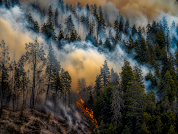
1. En la última década, la Comarca Andina del Paralelo 42 experimentó numerosos incendios forestales de gran extensión y alta severidad que generaron múltiples impactos socioambientales a diferentes escalas. Su ocurrencia refleja la convergencia de procesos como condiciones meteorológicas extremas, acumulación de combustibles forestales, escaso manejo forestal sostenible y un desordenado crecimiento demográfico en zonas urbanas y de interfase.
2. Este nuevo escenario socioambiental resulta en un paisaje muy vulnerable al fuego que, de no mediar cambios, se intensificará en el futuro. La planificación de un territorio en constante transformación requiere un enfoque territorial que contemple integralmente, desde una perspectiva socioecológica, todos los procesos descritos.
3. Para esto es indispensable un debate colectivo y participativo a fin de redefinir el modelo de desarrollo territorial, con especial énfasis en el desarrollo urbano y las actividades antrópicas en áreas boscosas y de interfase.
4. Resulta imprescindible un enfoque integral en la gestión del fuego a corto y mediano plazo en acciones de prevención y mitigación basadas en el fortalecimiento comunitario respecto de la complejidad del fuego y la noción de riesgo. Esto implica considerar tanto las actividades socioeconómicas y culturales arraigadas en el territorio como el marco político e institucional.
5. Implicancias. La planificación territorial debe concebirse como una herramienta estratégica para anticipar riesgos, minimizar impactos y promover una cultura del fuego sustentada en la educación ambiental, la organización social y el compromiso colectivo. El contexto actual plantea desafíos complejos para la gestión, la planificación territorial y el desarrollo de políticas públicas a corto y mediano plazo en la región.
Citas
Abreu, S. J. D. 2021. Toward a Holistic Approach: Considerations for Improved Collaboration in Wildfire Management. Open J 12:107-121. https://doi.org/10.4236/ojf.2022.121006.
Alcañiz, I., and R. A. Gutiérrez. 2020. Between the global commodity boom and subnational state capacities: Payment for environmental services to fight deforestation in Argentina. Global Environmental Politics 20(1):38-59. https://doi.org/10.1162/glep_a_00535.
Allen, C. D., A. K. Macalady, H. Chenchouni, D. Bachelet, N. McDowell, et al. 2010. A global overview of drought and heat-induced tree mortality reveals emerging climate change risks for forests. Forest Ecology and Management 259:660-684. https://doi.org/10.1016/j.foreco.2009.09.001.
Almazroui, M., M. Ashfaq, M. N. Islam, I. U. Rashid, S. Kamil, et al. 2021. Assessment of CMIP6 Performance and Projected Temperature and Precipitation Changes Over South America. Earth Systems and Environment 5:155-183. https://doi.org/10.1007/s41748-021-00233-6.
Amoroso, M. M., and B. C. Larson. 2010. Stand development patterns as a consequence of the mortality in Austrocedrus chilensis forests. Forest Ecology and Management 259:1981-1992. https://doi.org/10.1016/j.foreco.2010.02.009.
Amoroso, M. M., L. D. Daniels, R. Villalba, and P. Cherubini. 2015. Does drought incite tree decline and death in Austrocedrus chilensis forests? Journal of Vegetation Science 26:1171-1183. https://doi.org/10.1111/jvs.12320.
Barberá, I., A. M. Cingolani, F. Tiribelli, M. A. Mermoz, J. M. Morales, et al. 2025. Biotic and physical drivers of fire in northwestern Patagonia. Fire Ecology 21(1):1-21. https://doi.org/10.1186/s42408-025-00353-8.
Barros, V., and C. Vera (eds.). 2014. Cambio climático en Argentina, tendencias y proyecciones. Tercera Comunicación Nacional sobre Cambio Climático. Secretaría de Ambiente y Desarrollo Sustentable de la Nación, Buenos Aires, Argentina.
Bento-Gonçalves, A., and A. Vieira. 2020. Wildfires in the wildland-urban interface: Key concepts and evaluation methodologies. Science of the total environment 707:135592. https://doi.org/10.1016/j.scitotenv.2019.135592.
Bondel, S. 2008. Transformaciones territoriales y análisis geográfico en ámbitos patagónicos de montaña. La Comarca Andina del Paralelo 42. Facultad de Humanidades y Ciencias de la Educación, Universidad Nacional de La Plata, La Plata, Buenos Aires, Argentina.
Brendel, A. S., R. A. del Barrio, F. Mora, E. A. Orrego León, J. Rosales Flores, et al. 2020. Current agro-climatic potential of Patagonia shaped by thermal and hydric patterns. Theoretical and Applied Climatology 142:855-868. https://doi.org/10.1007/s00704-020-03350-w.
Brenkert-Smith, H., P. A. Champ, and N. Flores. 2006. Insights Into Wildfire Mitigation Decisions Among Wildland-Urban Interface Residents. Society and Natural Resources 19(8):759-768. https://doi.org/10.1080/08941920600801207.
Castellnou, M., N. Prat-Guitart, E. Arilla, A. Larrañaga, E. Nebot, et al. 2019. Empowering strategic decision-making for wildfire management: avoiding the fear trap and creating a resilient landscape. Fire Ecology 15:31. https://doi.org/10.1186/s42408-019-0048-6.
CIEFAP, and MAyDS. 2016. Actualización de la clasificación de los tipos forestales y cobertura del suelo de la región bosque Andino-Patagónico. Informe final, CIEFAP, Esquel, Argentina. URL: tinyurl.com/4a893jb9.
Cowan, C., and E. B. Kennedy. 2023. Determinants of residential wildfire mitigation uptake: A scoping review, 2013-2022. Fire Safety Journal 140:103851. https://doi.org/10.1016/j.firesaf.2023.103851.
Curth, M. de T., C. Biscayart, L. Ghermandi, and G. Pfister. 2012. Wildland-Urban Interface Fires and Socioeconomic Conditions: A Case Study of a Northwestern Patagonia City. Environmental Management 49(4):876-891. https://doi.org/10.1007/s00267-012-9825-6.
Defossé, G. E. 2021. Fuegos de vegetación: Evolución de un fenómeno socioecológico global y su impacto en la Interfase Urbano-Rural (IUR) de la Patagonia andina de Argentina. Ciencia e Investigación 71(2):5-20.
Dillehay, T. D., C. Ocampo, J. Saavedra, A. Olivera Sawakuchi, R. M. Vega, et al. 2015. New Archaeological Evidence for an Early Human Presence at Monte Verde, Chile. PLoS One 10:e0141923. https://doi.org/10.1371/journal.pone.0141923.
Dimitri, M. 1972. La región de los bosques andino-patagónicos de Argentina. Sinopsis general. Colección Científica del Inta. Tomo X. Buenos Aires, Argentina.
Dimitrov, R. S. 2020. Empty institutions in global environmental politics. International Studies Review 22(3):626-650. https://doi.org/10.1093/isr/viz029.
Ekayani, M., D. R. Nurrochmat, and D. Darusman. 2016. The role of scientists in forest fire media discourse and its potential influence for policy-agenda setting in Indonesia. Forest Policy and Economics 68:22-29. https://doi.org/10.1016/j.forpol.2015.01.001.
Garcia, R. M., and M. B. Rasmussen. 2023. Settling environmental citizenship: The presentation of self in conservation encounters. The Journal of Latin American and Caribbean Anthropology 29:17-26.https://doi.org/10.1111/jlca.12692.
Ghermandi, L., N. A. Beletzky, M. I. de Torres Curth, and F. J. Oddi. 2016. From leaves to landscape: A multiscale approach to assess fire hazard in wildland-urban interface areas. Journal of Environmental Management 183:925-937. https://doi.org/10.1016/j.jenvman.2016.09.051.
Godoy, M. M., S. Martinuzzi, H. A. Kramer, G. E. Defossé, J. Argañaraz, et. al. 2019. Rapid WUI growth in a natural amenity-rich region in central-western Patagonia, Argentina. International Journal of Wildland Fire 28(7):473-484. https://doi.org/10.1071/WF18097.
Godoy, M. M., S. Martinuzzi, P. Masera, and G. E. Defossé. 2022. Forty years of wildland urban interface growth and its relation with wildfires in central-western Chubut, Argentina. Frontiers in Forests and Global Change 5:850543. https://doi.org/10.3389/ffgc.2022.850543.
Gorelick, N., M. Hancher, M. Dixon, S. Ilyushchenko, D. Thau, et al. 2017. Google Earth Engine: Planetary-scale geospatial analysis for everyone. Remote sensing of Environment 202:18-27. https://doi.org/10.1016/j.rse.2017.06.031.
Hansen, M. C., P. V. Potapov, A. Pickens, A. Tyukavina, A. Hernández Serna, et al. 2022. Global land use extent and dispersion within natural land cover using Landsat data. Environmental Research Letters 17:034050. https://doi.org/10.1088/1748-9326/ac46ec.
Heusser, C. J., J. Rabassa, and A. Brandani. 1988. Late-Holocene vegetation of the Andean Araucaria region, Province of Neuquén, Argentina. Mountain Research and Development 8:53-63. https://doi.org/10.2307/3673406.
Holz, A., S. Haberle, T. T. Veblen, R. De Pol-Holz, and J. Southon. 2012. Fire history in western Patagonia from paired tree-ring fire-scar and charcoal records. Climate of the Past 8(2):451-466. https://doi.org/10.5194/cp-8-451-2012.
Holz, A., C. Méndez, L. Borrero, A. Prieto, F. Torrejón, et al. 2016. Fires: the main human impact on past environments in Patagonia? PAGES Magazine 24:72-73. https://doi.org/10.22498/pages.24.2.72.
Huidobro, G., L. Giessen, and S. L. Burns. 2024. And it burns, burns, burns, the ring-of-fire: reviewing and harmonizing terminology on wildfire management and policy. Environmental Science and Policy 157:103776. https://doi.org/10.1016/j.envsci.2024.103776.
Huidobro, G., L. Giessen, N. I. Gasparri, and S. L. Burns. 2025. Beyond wildfire crisis: explaining policy changes in the wildfire governance subsystem in Argentina through longitudinal analysis. Journal of Environmental Policy and Planning 1-24. https://doi.org/10.1080/1523908X.2025.2601124.
Secretaría de Desarrollo Económico. 2021. Informe de situación para promover la recuperación productiva de la Comarca del Paralelo 42. Secretaría de Desarrollo Económico, Municipalidad de El Hoyo, El Hoyo, Chubut, Argentina.
Instituto Nacional de Estadística y Censos. 2012. Censo Nacional de Población, Hogares y Viviendas 2010: Censo del Bicentenario: Resultados definitivos. Serie B Nº 2. Buenos Aires: INDEC. URL: censo.gob.ar.
Instituto Nacional de Estadística y Censos. 2023. Censo Nacional de Población, Hogares y Viviendas 2022: Resultados provisionales. Buenos Aires: INDEC. URL: censo.gob.ar.
Ministerio de Ambiente y Desarrollo Sostenible (MAyDS). 2021. Informe de Áreas Quemadas Incendios “Las Golondrinas” y “El Boquete”, Provincias de Río Negro y Chubut. Dirección Nacional de Planificación y Ordenamiento Ambiental del Territorio, Ministerio de Ambiente y Desarrollo Sostenible (MAyDS), Buenos Aires, Argentina.
Key, C. H., and N. C. Benson. 2006. Landscape Assessment: Ground Measure of Severity, the Composite Burn Index; and Remote Sensing of Severity, the Normalized Burn Ratio. En D. C. Lutes, R.E. Keane, J. F. Caratti, C. H. Key, N. C. Benson, S. Sutherland and L. J. Gangi (eds.). FIREMON: Fire effects monitoring and inventory system. Gen. Tech. Rep. US Department of Agriculture, Forest Service, Rocky Mountain Research Station, Fort Collins, Colorado, USA.
Kitzberger, T., T. T. Veblen, and R. Villalba. 1997. Climatic influences on fire regimes along a rain forest to xeric woodland gradient in northern Patagonia, Argentina. Journal of Biogeography 24:35-47. https://doi.org/10.1111/j.1365-2699.1997.tb00048.x.
Kitzberger, T., and T. T. Veblen. 1997. Influences of humans and ENSO on fire history of Austrocedrus chilensis woodlands in northern Patagonia, Argentina. Ecoscience 4(4):508-520. https://doi.org/10.1080/11956860.1997.11682430.
Kitzberger, T., and T. T. Veblen. 1999. Fire-induced changes in northern Patagonian landscapes. Landscape Ecology 14(1):1-15. https://doi.org/10.1023/A:1008069712826.
Kitzberger, T., E. Aráoz, J. H. Gowda, M. Mermoz, and J. M. Morales. 2012. Decreases in fire spread probability with forest age promotes alternative community states, reduced resilience to climate variability and large fire regime shifts. Ecosystems 15(1):97-112. https://doi.org/10.1007/s10021-011-9494-y.
Kitzberger, T., G. L. W. Perry, J. Paritsis, J. H. Gowda, A. J. Tepley, et al. 2016. Fire vegetation feedbacks and alternative states: common mechanisms of temperate forest vulnerability to fire in southern South America and New Zealand. New Zealand Journal of Botany 8643:1-26. https://doi.org/10.1080/0028825X.2016.1151903.
Kitzberger, T., F. Tiribelli, I. Barberá, J. H. Gowda, J. M. Morales, et al. 2022. Projections of fire probability and ecosystem vulnerability under 21st century climate across a trans-Andean productivity gradient in Patagonia. Science of the Total Environment 156303. https://doi.org/10.1016/j.scitotenv.2022.156303.
König, H. J., S. Uthes, J. Schuler, L. Zhen, S. Purushothaman, et al. 2013. Regional impact assessment of land use scenarios in developing countries using the FoPIA approach: Findings from five case studies. Journal of Environmental Management 127:S56-S64. https://doi.org/10.1016/j.jenvman.2012.10.021.
Landesmann, J. B., F. Tiribelli, J. Paritsis, T. T. Veblen, and T. Kitzberger. 2021. Increased fire severity triggers positive feedbacks of greater vegetation flammability and favors plant community‐type conversions. Journal of Vegetation Science 32(1):e12936. https://doi.org/10.1111/jvs.12936.
McDowell, C. 2013. Climate-Change Adaptation and Mitigation: Implications for Land Acquisition and Population Relocation. Development Policy Review 31:677-695. https://doi.org/10.1111/dpr.12030.
Mermoz, M., T. Kitzberger, T., and T. T. Veblen. 2005. Landscape influences on occurrence and spread of wildfires in Patagonian forests and shrublands. Ecology 86(10):2705-2715. https://doi.org/10.1890/04-1850.
Mockrin, M. H., H. K. Fishler, and S. I. Stewart. 2018. Does wildfire open a policy window? Local government and community adaptation after fire in the United States. Environmental Management 62:210-228. https://doi.org/10.1007/s00267-018-1030-9.
Mowery, M. 2018. Living on the edge: get to know your WUI. American Planning Association. URL: tinyurl.com/y4fzajm5.
Mundo, I. A., V. A. El Mujtar, M. H. Perdomo, L. A. Gallo, R. Villalba, et al. 2010. Austrocedrus chilensis growth decline in relation to drought events in northern Patagonia, Argentina. Trees 24:561-570. https://doi.org/10.1007/s00468-010-0427-8.
Mundo, I. A., R. Villalba, T. T. Veblen, T. Kitzberger, A. Holz, et al. 2017. Fire history in southern Patagonia: human and climate influences on fire activity in Nothofagus pumilio forests. Ecosphere 8(9):e01932. https://doi.org/10.1002/ecs2.1932.
Mundo, I. A., A. Holz, M. E. González, and J. Paritsis. 2017. Fire History and Fire Regimes Shifts in Patagonian Temperate Forests. Pp. 211-229 en M. M. Amoroso, L. D. Daniels, P. J. Baker and J. J. Camarero (eds.). Dendroecology: Tree-ring analyses applied to ecological studies. Springer, Cham. https://doi.org/10.1007/978-3-319-61669-8_9.
Oliveras Menor, I., N. Prat-Guitart, G. L. Spadoni, A. Hsu, P. M. Fernandes, et al. 2025. Integrated fire management as an adaptation and mitigation strategy to altered fire regimes. Commun Earth Environ 6:202. https://doi.org/10.1038/s43247-025-02165-9.
O’Farrell, P. J., and P. M. Anderson. 2010. Sustainable multifunctional landscapes: A review to implementation. Current Opinion in Environmental Sustainability 2(1-2):59-65. https://doi.org/10.1016/j.cosust.2010.02.005.
Paritsis, J., T. T. Veblen, and A. Holz. 2015. Positive fire feedbacks contribute to shifts from Nothofagus pumilio forests to fire‐prone shrublands in Patagonia. Journal of Vegetation Science 26(1):89-101. https://doi.org/10.1111/jvs.12225.
Paritsis, J., J. B. Landesmann, T. T. Kitzberger, F. Tiribelli, F., Y. Sasal, et al. 2018. Pine plantations and invasion alter fuel structure and potential fire behavior in a Patagonian forest-steppe ecotone. Forests 9(3):117. https://doi.org/10.3390/f9030117.
Paruelo, J. M., A. Beltrán, E. Jobbágy, O. E. Sala, and R. A. Golluscio. 1998. El clima de la Patagonia: patrones generales y controles sobre los procesos bióticos. Ecología Austral 8:85-101.
Pessaq, N., F. Silvia, F., S. Solman, and M. Pascual 2020. Climate change in northern Patagonia: critical decrease in water resources. Theoretical and Applied Climatology 140:807-822. https://doi.org/10.1007/s00704-020-03104-8.
Potapov, P., M. C. Hansen, A. Pickens, A. Hernández-Serna, A. Tyukavina, et al. 2022. The global 2000-2020 land cover and land use change dataset derived from the Landsat archive: first results. Frontiers in Remote Sensing 3:856903. https://doi.org/10.3389/frsen.2022.856903.
QGIS.org. 2025. QGIS Geographic Information System (Versión 3.40.7 ‘Bratislava’). QGIS Association. URL: qgis.org.
Radeloff, V. C., R. B. Hammer, S. I. Stewart, J. S. Fried, S. S. Holcomb, et al. 2005. The wildland-urban interface in the United States. Ecological applications 15(3):799-805. https://doi.org/10.1890/04-1413.
Rametsteiner, E., H. Pülzl, J. Alkan-Olsson, and P. Frederiksen. 2011. Sustainability indicator development—Science or political negotiation? Ecological Indicators 11(1):61-70. https://doi.org/10.1016/j.ecolind.2009.06.009.
Robinson, J. 2004. Squaring the circle? Some thoughts on the idea of sustainable development. Ecological Economics 48(4):369-384. https://doi.org/10.1016/j.ecolecon.2003.10.017.
Rodríguez-Catón, M., R. Villalba, M. S. Morales, and A. M. Srur. 2016. Influence of droughts on Nothofagus pumilio forest decline across northern Patagonia, Argentina. Ecosphere 7:e01390. https://doi.org/10.1002/ecs2.1390.
Schulte, S., and K. A. Miller. 2010. Wildfire Risk and Climate Change: The Influence on Homeowner Mitigation Behavior in the Wildland-Urban Interface. Society and Natural Resources 23(5):417-435. doi:10.1080/08941920903431298.
Seidl, R., T. A. Spies, D. L Peterson, S. L Stephens, and J. A. Hicke. 2016. REVIEW: Searching for resilience: addressing the impacts of changing disturbance regimes on forest ecosystem services. Journal of Applied Ecology 53:120-129. https://doi.org/10.1111/1365-2664.12511.
Stewart, S. I., V. C. Radeloff, R. B. Hammer, and T. J. Hawbaker. 2007. Defining the wildland-urban interface. Journal of Forestry 105(4):201-207. https://doi.org/10.1093/jof/105.4.201.
Spinoni, J., P. Barbosa, E. Bucchignani, J. Cassano, T. Cavazos, et al. 2020. Future global meteorological drought hotspots: a study based on CORDEX data. Journal of Climate 33(9):3635-3661. https://doi.org/10.1175/JCLI-D-19-0084.1.
Srur, A., M. M. Amoroso, I. A. Mundo, M. S. Morales, M. Rodríguez-Catón, et al. 2020. Forest dynamics in the Argentinean Patagonian Andes Lessons learned from dendroecology. Pp. 171-201 en M. Pompa-Garcia, J. J. Camarero (eds.). Latin American Dendroecology: Combining tree-ring sciences and ecology in a mega diverse territory. Springer, Cham, New York, USA. https://doi.org/10.1007/978-3-030-36930-9_8.
Suarez, M. L., L. Ghermandi, and T. Kitzberger. 2004. Factors predisposing episodic drought-induced tree mortality in Nothofagus—site, climatic sensitivity and growth trends. Journal of Ecology 92:954-966. https://doi.org/10.1111/j.1365-2745.2004.00941.x.
Suarez, M. L., and T. Kitzberger. 2010. Differential effects of climate variability on forest dynamics along a precipitation gradient in northern Patagonia. Journal of Ecology 98:1023-1034. https://doi.org/10.1111/j.1365-2745.2010.01698.x.
Tiribelli, F., J. M. Morales, J. H. Gowda, M. Mermoz, M., and T. Kitzberger. 2019. Non-additive effects of alternative stable states on landscape flammability in NW Patagonia: fire history and simulation modelling evidence. International Journal of Wildland Fire 28(2):149-159. https://doi.org/10.1071/WF18073.
Tiribelli, F., J. Paritsis, I. Barberá, and T. Kitzberger. 2024. Spatial and temporal opportunities for forest resilience promoted by burn severity attenuation across a productivity gradient in north western Patagonia. International Journal of Wildland Fire 33(2). https://doi.org/10.1071/WF23098.
Veblen, T. T., T. Kitzberger, R. Villalba, and J. Donnegan. 1999. Fire history in Northern Patagonia: the roles of humans and climatic variation. Ecological Monographs 69:47-67. https://doi.org/10.2307/2657194.
Veblen, T. T., T. Kitzberger, E. Raffaele, and D. C. Lorenz. 2003. Fire History and Vegetation Changes in Northern Patagonia, Argentina. Pp. 265-293 en T. T. Veblen, W. L. Baker, G. Montenegro and T. W. Swetnam (eds.). Fire and Climatic Change in Temperate Ecosystems of the Western Americas. Springer-Verlag, New York, USA. https://doi.org/10.1007/0-387-21710-X_9.
Veblen, T. T., T. Kitzberger, E. Raffaele, M. Mermoz, M. E. Gonzalez, et al. 2008. The historical range of variability of fires in the Andean-Patagonian Nothofagus forest region. International Journal of Wildland Fire 17:724-741. https://doi.org/10.1071/WF07152.
Veblen, T. T., A. Holz, J. Paritsis, E. Raffaele, T. Kitzberger, and M. Blackhall. 2011. Adapting to global environmental change in Patagonia: what role for disturbance ecology? Austral Ecology 36:891-903. https://doi:10.1111/j.1442-9993.2010.02236.x.
Whitlock, C., P. L. Moreno, and P. Bartlein. 2007. Climatic controls of Holocene fire patterns in southern South America. Quaternary Research 68:28-36. https://doi.org/10.1016/j.yqres.2007.01.012.
Descargas
Archivos adicionales
Publicado
Cómo citar
Número
Sección
Licencia
Derechos de autor 2026 Mariano M. Amoroso, Daniela Arpigiani, Rocío García, Tomás González, Melina Páez

Esta obra está bajo una licencia internacional Creative Commons Atribución 4.0.
Las/os autoras/es conservan sus derechos de autoras/es: 1) cediendo a la revista el derecho a su primera publicación, y 2) registrando el artículo publicado con una Licencia de Atribución de Creative Commons (CC-BY 4.0), lo que permite a autoras/es y terceros verlo y utilizarlo siempre que mencionen claramente su origen (cita o referencia incluyendo autoría y primera publicación en esta revista). Las/os autores/as pueden hacer otros acuerdos de distribución no exclusiva siempre que indiquen con claridad su origen, así como compartir y divulgar ampliamente la versión publicada de su trabajo.