The self-purification capacity of an urban stream and the loss of ecosystem services
DOI:
https://doi.org/10.25260/EA.25.35.3.0.2484Keywords:
ecosystem services, self-depuration, urban stream, point pollutionAbstract
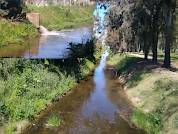
The hypothesis was that all streams, even those highly transformed, retain some of their capacity to provide ecosystem services. The Salgado stream is an urban stream located in the city of Lobos; it is channelled to prevent flooding and promote faster flow of its waters. In its middle section, this stream receives the drainage of the treated effluent from Lobos. Its purification capacity was analysed using two methods, and in two adjacent reaches. In one approach, the wastewater treatment plant effluent was considered a continuous addition of nutrients, and stations were established downstream to analyse the potential for retention of these materials and selfpurification of the stream. In the other approach, sewage effluent was added using a peristaltic pump. After the entire water body was mixed and stabilized, samples were taken downstream to evaluate the nutrient uptake and retention capacity of other materials. In both cases, metrics were used to estimate the length of the nutrient spiral as a measure of self-purification capacity for phosphates, nitrates, ammonium and particulate matter. In cases where the spiral length could be estimated, it was up to 15 and 20 times shorter upstream of the wastewater treatment plant; its efficiency and capture rate also decreased significantly. These differences are attributed to the intensity and persistence of the impact after the wastewater treatment plant. It is concluded that the canal continues to function —at least partially— as a stream, providing the self-purification service, albeit with reduced efficiency. Furthermore, the differences in retention capacity in each section can be considered a way of measuring the loss of the self-purification ecosystem service downstream of a point source of pollution.
References
Acuña i Salazar, V. 2002. Variacions en el procés de la retenció de nutrients associades al desenvolupament algal en el riu de Perles (Vall d’Alinyà, Alt Urgell). Butlletí de la Institució Catalana D’Historia Natural 70:113-123.
APHA. 2005. Standard methods for the examination of water and wastewater. American Public Health Association. Washington D.C.
Argerich, A., E. Martí, F. Sabater, M. Ribot, D. von Shiller, and J. L. Riera. 2008. Combined effects of leaf litter inputs and a flood on nutrient retention in a Mediterranean mountain stream. American Society of Limnology and Oceanography 53(2):631-641. https://doi.org/10.4319/lo.2008.53.2.0631.
Bernot, M. J., and W. K. Dodds. 2005. Nitrogen retention, removal, and saturation in lotic ecosystems. Ecosystems 8:442-453. https://doi.org/10.1007/s10021-003-0143-y.
Branco, S. M. 1984. Limnología Sanitaria, Estudio de la Polución de Aguas Continentales. Monografía Nº 28. OEA. Editora: Eva V. Chesnau.
Dangavs, N. V. 1991. Estudio de solución para frenar el proceso de eutroficación en la laguna de Lobos. Buenos Aires. Biología Acuática N° 15(1):40-41.
Feijoó, C., A. Giorgi, and N. Ferreiro. 2011. Phosphate uptake in a macrophyte-rich Pampean stream. Limnologica 41:285-289. https://doi.org/10.1016/j.limno.2010.11.002.
Fellows, C. S., H. M. Valet, C. N. Dahm, P. J. Mulholland, and S. A. Thomas. 2006. Coupling nutrient uptake and energy flow in headwater streams. Ecosystems 9:788-804. https://doi.org/10.1007/s10021-006-0005-5.
García, M. V., P. Gantes, L. Giménez, C. Hegoburu, N. Ferreiro, F. Sabater, and C. Feijoó. 2017 High nutrient retention in chronically nutrient-rich lowland streams. Freshwater Science. 36(1):26-40. https://doi.org/10.1086/690598.
Gordon, N. D., T. A. Mc Mahon, and B. L. Finlayson. 1992. Stream hydrology. J. Wiley and Sons, Toronto.
Haggard, B. E., E. H. Stanley, and D. E. Storm. 2005. Nutrient retention in a point-source-enriched stream. J N Am Benthol Soc 24(1):29-47. https://doi.org/10.1899/087-3593(2005)024<0029:NRIAPS>2.0.CO;2.
Hanafi, S., M. Grace, J. A. Webb, and B. Hart. 2007. Uncertainty in Nutrient Spiraling Indices to Small Errors in Measured Nutrient Concentration. Ecosystems 10:477-487. https://doi.org/10.1007/s10021-007-9031-1.
Hauer, F. R., and G. A. Lamberti. 1996. Methods in stream ecology. Academic Press, U.S.A.
Heidenwag, I., U. Langheinrich, and V. Lüderitz. 2001. Self-purification in upland and lowland streams. Acta Hydrochim Hydrobiol 29(1):22-33. https://doi.org/10.1002/1521-401X()29:1<22::AID-AHEH22>3.0.CO;2-M.
INDEC. 2008. Estimaciones de población total por departamento y año calendario Período 2001-2010, serie análisis demográfico N° 34.
Margalef, R. 1983. Limnología. Ediciones Omega S.A. Barcelona.
Margalef, R. 1994. El Río Planetario. Tankay 1:3-9. https://doi.org/10.1016/0925-8574(94)90021-3.
Martí, E., and F. Sabater. 1996. High variability in temporal and spatial nutrient retention in mediterranean streams. Ecology 77(3):834-869. https://doi.org/10.2307/2265506.
Newbold, J. D., J. W. Elwood, R. V. O’Neill, and W. Van Winkle. 1981. Measuring nutrient spiraling in streams. Can J Fish Aquat 38:860-863. https://doi.org/10.1139/f81-114.
Palmeri, F. 2002. Manual de Técnicas de Ingeniería Naturalística en Ámbito Fluvial. Administración de la Comunidad Autónoma del País Vasco, Departamento de Transporte y Obras Públicas.
Piccinini, M., A. Sánchez Caro, M. L. Gultemiriam, and A. Giorgi. 2015. Estimating the Self-depuration Capacity of a Reach of the Luján River. Int J Environ Res 9(3):1037-1046. https://doi.org/10.22059/IJER.2015.991.
Smith, R. L., and T. M. Smith. 2001. Ecología. Pearson Educación S.A. Editora.
Stream Solute Workshop. 1990. Concepts and methods for assessing solute dynamics in stream ecosystems. Journal of the North American Benthological Society 9:95-119. https://doi.org/10.2307/1467445.
Downloads
Published
How to Cite
Issue
Section
License
Copyright (c) 2025 Mauricio Piccinini, Marina Tagliaferro, Virginia Pozzobon, Eduardo Zunino, Adonis Giorgi

This work is licensed under a Creative Commons Attribution 4.0 International License.
Authors retain their rights as follows: 1) by granting the journal the right to its first publication, and 2) by registering the published article with a Creative Commons Attribution License (CC-BY 4.0), which allows authors and third parties to view and use it as long as they clearly mention its origin (citation or reference, including authorship and first publication in this journal). Authors can make other non-exclusive distribution agreements as long as they clearly indicate their origin and are encouraged to widely share and disseminate the published version of their work.