Love in the time of cholera: Argentine science in the face of adversity
DOI:
https://doi.org/10.25260/EA.26.36.1.0.2640Keywords:
collective actions, science communication, multidisciplinary teams, memory, opportunity, political participation, public science system, social and environmental resilienceAbstract
1. Argentine science is undergoing a paradigm shift that undervalues their socio-environmental relevance and relegates the role of the state in sustaining public science and education. This crisis, marked by lack of funding and institutional instability, generates uncertainty and discouragement among the scientific community.
2. In response, we generated and here summarized the discussions from the roundtable Love in the Time of Cholera (XI Argentine Limnology Congress, August 2025), a space where strategies were proposed to foster interpersonal connection and well-being as ways to navigate, confront and even grow amid the current situation.
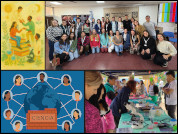
3. The proposed strategies include: a) revaluing the memory and legacy of those who preceded us as a way to support and grow alongside new generations; b) turning adversity into opportunity and promoting participatory work in multidisciplinary teams to generate creative studies regardless of the economic context; c) engaging in science outreach and social commitment as bridges between scientific practice and society, and d) participating in politics and decision-making spaces to strengthen democracy and defend knowledge against individualistic and misinformative discourses.
4. Implications. In uncertain times, Argentine science resists, reinvents itself and embraces the collective work, guided by the strength of love and perseverance.
References
Anderson, C. B., J. C. Pizarro, R. Estévez, A. Sapoznikow, A. Pauchard, O. Barboza, A. Moreira-Muñoz, and A. E. J. Valenzuela. 2015. ¿Estamos avanzando hacia una socio-ecología? Reflexiones sobre la integración de las dimensiones humanas en la ecología en el sur de América. Ecología Austral 25:263-72. https://doi.org/10.25260/EA.16.25.3.0.94.
Canevari, G. 2024. El péndulo Diamand. Alcances y limitaciones para pensar el desarrollo político-económico en la Argentina reciente (2015-2024). Divulgatio 8:1-23. https://doi.org/10.48160/25913530di24.444.
Cohen, I. B., and A. Whitman. 1999. Isaac Newton. The principia: Mathematical principles of natural philosophy. University of California Press, Berkeley, California, USA.
CONICET (Consejo Nacional de Investigaciones Científicas y Técnicas). 2025. Finalizó la histórica campaña submarina liderada por científicos del Conicet que emocionó a millones de personas a través del streaming. URL: tinyurl.com/bde6bsmm.
De Piano, G., and C. Francese. 2016. A 50 años de la noche de los bastones largos. La Ménsula 10:1-8.
Diamand, M. 1977. El péndulo argentino: ¿empate político o fracasos económicos? Pp. 385-409 en AA. VV. (ed.). Pensar la república. Persona a Persona S.A., Buenos Aires, Argentina.
Lave, G. M., E. F. Poovey, and M. J. Fischer. 2010. Introduction: STS and neoliberal science. Social Studies of Science 40:647-657. https://doi.org/10.1177/0306312710372129.
Lomascolo, S. B., M. L. Sandoval-Salinas, A. Novillo, G. Fontanarrosa, M. G. Núñez Montellano, et al. 2024. Perspectives - Academic career in ecology: Effect of gender, caregiving labor, and the working environment. Forest Ecology and Management 560:121801. https://doi.org/10.1016/j.foreco.2024.121801.
Lomascolo, S. B., A. Novillo, E. J. I. Pero, M. L. Sandoval-Salinas, M. G. Nuñez Montellano, G. Fontanarrosa, and M. Piquer-Rodríguez. 2025. Avanzar sobre suelo resbaladizo: desafíos que enfrentan las ecólogas, relacionados con el trabajo de campo, viajes y el entorno de trabajo. Ecología Austral 35:869-878. https://doi.org/10.25260/EA.25.35.2.1.2496.
Hurtado, D. 2010. La ciencia argentina: un proyecto inconcluso (1930-2000). Edhasa, Buenos Aires, Argentina.
Moreno, S. 2016. La noche de los bastones largos. Primera edición. Eudeba, Ciudad Autónoma de Buenos Aires, Argentina.
Olssen, M., and M. A. Peters. 2005. Neoliberalism, higher education and the knowledge economy: From the free market to knowledge capitalism. Journal of Education Policy 20:313-345. https://doi.org/10.1080/02680930500108718.
Pucci, R. 2012. Pasado y presente de la Universidad Nacional de Tucumán: Reforma, dictaduras y populismo neoliberal. Primera edición. Editorial Lumiere, Buenos Aires, Argentina.
Sábato, E. 1999. Antes del fin. Plaza and Janés Editores, Barcelona, España.
Somma, N. M. 2012. The Chilean student movement of 2011-2012: Challenging the marketization of education. Interface: A Journal for and about Social Movements 4:296-309.
Downloads
Published
How to Cite
Issue
Section
License
Copyright (c) 2026 Luis Epele, María F. Gutierrez, Edgardo J. I. Pero, Romina E. Principe

This work is licensed under a Creative Commons Attribution 4.0 International License.
Authors retain their rights as follows: 1) by granting the journal the right to its first publication, and 2) by registering the published article with a Creative Commons Attribution License (CC-BY 4.0), which allows authors and third parties to view and use it as long as they clearly mention its origin (citation or reference, including authorship and first publication in this journal). Authors can make other non-exclusive distribution agreements as long as they clearly indicate their origin and are encouraged to widely share and disseminate the published version of their work.