Thinking through mycorrhizae: Philosophical debates at the lab bench
DOI:
https://doi.org/10.25260/EA.26.36.3.0.2689Keywords:
philosophy of biology, biological individual, negative results, holobiont, symbiosisAbstract
1. A common approach for studying soil fungi involves in vitro isolation and culture. However, these attempts frequently fail when dealing with ectomycorrhiza-forming fungi (EMFF). Successive failed attempts have revealed an epistemological and ontological window that exposes the limitations of scientific practices based on the separation and the abstraction of living organisms.
2. This study proposes an interdisciplinary analysis of the assumptions guiding our scientific practices. A historiographical and philosophical review of frequently used concepts of the individuals and symbiosis was conducted and contrasted with the laboratory experiences of the authors and other researchers in the field, gathered through a survey.
3. The review revealed that the issues surrounding the definition of the individual are not new and that the organisms participating in the symbiosis could be considered an indivisible whole (holobiont).
4. Responses from specialists in the field suggest that the difficulty of isolating EMFF is persistent and may stem not only from technical issues, but also from the relational nature of the symbiosis.
5. Implications. Experimental difficulties hold epistemological value that extends beyond the technical problem. This prompts us to re-examine the application of certain methodologies when dealing with highly interdependent organisms, as well as to consider them from a relational perspective. Thus, we propose recognizing interdisciplinary discussions as a guide for new scientific and epistemological practices, as they open new horizons for inquiry and could hold the key to new ways of studying living systems.
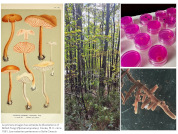
NOTE: the image on the left was extracted from Illustrations of British Fungi. Cook M. C., circa 1881.
References
Baedke, J. 2020. The holobiont concept before Margulis. J Exp Zool (Mol Dev Evol) 334:149-155. https://doi.org/10.1002/jez.b.22931.
Barad, K. 2007. Encontrando el universo a medio camino: Física cuántica y el entrelazamiento de la materia y el significado. Durham y Londres: Duke University Press. https://doi.org/10.1215/9780822388128.
Bespalov, A., T. Steckler, and P. Skolnick. 2019. Be positive about negatives-recommendations for the publication of negative (or null) results. European Neuropsychopharmacology 29(12):1312-1320. https://doi.org/10.1016/j.euroneuro.2019.10.007.
Booth, A. 2014. Populations and individuals in heterokaryotic fungi: A multilevel perspective. Philosophy of Science 81(4):612-632. https://doi.org/10.1086/677953.
Cárdenas, F. J. 2021. Individualidad biológica en la práctica científica: criterios de individuación y objetivos epistémicos. Revista Culturas Científicas 2(1):56-74. https://doi.org/10.35588/cc.v2i1.4880.
Clarke, E. 2010. The Problem of Biological Individuality. Biological Theory 5(4):312-325. https://doi.org/10.1162/BIOT_a_00068.
Fanelli, D. 2012. Negative results are disappearing from most disciplines and countries. Scientometrics 90(3):891-904. https://doi.org/10.1007/s11192-011-0494-7.
Fernández, N. V., P. Marchelli, and S. B. Fontenla. 2013. ectomycorrhizas naturally established in Nothofagus nervosa seedlings under different cultivation practices in a forest nursery. Microbial Ecology 66(3):581-92. https://doi.org/10.1007/s00248-013-02299.
Gilbert, S. F., J. Sapp, and A. I. Tauber. 2012. A symbiotic view of life: we have never been individuals. The Quarterly Review of Biology 87(4):325-341. https://doi.org/10.1086/668166.
Gontier, N. 2016. Symbiosis, history of. En Encyclopedia of Evolutionary Biology. Elsevier. https://doi.org/10.1016/B978-0-12-800049-6.00015-9.
Gorzelak, M. A., A. K. Asay, B. J. Pickles, and S. W. Simard. 2015. Inter-plant communication through mycorrhizal networks mediates complex adaptive behaviour in plant communities. AoB Plants 7:plv050. https://doi.org/10.1093/aobpla/plv050.
Guy, P., R. Sibly, S. M. Smart, M. Tibbett, and B. J. Pickles. 2022. Mycorrhizal type of woody plants influences understory species richness in British broadleaved woodlands. New Phytologist 235(5):2046-2053. https://doi.org/10.1111/nph.18274.
Haraway, D. 2008. When species meet. Nachdr. Posthumanities 3. Univ. of Minnesota Press.
Haraway, D. 2019. Seguir con el problema: generar parentesco en el Chthuluceno. Primera edición en español. Consonni.
Hoeksema, J. D. 2010. Ongoing coevolution in mycorrhizal interactions. The New Phytologist 187(2):286-300. https://doi.org/10.1111/j.1469-8137.2010.03305.x.
Leff, E. 2004. Racionalidad ambiental. La Reapropiación. Siglo XXI Ediciones.
Lewis, J. D. 2016. Mycorrhizal fungi, evolution and diversification of. En Encyclopedia of Evolutionary Biology. Elsevier. https://doi.org/10.1016/B978-0-12-800049-6.00251-1.
Margulis, L. 1991. Symbiosis in evolution: origins of cell motility. En S. Osawa and T. Honjo (eds.). Evolution of life. Springer, Tokyo. https://doi.org/10.1007/978-4-431-68302-5_19.
Margulis, L. 1997. Slanted truths: Essays on Gaia, symbiosis and evolution. Copernicus New York, NY. Springer Book Archive. New York. Pp. 368. https://doi.org/10.1007/978-1-4612-2284-2
Margulis, L. 2002. Planeta simbiótico: un nuevo punto de vista sobre la evolución. Debate.
Marín, C., and J. Suárez. 2024. Filosofía fungi. Ludus vitalis. Revista de Filosofía de las Ciencias de la Vida 30(2):71-96. https://doi.org/10.22370/lv.2024.30.2.4566.
Mayr, E. 1982. The growth of biological thought: diversity, evolution, and inheritance. Belknap Press of Harvard Univ. Press, Cambridge, MA.
Mestre, C. 2011. Biodiversidad de levaduras de suelo y rizósfera asociadas a especies de Nothofagus ectomicorrícicos del bosque Andino-patagónico. Tesis Doctoral, Universidad Nacional del Comahue.
Molina, R., and T. R. Horton. 2015. Mycorrhiza specificity: its role in the development and function of common mycelial networks. Mycorrhizal Networks. Vol. 224. Ecological Studies. Springer Netherlands. https://doi.org/10.1007/978-94-017-7395-9_1.
Molter, D. J. 2019. On mycorrhizal individuality. Biology and Philosophy 34(5):52. https://doi.org/10.1007/s10539-019-9706-y.
Nara, K. 2006. Ectomycorrhizal networks and seedling establishment during early primary succession. New Phytologist 169:169-178. https://doi.org/10.1111/j.1469-8137.2005.01545.x.
Pradeu, T. 2012. The limits of the self: inmunology and biological identity. Oxford University Press. https://doi.org/10.1093/acprof:oso/9780199775286.001.0001.
Santelices, B. 1999. How many kinds of individual are there? TREE 14(4):152-155. https://doi.org/10.1016/s0169-5347(98)01519-5.
Shapin, S., and J. R. Feito. 2000. La revolución científica: una interpretación alternativa. Paidós.
Simard, S. W., K. J. Beiler, M. A. Binghama, J. R. Deslippe, L. J. Philip, et al. 2012. Mycorrhizal networks: Mechanisms, ecology and modelling. Fungal Biology Reviews. https://doi.org/10.1016/j.fbr.2012.01.001.
Simard, S. W. 2018. Mycorrhizal networks facilitate tree communication, learning, and memory. En F. Baluska, M. Gagliano and G. Witzany (eds.). Memory and Learning in Plants. Signaling and Communication in Plants. Springer, Cham. https://doi.org/10.1007/978-3-319-75596-0_10.
Simon, J. C., J. R. Marchesi, C. Mougel, and M. A. Selosse. 2019. Host-microbiota interactions: from holobiont theory to analysis. Microbiome 7(1):5. https://doi.org/10.1186/s40168-019-0619-4.
Smith, S. E., and D. J. Read. 2008. Mycorrhizal Symbiosis. 3rd ed. Academic Press.
Suárez, J., and A. Stencel. 2020. A part-dependent account of biological individuality: why holobionts are individuals and ecosystems simultaneously. Biol Rev 95:1308-1324. https://doi.org/10.1111/brv.12610.
Teste, F. R., S. W. Simard, D. M. Durall, R. D. Guy, et al. 2009. Access to mycorrhizal networks and roots of trees: importance for seedling survival and resource transfer. Ecology 90(10):2808-2822. https://doi.org/10.1890/08-1884.1.
Trappe, J. M. 2005. A. B. Frank and mycorrhizae: the challenge to evolutionary and ecologic theory. Mycorrhiza 15(4):277-281. https://doi.org/10.1007/s00572-004-0330-5.
Varela, F. J., and H. Maturana Romesín. 1980. Autopoiesis and Cognition: The realisation of the living. Boston Studies in the Philosophy of Science 42.
Wilson, R. A., and M. Barker. 2024. Biological Individuals. En E. N. Zalta and U. Nodelman (eds.). Stanford Encyclopedia of Philosophy. Spring 2024. URL: bit.ly/49GIbA6.
Wood, K. A. 2020. Negative results provide valuable evidence for conservation. Perspectives in Ecology and Conservation 18(4):235-237. https://doi.org/10.1016/j.pecon.2020.10.007.
Yilmaz, Ö., and J. Dupré. 2025. Plant individuality: a physiological approach. Philosophy, Theory, and Practice in Biology 17(1). https://doi.org/10.3998/ptpbio.5261.
Downloads
Additional Files
Published
How to Cite
Issue
Section
License
Copyright (c) 2026 Sofía Crescio, Natalia V. Fernández, M. Cecilia Mestre, Gabriela K. Klier

This work is licensed under a Creative Commons Attribution 4.0 International License.
Authors retain their rights as follows: 1) by granting the journal the right to its first publication, and 2) by registering the published article with a Creative Commons Attribution License (CC-BY 4.0), which allows authors and third parties to view and use it as long as they clearly mention its origin (citation or reference, including authorship and first publication in this journal). Authors can make other non-exclusive distribution agreements as long as they clearly indicate their origin and are encouraged to widely share and disseminate the published version of their work.